Fluctuations in the Fourier Coefficient of Current in Periodically Driven Systems
Explore probability current fluctuations in periodically driven stochastic systems, focusing on Fourier component statistics and cumulant generating function analysis.
Packets of Diffusing Particles Exhibit Universal Exponential Tails
Explore universal exponential tails in diffusing particle packets, extending large deviation theory for continuous time random walks and uncovering general behaviors in transport phenomena.
On the Origin of Fat Tailed Distribution Functions in Driven Complex Systems
Explore the origin of fat-tailed distributions in driven complex systems through sample space reducing processes, offering insights into various statistical phenomena and their applications.
Anomalous Thermal Relaxation for Over-damped Langevin Dynamics
Explore anomalous thermal relaxation phenomena, focusing on the Mpemba effect in over-damped Langevin dynamics. Examine theoretical results and link to physical system properties.
Engineered Swift Equilibration: Applications and Optimization - Lecture
Explore Engineered Swift Equilibration (ESE) applications in physics, including particle compression, first passage time optimization, and atomic force microscopy enhancements.
Stochastic Resetting: Overview and Recent Developments
Explore stochastic resetting in dynamical processes, its impact on system behavior, and applications in chemical reactions and search processes.
Entropy Growth During Free Expansion of an Ideal Gas
Explore entropy growth in free expansion of ideal gas, examining macrostates, irreversibility, and factors influencing entropy increase in non-equilibrium systems.
Quantum Bounds and Fluctuation-Dissipation Relation
Explore quantum bounds for transport coefficients and their connection to the Fluctuation-Dissipation relation, with insights from high-energy physics and String Theory.
Coarsening, Condensates and Extremes in Aggregation-Fragmentation Models
Explore coarsening in aggregation-fragmentation models, focusing on condensate formation, extreme value statistics, and scaling behavior in zero range and conserved mass aggregation systems.
The Ising Model and Its Quantum Interface Dynamics - A Centennial Perspective
Explore quantum Ising model's interface dynamics, examining domain evolution, quantum nucleation, and false-vacuum decay. Discover connections to mathematics and classical statistical physics.
Ordering of Diffusing Spins in Brownian Spin Models
Explore phase transitions in Brownian spin models, examining continuous transitions in Potts models and BKT transitions in clock models. Analyze numerical simulations and discuss extensions to active particles.
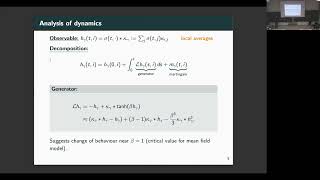
Convergence of the Ising-Kac Model to Φ4 in Three Dimensions
Explore the convergence of the Ising-Kac model to $\Phi^4$ in 3D, analyzing Glauber dynamics and applying regularity structure theory to discrete particle systems.
MaZe: A New Approach for Simulating Adiabatic Systems - Lecture
Explore MaZe, a novel approach for simulating adiabatic systems in physics. Learn about its applications in first principles simulations, polarizable systems, and ionic transport studies.
Phase Transitions and Self-Assembly in Active Matter
Explore phase transitions and self-assembly in active matter systems, from bird flocks to nanorobots. Analyze statistical models, emergent behaviors, and out-of-equilibrium dynamics in collective motion phenomena.
Uniqueness and Non-Uniqueness for Percolation on Groups
Explore percolation theory on groups, examining uniqueness and non-uniqueness of infinite clusters and their connections to group-theoretic concepts.
From Newton's Laws to Fluid Mechanics: Deriving the Boltzmann Equation - Award Lecture
Explore the derivation of fluid mechanics equations from Newton's laws, examining irreversibility and propagation of chaos in the context of Boltzmann's kinetic theory.
Brownian Motion at Interfaces - Experimental and Theoretical Studies
Explore Brownian motion near interfaces using experimental, theoretical, and numerical methods. Analyze microparticle trajectories, probability densities, and non-Gaussian behavior to infer nanoscale properties.
Relationship Between Grosse-Wulkenhaar Model and N-Body Harmonic Oscillators or Calogero Models
Explore the connection between Grosse-Wulkenhaar model and N-body harmonic oscillators in quantum field theory, presented by Akifumi Sako at ESI's Workshop on Exactly Solvable Models.
Topological Origins of Yielding in Soft Glassy Materials
Explore topological failure points in soft glassy materials during yielding, using network science tools to predict and understand plastic events in colloidal gels.
Yielding in Colloidal Systems Far-From-Equilibrium: From Gels to Active Matter
Explore yielding in colloidal systems, from depletion gels to active colloids. Discover microscopic mechanisms behind counterintuitive phenomena and altered yielding under extreme conditions.
The Fate of Shear-Oscillated Amorphous Solids
Explore the behavior of shear-oscillated amorphous materials using a coarse-grained model. Analyze steady states, critical thresholds, and transitions in poorly annealed and ultra-stabilized materials.