Loss of Self-Organization in Earth's Climate
Análisis de cambios en la autorregulación del clima terrestre mediante herramientas de sistemas complejos, comparando datos de temperatura global con el modelo Daisyworld.

Olivia Judson on Major Energy Transitions in Evolutionary History
Explore major energy transitions in evolutionary history with Olivia Judson, examining how life's processes shaped Earth's atmosphere, ecosystems, and geological features over billions of years.
Nonequilibrium Physics in Living Systems
Explore the fascinating intersection of physics and biology, uncovering how nonequilibrium principles shape living systems and their complex behaviors.
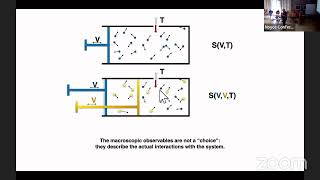
What Makes the Past Different from the Future?
Explore the fundamental differences between past and future, examining scientific concepts and philosophical implications in this thought-provoking lecture on time's arrow.
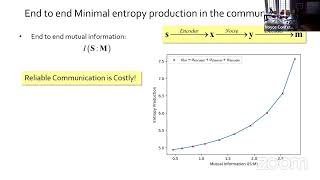
Minimal End-to-end Thermodynamic Costs of Communication Channels
Explore the thermodynamic costs of communication channels, examining minimal end-to-end requirements and their implications for information transfer efficiency.
Death and Resurrection of the Zeroth Principle
Explore the intriguing concept of the Zeroth Principle, its demise, and potential revival in this thought-provoking lecture from the Santa Fe Institute.
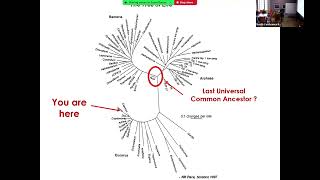
Topological Scaling Laws and the Mathematics of Evolution
Explore topological scaling laws in evolutionary biology, examining phylogenetic tree structures and their implications for understanding large-scale evolutionary patterns and processes.
Biophysical Chemistry
Explore protein structure, folding mechanisms, and biophysical techniques. Gain insights into forces driving protein stability, denaturation processes, and experimental methods for studying protein dynamics.
Thermodynamics - Classical to Statistical
Comprehensive exploration of thermodynamics, from classical concepts to statistical mechanics, covering fundamental principles, applications, and advanced problem-solving techniques.
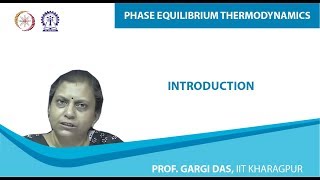
Phase Equilibrium Thermodynamics
Explore thermodynamic principles, phase equilibria, and solution behavior. Learn about laws, entropy, Gibbs energy, P-v-T relationships, chemical potential, fugacity, and ideal/non-ideal solutions.
Computational Fluid Dynamics for Incompressible Flows
Explore incompressible flow dynamics through finite difference and volume methods. Master equations, boundary conditions, and numerical techniques for solving fluid dynamics problems.
Introduction to Statistical Mechanics
This is an introductory course in classical and quantum statistical mechanics which deals with the principle of ensembles, Classical, Fermi and Bose ideal gases, Pauli paramagnestim, Debye and Einstein’s theory of specific heat and the 1D Ising model.
Phase Equilibrium Thermodynamics
Explore phase equilibrium thermodynamics, covering laws, entropy, spontaneity, Gibbs free energy, P-v-T behavior, chemical potential, and fugacity in various systems.
High Speed Aero Dynamics
Comprehensive exploration of high-speed aerodynamics, covering thermodynamics, gas dynamics, waves, supersonic flow, shock theory, and advanced topics like linearized problems and similarity rules.

Thermodynamics
Explore fundamental concepts, laws, and applications of thermodynamics, including system properties, energy conservation, and practical devices like heat exchangers and turbines.
Advanced Thermodynamics
This course offers step-by-step understanding of required thermodynamic properties to handle such equilibrium cases and explore possible ways of solving problems associated with non-ideality in VLE, LLE, VLLE and SLE for multicomponent mixtures.

Basic Statistical Mechanics
The present course will address the basic postulates of Statistical Mechanics and then will show how starting from the basic postulates one builds a formidable framework that can be used to explain phenomena mentioned above.
Introduction to Molecular Thermodynamics
Explore molecular thermodynamics, from classical principles to statistical mechanics. Learn about microstates, ensembles, ideal gases, and chemical equilibrium. Gain insights into applications in various scientific fields.

Statistical Mechanics
The course provides a fundamental understanding of Thermodynamics and Statistical Mechanics. It starts with the fundamental concepts of thermodynamics and builds on its foundation, the principles of statistical mechanics. It does not require a prior expo…
Advanced Thermodynamics and Molecular Simulations
Explore advanced thermodynamics and molecular simulations, covering probability distributions, ensembles, phase equilibria, and computational methods for analyzing complex molecular systems.
Heat Transfer
Comprehensive exploration of heat transfer principles, covering conduction, convection, and radiation through theoretical concepts and practical examples in various geometries and scenarios.