Quantum States under Floquet Heating
Explore quantum states under Floquet heating, examining stability mechanisms in many-body systems and their implications for non-equilibrium physics and quantum technologies.

KPZ Physics in Integrable Spin Chains
Explores KPZ physics in integrable spin chains, examining quantum matter stability and non-equilibrium dynamics. Discusses mechanisms constraining many-body dynamics and their implications for novel quantum phases.
Weak Universality, Quantum Many-Body Scars and Anomalous Infinite-Temperature Autocorrelations
Explore weak universality, quantum many-body scars, and anomalous infinite-temperature autocorrelations in quantum systems. Gain insights into non-equilibrium physics and mechanisms constraining many-body dynamics in Hilbert space.
Scale-Invariant Critical Dynamics at Eigenstate Transitions
Explores scale-invariant critical dynamics at eigenstate transitions in many-body quantum systems, focusing on stability and non-equilibrium behavior in coherent time evolution.
Spectral Gap Estimates for the Random Field Ising Model - Lecture
Spectral gap estimates for random field Ising model: convergence rates, Glauber dynamics, Griffiths phase. Combines stochastic localization and percolation-theoretic coarse-graining techniques.
Dimers in 3D - Large Deviations Principle and Statistical Mechanics
Explore 3D dimer tilings and their large deviations principle, comparing with 2D results and examining unique challenges in higher dimensions through simulations and mathematical insights.
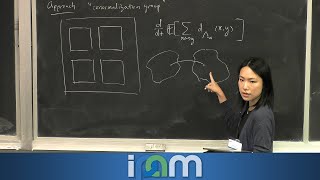
Distances in Hierarchical Percolation
Explore hierarchical percolation's behavior across dimensions, examining chemical, extremal, and pivotal distances in high and upper-critical dimensions through renormalization group analysis.
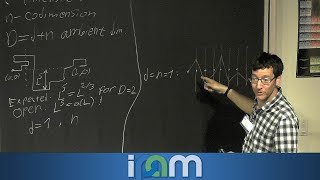
Minimal Surfaces in Random Environment
Explore minimal surfaces in random environments, their geometric properties, and connections to disordered systems. Gain insights into surface delocalization, localization, and fluctuations across dimensions.
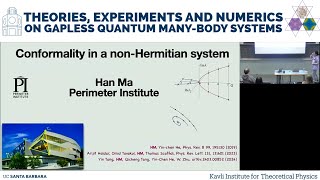
Conformality in Non-Hermitian Potts Model
Explore conformality in non-Hermitian Potts models with Han Ma. Delve into advanced quantum physics concepts, focusing on gapless quantum many-body systems and their theoretical implications.
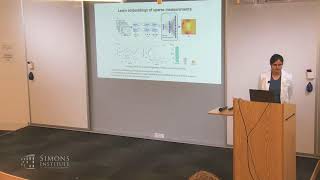
Robust Equation Discovery and Sparse Sensing with Guarantees
Explore statistical mechanics for robust sparse equation discovery and optimal sensor placement, with applications in nuclear digital twins and high-dimensional field reconstruction.
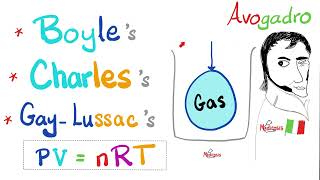
Gas Laws: Boyle's, Charles', Gay-Lussac's, and Avogadro's Laws - Ideal Gas Equation and Gas Density
Comprehensive overview of gas laws, including Boyle's, Charles', Gay-Lussac's, and Avogadro's laws, as well as the ideal gas equation and gas density calculations. Essential for chemistry exams and understanding gas behavior.
Stability and Chaos in Dynamical Last Passage Percolation
Explore stability and chaos in dynamical last passage percolation, examining energy landscapes, ground states, and the transition from stability to chaos using probabilistic and geometric techniques.
Fermionic Gaussian Free Field and Connections to Random Lattice Models
Explore determinantal and permanental point processes, fermionic and bosonic variables, and their connections to physics. Discover the fermionic Gaussian free field and its relation to random lattice models.
Shuffle Algebras, Lattice Paths and Macdonald Functions
Explore connections between Macdonald functions, shuffle algebras, and vertex model partition functions in this advanced mathematics lecture on algebraic and probabilistic aspects of universality.
Arctic Curves for Vertex Models
Exploration of arctic curves in 2D integrable lattice models, focusing on 6 Vertex and 20 Vertex models. Discusses phase boundaries, tangent method, and related combinatorial results in tiling problems.
Vertex Model Integrability for Stochastic Particle Systems
Explore integrable stochastic particle systems and their connection to vertex models. Learn about TASEP, Yang-Baxter equations, and applications in mathematics and biology.
Exact Three- and Four-Point Correlation Functions in O(n) and Potts Loop Models
Explore exact three- and four-point correlation functions in O(n) and Potts loop models, combining CFT symmetry, lattice discretization, and conformal bootstrap for insights into 2D conformally invariant systems.
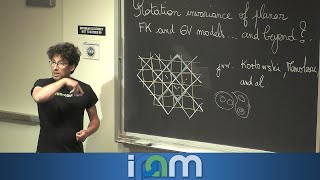
Rotational Invariance of Planar Random Cluster Models and Beyond
Exploration of rotational invariance in planar random cluster models, discussing its applications and potential for new insights into critical models on Z^2.
Critical Phenomena Through the Lens of the Ising Model
Explore critical phenomena in the Ising model, from its origins in ferromagnetism to recent breakthroughs in three and four dimensions using probabilistic interpretations and percolation models.
Six-Vertex Model in the Rare Corners Regime
Explore limit shapes in six-vertex models, focusing on low-density corner scenarios. Discover new features, hyperbolic PDEs, density discontinuities, and connections to random permutations.
Interacting Polya Urns - Statistical Mechanics Beyond 2D
Explore interacting Polya urns on graphs, their asymptotic behavior, and convergence to equilibrium in this statistical mechanics presentation by Omer Angel at UCLA's IPAM workshop.