Brownian Motion, Evolving Geometries and Entropy Formulas - A. Thalmaier
Explore Brownian motion, stochastic processes, and related mathematical concepts in this comprehensive lecture on evolving geometries and entropy formulas.
Building Thermodynamics for Non-Uniformly Hyperbolic Maps - Yakov Pesin
Explore advanced concepts in dynamical systems, focusing on non-uniformly hyperbolic maps, symbolic models, and equilibrium measures in thermodynamics.
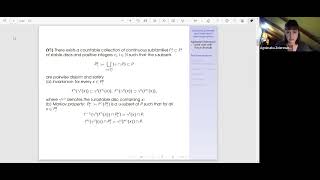
Inducing Schemes and Their Role in Thermodynamics - ICTP 2021
Explore inducing schemes in thermodynamics, focusing on Young diffeomorphisms, symbolic representations, and equilibrium measures. Gain insights into pressure analyticity and phase transitions.
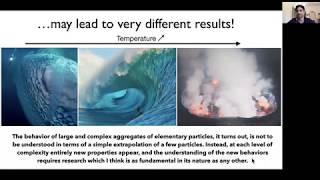
Phase Transitions - From Physics to Computer Science
Explore phase transitions across physics and computer science, from water states to combinatorial optimization and information theory, revealing their universal nature in complex systems.
Pose Estimation, Temperature, Noise, and Biological Temperature Sensors via Cryo-EM
Explore pose estimation, temperature, noise, and heterogeneity in cryo-EM for understanding biological temperature sensors, with focus on TRP channels and advanced analytical techniques.
Quantum Time Correlation Functions in an Open-Chain Path Integral Distribution
Explore quantum time correlation functions using open-chain path integrals, offering a new perspective on semiclassical approximations in computational chemistry with potential applications in rate theory and spectroscopy.
Fundamentals of Energy, Work and Power - Lecture 1
Explore thermodynamics laws, efficiency, and work in systems. Gain insights into renewable energy concepts through interactive discussions and practical examples.
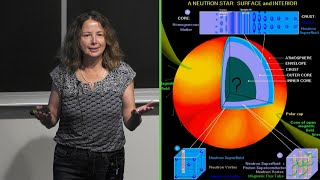
Realistic Binary Neutron Stars Collisions Simulations - Challenges and Opportunities
Explore challenges and opportunities in simulating binary neutron star collisions, focusing on realistic models, electromagnetic counterparts, and remnant properties using open-source codes and parametrized equations of state.
Mesoscale Models and Many-Body Systems - IPAM at UCLA
Explores mesoscale structures in many-body systems, explaining the autonomy of continuum equations and their connection to lower-scale physics, with implications for deep neural networks.
Arctic Curves for Ice Models
Explore arctic curves in statistical mechanics, focusing on the six-vertex model with ice point and domain-wall boundary data. Learn about the geometric tangent method for locating arctic boundaries.
Large Deviations of Markov Processes - Part 1
Explore large deviation theory in statistical physics, covering Markov processes, dynamical observables, and advanced mathematical concepts. Gain insights into recent developments and applications in nonequilibrium systems.
Gravitational Waves from Neutron Stars - Lecture 1
Explore gravitational waves from neutron stars, covering detection methods, signal analysis, radiation mechanisms, and fluid dynamics in astrophysical contexts.
Entanglement Entropy, Quantum Field Theory, and Holography by Matthew Headrick
Explore entanglement entropy in quantum systems, focusing on its applications in field theory and holography. Learn about classical and quantum correlations, mutual information, and entropy in spin systems.
Why Do Simple Models Work? Partial Answers from Information Geometry - Lecture 1
Explores information geometry to understand why simple models effectively describe complex systems, focusing on statistical mechanics, renormalization, and model reduction in physics and biology.
Carnot Cycle and Carnot Engine - Thermodynamics - Physics
Explore the Carnot cycle and Carnot heat engine in this comprehensive introduction. Learn key principles of thermodynamics and their practical applications in engineering and physics.
On the Thermodynamical Formalism for Expanding Measures - ICTP 2021
Explore thermodynamical formalism for expanding measures with expert Vilton Pinheiro, delving into advanced mathematical concepts and their applications in dynamical systems.

Active Associative Memory by Suri Vaikuntanathan - University of Chicago - KITP Chalk Talk
Explore how non-equilibrium dynamics enhance memory and information processing in biological systems, from neuronal circuits to immune responses, challenging traditional equilibrium-based paradigms.
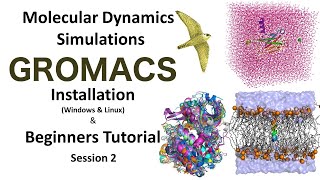
Molecular Dynamics Simulations with Gromacs - Beginner Tutorial Session 2
Learn MD simulation steps, RMSD/RMSF graph generation in Windows using Gromacs. Covers system preparation, energy minimization, equilibration, and analysis for molecular dynamics simulations.

Entropy and the Arrow of Time - Your Daily Equation Episode 32
Explore entropy, the second law of thermodynamics, and their connection to the arrow of time. Discover why events happen in one direction and how these concepts relate to the Big Bang and our understanding of the universe.
Absence of Superdiffusion in Certain Random Spin Models - Austen Lamacraft
Explore non-equilibrium many-body physics and universal aspects in diverse fields. Discover novel phases of matter, entanglement dynamics, and connections between classical and quantum systems.
Extracting Complexity of Quantum Dynamics Using Machine Learning - Zala Lenarcic
Explores machine learning techniques to analyze complex quantum dynamics, focusing on non-equilibrium many-body physics and its applications across various fields of physics.