Data Compression I - Lecture 5: Asymptotic Equipartition Property
Explore the Asymptotic Equipartition Property in data compression, a fundamental concept for understanding information theory and efficient coding techniques.
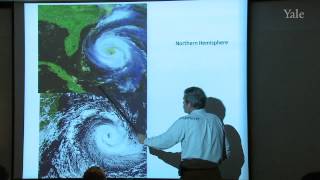
Coriolis Force and Storms - Atmospheric Dynamics and Weather Patterns
Explore atmospheric dynamics, pressure systems, and storm formation. Learn about geostrophic balance, Coriolis effects on hurricanes, and various types of storms including convective and severe thunderstorms.
Oxygen and the Chemical Revolution - From Alchemy to Lavoisier (1789)
Explore the origins of modern chemistry, from alchemy to Lavoisier's revolutionary ideas on oxidation, elements, and scientific language in this historical journey through early chemical discoveries.
Isoprenoids, Rubber, and Tuning Polymer Properties - Freshman Organic Chemistry II
Explore isoprenoids, rubber vulcanization, and polymer properties. Learn about biosynthesis, statistical mechanics, and free-radical polymerization in this comprehensive organic chemistry lecture.
The Boltzmann Constant and First Law of Thermodynamics - Lecture 22
Explore thermodynamics, heat generation, and measurement. Learn about the Boltzmann Constant, microscopic temperature, and the First Law of Thermodynamics. Gain insights into molecular mechanics and quasi-static processes.

The Second Law of Thermodynamics and Carnot's Engine - Lecture 23
Explore the Second Law of Thermodynamics, entropy, and Carnot's engine. Learn about irreversibility, heat engine efficiency limits, and how entropy arises from macroscopic considerations in thermodynamics.

Introduction to Thermodynamics - Lecture 21
Comprehensive introduction to thermodynamics, covering temperature, heat transfer, and thermal properties. Explores key concepts like absolute zero, specific heat, and phase changes through detailed explanations and examples.
The Science of Cities: Defining Size, Shape, Scale and Performance Using Percolation Theory
Exploring how city size impacts shape and performance using percolation theory, challenging the notion that bigger cities are always better through innovative spatial analysis methods.

The Mechanical Universe
Comprehensive exploration of physics principles, from classical mechanics to quantum theory, using visual aids and mathematical concepts to illuminate the workings of the universe.

Pricing Options with Mathematical Models
Explore mathematical models for pricing financial instruments, including stocks, bonds, options, and derivatives. Learn risk-neutral pricing, stochastic processes, and hedging strategies.
Phase Diagrams in Materials Science and Engineering
Comprehensive exploration of phase diagrams in materials science, covering binary and ternary systems, equilibria, transformations, and applications in metals, ceramics, and alloys.
Advanced Metallurgical Thermodynamics
In this course, you will learn, First, second and third laws of thermodynamics, Maxwell's relations, Clausius-Clapeyron equation, Equilibrium Concepts, Thermodynamics of Phase Transformations etc.
Advanced Gas Dynamics
The course concentrates primarily on the understanding of the physical concepts of compressible flow and keeps a reference to various numerical methods for solving the governing equations to a minimum.
Concepts of Thermodynamics
Comprehensive exploration of thermodynamic principles, covering properties, laws, processes, and cycles. Includes problem-solving techniques and computer-aided analysis for practical applications.
Probability and Stochastics for Finance
This course provides the minimum mathematical requirements to study mathematical finance or more precisely the pricing of financial derivatives.
Laws of Thermodynamics
Explore fundamental thermodynamic principles, including system properties, heat, work, and the laws governing energy transfer and transformation in closed and open systems.
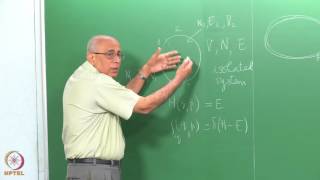
Physics - Nonequilibrium Statistical Mechanics
Explore advanced concepts in nonequilibrium statistical mechanics, including Langevin models, linear response theory, Fokker-Planck equations, and critical phenomena, with practical applications and quizzes.
Engineering Thermodynamics
The main emphasis in this course is placed on the precise and logical presentation of the basic concepts and principles, which are essential for a better understanding of engineering thermodynamics.
Applied Thermodynamics for Engineers
Comprehensive exploration of thermodynamic principles, cycles, and applications in engineering, covering power generation, refrigeration, and combustion processes.
Thermodynamics & Kinetics
Comprehensive exploration of chemical thermodynamics and kinetics, covering laws, equilibrium, electrochemistry, and reaction dynamics. Ideal for deepening understanding of fundamental chemical principles.
Thermodynamics
Comprehensive exploration of thermodynamic principles, from basic concepts to advanced applications, covering laws, processes, and cycles in engineering systems.