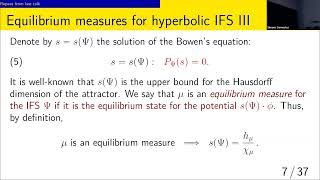
One-Parameter Families of Hyperbolic Iterated Function Systems on the Line - Lecture 3
Delve into hyperbolic iterated function systems and their dimensional properties, exploring transversality methods for analyzing one-parameter families and their applications in measure theory and dynamics.

Heat Equation- Derivation and Equilibrium Solution in 1D - Laplace's Equation
Explore the derivation and equilibrium solution of the heat equation in 1D, including Laplace's equation, boundary conditions, and practical applications in engineering mathematics.
Random Matrix Theory and its Applications - Lecture 4
Explore advanced concepts in Random Matrix Theory, including rotational invariance, correlation functions, spacing distributions, and applications to complex systems stability.
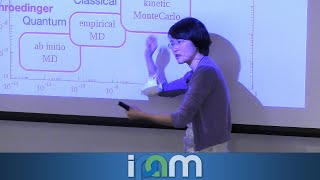
Multiscale Inverse Problem, from Schroedinger to Newton to Boltzmann - IPAM at UCLA
Explore multiscale inverse problems across quantum, classical, and statistical physics, connecting Schroedinger, Newton, and Boltzmann equations to reveal universal mathematical principles in diverse scientific domains.
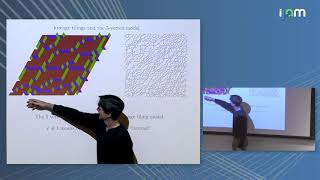
On the 5-Vertex Model
Exploration of the 5-vertex model, a generalization of lozenge tiling, discussing free energy, surface tension, and probabilities. Insights into asymptotic algebraic combinatorics and lattice path models.

SRB Measures and Young Towers - Lecture 3 of 4
Explore SRB measures and Young towers in dynamical systems, focusing on nonuniformly hyperbolic systems and their statistical properties. Learn about recent advances in this field of mathematics.
Symbolic Dynamics for Nonuniformly Hyperbolic Systems - Lecture 4
Explore advanced techniques in nonuniformly hyperbolic dynamics, focusing on symbolic coding and statistical properties of complex systems using Markov Partitions and Young Towers.
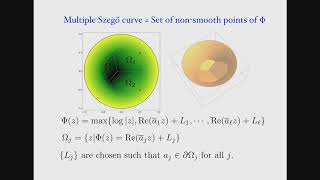
Asymptotics of the Averaged Characteristic Polynomial for Ginibre Ensemble
Explore asymptotics of averaged characteristic polynomials in Ginibre Ensemble, covering Coulomb gas, Szego curves, orthogonal polynomials, and partition functions in random matrix theory.
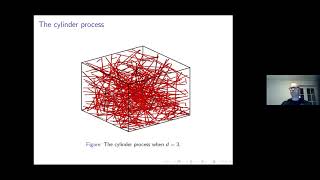
Erik Broman- Higher Dimensional Stick Percolation
Explore higher dimensional stick percolation, its applications in physics and chemistry, and the scaling of critical parameters as stick length increases in arbitrary dimensions.
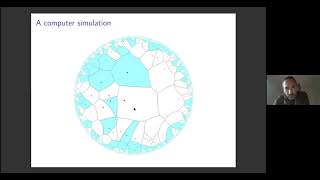
Percolation on Hyperbolic Poisson-Voronoi Tessellations
Explore percolation on hyperbolic Poisson-Voronoi tessellations, resolving conjectures about critical probability behavior and its dependence on Poisson process intensity.
Random Matrix Theory and Its Applications - Lecture 5
Explore advanced random matrix theory concepts, including Gaussian ensembles, coarse-graining techniques, and the Wigner semi-circular law in this comprehensive lecture.
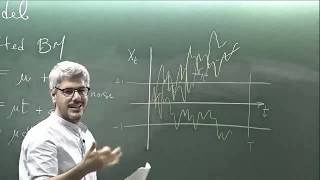
Dynamical Phase Transitions in Markov Processes by Hugo Touchette
Explore dynamical phase transitions in Markov processes, contrasting with equilibrium transitions and examining a Brownian motion model showcasing localization-delocalization phenomena.
Chance and Chaos - How to Predict the Unpredictable by Jens Marklof
Explore chaos theory, unpredictability, and mathematical tools for analyzing chaotic systems. Discover applications in weather forecasting, statistical physics, and everyday phenomena like coin tosses and bread kneading.
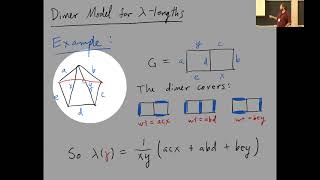
Cluster Algebra Structures from Decorated Super-Teichmüller Spaces
Explore cluster algebra structures derived from decorated super-Teichmüller spaces, examining dimer models and labels in the context of supergeometry and bracket structures.
Order and Patterns in Randomness by Abhishek Dhar
Explore hidden patterns in seemingly random events through examples of Random Walk, Brownian Motion, Statistical Physics, and a card trick. Gain insights into physicists' and mathematicians' approaches.
Topological Recursion, Virasoro-W-Algebra Constraints, and Kontsevich-Soibelman
Explore Virasoro and W-algebra constraints in topological recursion, Kontsevich-Soibelman operators, and their connection to Conformal Field Theory in this advanced mathematics lecture.
Generalized Riemann Hypothesis and Brownian Motion - Giuseppe Mussardo
Explore the fascinating connection between number theory and physics, focusing on the Riemann Hypothesis and its relation to Brownian motion through statistical physics perspectives.
Learning Uncertainty-Aware Models of Defect Kinetics at Scale - IPAM at UCLA
Explore advanced techniques for modeling metal properties, including energy landscape exploration, coarse-graining with uncertainty quantification, and descriptor-based approaches for capturing diverse material characteristics.
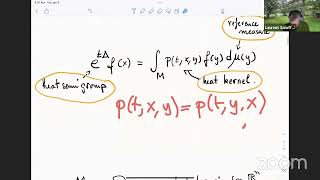
Laurent Saloff-Coste - Breaking Heat Kernel Estimates Into Pieces
Breaking heat kernel estimates on Riemannian manifolds by analyzing pieces separately and reconstructing the whole. Explores Brownian motion within segments and transitions between them.
Slow Time-Scale Behavior of Fast Microscopic Dynamics - IPAM at UCLA
Explores computational methods for understanding slow time-scale behavior of rapid microscopic dynamics, with applications in materials modeling and plasticity. Presents theory and examples for coarse-graining complex systems.
Determinantal Point Processes - Lecture 3
Explore advanced concepts in determinantal point processes, focusing on mathematical theory and applications in random matrix theory and point processes.