Q Learning Tutorial - Training Loop
Explore the DQN training loop, covering policy implementation, reward calculation, and key steps in reinforcement learning algorithm implementation.
Q Learning Tutorial - Experience Replay
Explore Experience Replay in Q-Learning, focusing on data formatting and implementation. Learn key techniques for improving reinforcement learning algorithms in this hands-on tutorial.
Chip Placement with Deep Reinforcement Learning - Paper Explained
Explore deep reinforcement learning for efficient chip placement, covering RL agents, computer manufacturing, and edge graph neural networks. Gain insights into innovative AI applications in hardware design.

Reinforcement Learning - Full Course Using Python
Comprehensive introduction to reinforcement learning using Python, covering fundamentals, custom environments, and practical projects like Atari games and autonomous driving.
Custom Indicators for Reinforcement Learning Trading Tutorial - GME Python Trading PT2
Learn to create custom financial indicators for Python Reinforcement Learning trading bots. Calculate RSI, SMA, and OBV, integrate them into a trading environment, and train an RL model for improved stock trading performance.

Reinforcement Learning for Trading Tutorial - GME RL Python Trading
Learn to build a Python trading bot using reinforcement learning, focusing on Gamestop stock data. Covers environment setup, data loading, agent training, and performance evaluation.
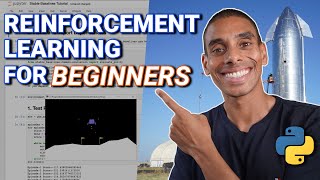
Python Reinforcement Learning Tutorial for Beginners
Learn to create an OpenAI gym environment, train a reinforcement learning algorithm for the Lunar Lander problem, and use stable_baselines algorithms in Python. Practical guide with code examples and step-by-step instructions.

Building a Custom Environment for Deep Reinforcement Learning with OpenAI Gym and Python
Learn to create and train custom reinforcement learning environments using OpenAI Gym and Python. Covers environment setup, DQN agent training, and practical implementation with Keras-RL.
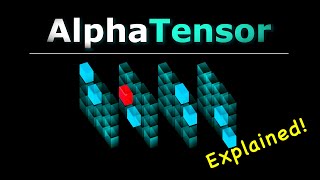
AlphaTensor by DeepMind Explained
Explore DeepMind's AlphaTensor, a revolutionary AI system that discovers efficient matrix multiplication algorithms, outperforming human-designed methods and advancing computational efficiency across various fields.
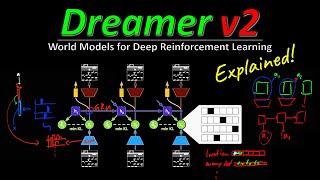
Mastering Atari with Discrete World Models - Machine Learning Research Paper Explained
Explore cutting-edge reinforcement learning with DreamerV2, a model-based AI agent achieving human-level performance on Atari games using discrete world models and latent space predictions.
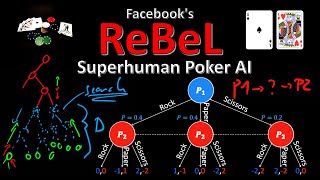
ReBeL - Combining Deep Reinforcement Learning and Search for Imperfect-Information Games
Explores ReBeL, an AI framework combining reinforcement learning and search for imperfect-information games. Explains its application to poker, convergence to Nash equilibrium, and superhuman performance with minimal domain knowledge.
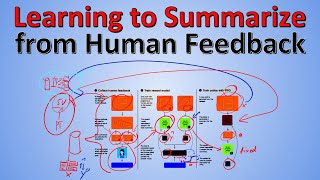
Learning to Summarize from Human Feedback
Explore OpenAI's innovative approach to text summarization using human feedback and reinforcement learning, improving summary quality beyond traditional metrics and supervised learning methods.
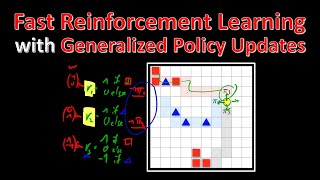
Fast Reinforcement Learning With Generalized Policy Updates - Paper Explained
Explanation of a novel reinforcement learning framework that enables agents to transfer knowledge between tasks, potentially solving new problems with zero-shot learning through generalized policy updates.
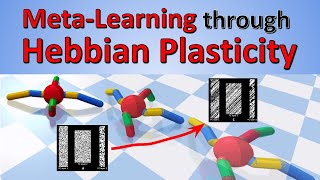
Meta-Learning Through Hebbian Plasticity in Random Networks - Paper Explained
Explores biologically-inspired Hebbian learning for adaptive AI agents. Demonstrates how random neural networks can self-organize during runtime to solve RL tasks and adapt to new situations without fixed policies.
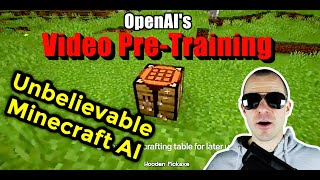
Learning to Act by Watching Unlabeled Online Videos - Paper Explained
Exploring OpenAI's Video PreTraining for Minecraft: leveraging unlabeled gameplay footage to create an AI agent capable of complex tasks, including crafting a diamond pickaxe.

Author Interview - ACCEL- Evolving Curricula with Regret-Based Environment Design
Explore ACCEL, a novel approach combining regret-based sampling and level-editing for training robust AI agents. Learn about curriculum generation, minimax regret, and the future of reinforcement learning.
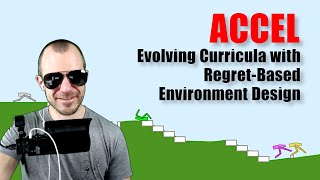
ACCEL - Evolving Curricula with Regret-Based Environment Design
Explore ACCEL, a novel approach combining regret-based sampling and level-editing for creating adaptive curricula in reinforcement learning, enhancing agent capabilities and robustness.
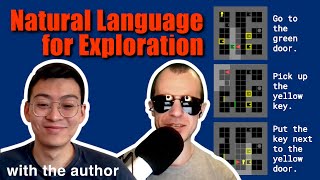
Improving Intrinsic Exploration with Language Abstractions - Author Interview
Interview exploring how language abstractions can improve intrinsic exploration in reinforcement learning, discussing experimental results, challenges, and future directions in this promising research area.
Improving Intrinsic Exploration with Language Abstractions - Machine Learning Paper Explained
Explores using natural language to improve reinforcement learning agents' exploration in sparse-reward environments, demonstrating significant performance gains across challenging tasks in MiniGrid and MiniHack.

Spurious Normativity Enhances Learning of Compliance and Enforcement Behavior in Artificial Agents
Explore how arbitrary social norms enhance learning of rule enforcement in AI agents, with insights on societal implications and potential applications in artificial general intelligence.
Can Wikipedia Help Offline Reinforcement Learning - Author Interview
Exploring the potential of pre-trained language models in offline reinforcement learning, discussing experimental results, model performance, and future directions for leveraging sequence modeling techniques in RL tasks.