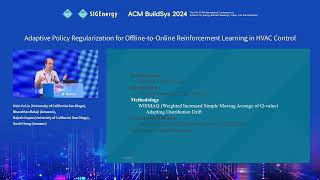
Adaptive Policy Regularization for Offline to Online Reinforcement Learning in HVAC Control
Explore advanced reinforcement learning techniques for HVAC systems, focusing on adaptive policy regularization methods that bridge offline and online control strategies.
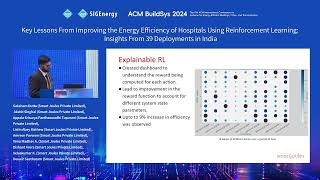
Key Lessons From Improving the Energy Efficiency of Hospitals Using Reinforcement Learning
Discover how reinforcement learning optimizes hospital energy efficiency through real-world insights from 39 Indian healthcare facilities, exploring practical implementation strategies and outcomes.
Q-Learning and Hindsight Regeneration for Interactive AI Agents
Explore groundbreaking Q-Learning techniques for AI agents, featuring Hindsight Regeneration and Q-SFT approaches that enhance conversational AI capabilities through advanced reinforcement learning methods.
Building Adaptive Multi-Agent AI Systems: From Theory to Implementation
Explore adaptive multi-agent AI systems through reinforcement learning, examining how agents navigate dynamic physical and social environments while developing cooperative strategies and decision-making capabilities.

Learning Libraries of Programmatic Policies
Discover how artificial agents can learn and maintain libraries of reusable behaviors for solving sequential decision-making problems through programming and neural network approaches.

Information-Directed Sampling for AI Agent Alignment - From Theory to Practice
Explore Stanford's groundbreaking Information-Directed Sampling approach for aligning AI agents with human values, focusing on optimal decision-making and continuous learning in dynamic environments.

Weakly Supervised Learning for Adaptive Language Learning Model Agents
Explore cutting-edge techniques for training adaptable LLM agents through weakly supervised learning, focusing on frameworks like Agent Lumos and innovative approaches to enhance generalization capabilities.
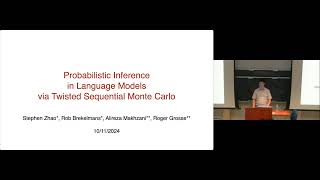
Probabilistic Inference in Language Models via Twisted Sequential Monte Carlo
Explore advanced probabilistic inference techniques for Large Language Models using Sequential Monte Carlo methods, focusing on safety, capability enhancement, and evaluation frameworks.

Reward-Guided Tree Search for Enhanced LLM Reasoning
Discover how reward-guided tree search enhances LLM reasoning capabilities through policy models, reward evaluation, and Monte Carlo algorithms for complex mathematical problem-solving.
Sustaining Git Performance Under Heavy Workloads - An AI-Driven Approach
Discover how AI-driven maintenance strategies optimize Git repository performance under heavy workloads, focusing on efficient solutions beyond traditional GC and geometric repacking methods.

Games and Filters: A Road to Safe Intelligence
Explore game-theoretic approaches and safety principles in AI systems, from robotic control to human-AI interactions, focusing on developing reliable safety guarantees for autonomous systems.
Recent Progress on Foundation Model Supervision for Robot Learning
Discover how foundation models from non-robot domains can revolutionize robot learning, enabling automated task acquisition without extensive data collection or manual controller design.
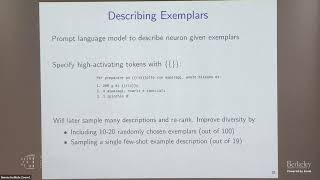
Scalably Understanding AI with AI - Using AI Systems for Model Behavior Analysis
Explore advanced techniques for analyzing AI systems, from behavior elicitation to neuron description, focusing on using AI tools to understand and improve AI model behaviors and representations.
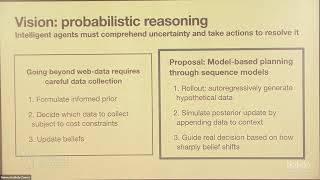
Adaptive Data Collection via Autoregressive Generation in News Recommendation Systems
Discover how autoregressive models can enhance adaptive data collection and decision-making through Thompson sampling, with applications in news recommendation systems and cold-start problems.
6Sense: Internet-Wide IPv6 Scanning and Security Applications
Discover groundbreaking IPv6 scanning technology that uses reinforcement learning to efficiently discover and analyze millions of IPv6 hosts, enabling comprehensive Internet security research and vulnerability detection.
AttackGNN: Red-Teaming GNNs in Hardware Security Using Reinforcement Learning
Discover how reinforcement learning can generate adversarial examples to challenge GNN-based hardware security systems, demonstrating vulnerabilities in IP piracy detection and Trojan identification methods.
GuideEnricher: Protecting the Anonymity of Ethereum Mixing Service Users with Deep Reinforcement Learning
Explore how deep reinforcement learning enhances anonymity protection in Ethereum mixing services through automated pattern detection and guidebook enrichment for safer transactions.

From Smith's Invisible Hand to Distributed Optimization and Control
Explore how economic theory's "invisible hand" concept applies to distributed control systems, optimization algorithms, and machine learning through innovative mathematical frameworks.