
CAP6412 - Final Project Presentations - Lecture 27
Final project presentations showcasing innovative approaches in video action recognition, offline reinforcement learning, and decision transformer encoders, with discussions on methodologies, results, and implications.
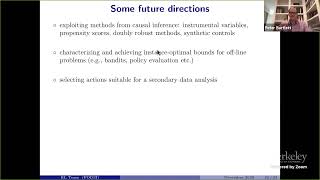
Reinforcement Learning
Explore reinforcement learning's foundations, applications, and advanced concepts, including Q-learning, exploration-exploitation trade-offs, and instance-optimality in policy evaluation.

NeurIPS 2023 Poster Session 1 - Adversarial Patches, Continual Learning, and Reinforcement Learning
Explore cutting-edge AI research from NeurIPS 2023, covering adversarial patches, continual learning, neural network inference, and offline reinforcement learning.
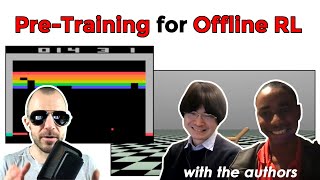
Can Wikipedia Help Offline Reinforcement Learning - Author Interview
Exploring the potential of pre-trained language models in offline reinforcement learning, discussing experimental results, model performance, and future directions for leveraging sequence modeling techniques in RL tasks.
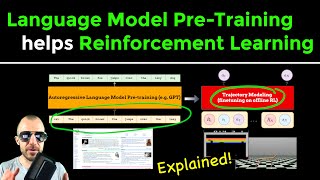
Can Wikipedia Help Offline Reinforcement Learning? - Paper Explained
Exploring how pre-training on Wikipedia improves offline reinforcement learning models, enhancing performance, reducing parameters, and revealing connections between language and RL domains.
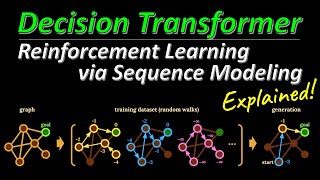
Decision Transformer - Reinforcement Learning via Sequence Modeling
Explore how Decision Transformer reframes offline reinforcement learning as sequence modeling, leveraging Transformer architecture to generate optimal actions based on desired returns, past states, and actions.
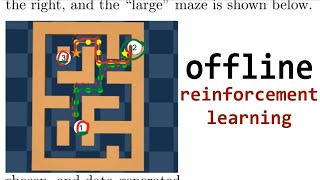
Datasets for Data-Driven Reinforcement Learning
Explore offline reinforcement learning benchmarks and datasets for evaluating algorithms in various settings, including safety-critical tasks and learning from expert demonstrations.
Bayesian RL
Explore Bayesian reinforcement learning techniques, including planning, sampling, and value iteration, to optimize decision-making in uncertain environments.
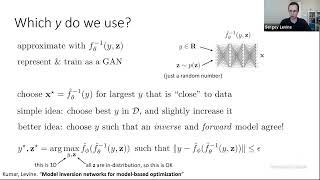
Offline Reinforcement Learning and Model-Based Optimization
Explore offline reinforcement learning and model-based optimization techniques, focusing on data-driven approaches, Q-function lower bounds, and model inversion networks for automated decision-making.

What Are the Statistical Limits of Offline Reinforcement Learning With Function Approximation?
Explore statistical limitations in offline reinforcement learning with function approximation, covering realizability, coverage, policy evaluation, and practical considerations.

Discussion - Offline Reinforcement Learning
Explore offline reinforcement learning, covering data sets, optimism under uncertainty, state coverage, and policy evaluation. Gain insights into pragmatic and conceptual approaches.

Batch Offline Reinforcement Learning - Part 1
Explore offline reinforcement learning theory, covering key concepts, challenges, and evaluation methods for developing AI systems using pre-collected data.
Generalization and Robustness in Offline Reinforcement Learning
Explore offline reinforcement learning for safety-critical applications, covering generalization, robustness, and imitation learning in large-scale settings with rich function approximation.

Offline Reinforcement Learning for Process Control - CDU Air Fan Cooler Control Application
Discover how offline reinforcement learning can optimize crude distillation unit control through historical data analysis, avoiding costly trial-and-error approaches in industrial process control systems.