Implementation and Synthesis of Math Library Functions
Explore MegaLibm, a domain-specific language for implementing, testing, and tuning math library functions. Learn how it enhances safety, modularity, and tunability in mathematical software development.
Binding Syntax for Dependently-Typed Programs - WITS'24
Explore innovative binding syntax for dependently-typed programs, enhancing ergonomics while maintaining fixed grammar for improved error messaging.
Leveraging Rust Types for Program Synthesis
Explore how Rust's type system enhances program synthesis, simplifying specifications and improving performance. Learn about Synthetic Ownership Logic and the RusSOL tool for automatic synthesis of correct Rust programs.
Designing a Programming Language for Local Reasoning and Simple Debugging
Explore how programming language design can minimize bugs and simplify debugging. Learn about trade-offs in language design and their impact on software stability and correctness.
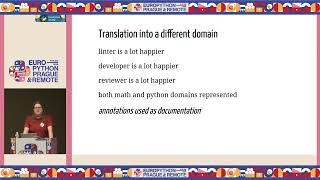
Those Annotations Can Have Things Other Than Typing - Exploring Function Annotations Beyond Type Hints
Explore innovative uses of Python function annotations beyond typing, uncovering potential applications and their implications for code design and functionality.
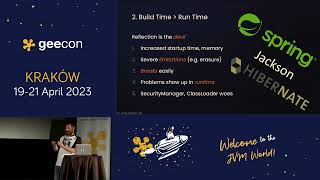
What Scala Taught Me About Software Engineering
Explore how Scala's principles and features influence software engineering practices, enhancing your approach to coding across languages.
The Public Keyword and Public APIs in Julia
Explore Julia's `public` keyword, its role in API design, and tooling support. Learn about declaring public APIs, existing conventions, and future developments in Julia's ecosystem.
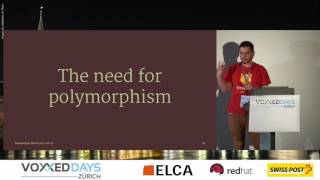
The Many Shapes of Polymorphism
Explore polymorphism's impact on programming language design through Java and Scala examples, comparing code evolution and examining how different language features coexist.

Java Language Futures - Fall 2024 Edition
Discover the latest Java language developments and upcoming features, exploring recent changes and future directions in Java's evolution through insights from Oracle's technical staff.
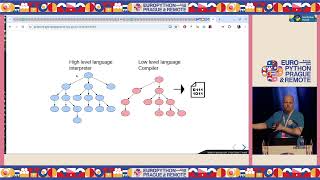
SPy - Static Python Language: Fast as C, Pythonic as Python
Explore SPy, a statically typed Python variant aiming for C-like performance while maintaining Pythonic style. Learn about its design, features, and current status.

Syntaxation
Explore programming language design, parsing techniques, and the impact of fashion on syntax preferences with JSON creator Douglas Crockford in this thought-provoking talk.
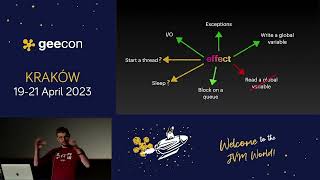
Effects: To Be or Not to Be - Exploring Effect Systems in Scala and Beyond - Lecture 1
Explore effect systems in Scala, JVM, and beyond. Analyze their necessity, differences, and tradeoffs in static typing and type system design.
Filling the Core Language Gaps - Proposed New Primitives in APL
Explore three proposed APL primitives enhancing function composition, generalization, and indexing, completing the language's core functionality.
The Principles of the Flix Programming Language
Explore the design values and principles of Flix, a multi-paradigm programming language, and their impact on its syntax, semantics, type system, and standard library.
Haskell for Choice-Based Learning in Machine Learning Programming
Explore language design for machine learning, focusing on choice-based learning. Combine algebraic effects, handlers, and selection monad to create powerful frameworks for decision-making models and optimization techniques.
Layout Polymorphism: Using Static Computation for Efficient Polymorphism Over Variable Representations
Explore layout polymorphism in OCaml, enabling efficient unboxed types while preserving parametric polymorphism. Learn about type-system design and implementation challenges in managing specializations.
Resource Polymorphism: Integrating First-Class Resources into ML
Explore resource polymorphism in ML, integrating destructors and resource types for enhanced memory management and functional programming in systems and parallel contexts.
The Rational Programmer: An Investigative Method for Programming Language Pragmatics
Explore the Rational Programmer method for evaluating programming language pragmatics through simulations, enhancing developer productivity and informing language design and teaching strategies.
A Type System for Elixir
Explore progress in adding static and gradual typing to Elixir, including set-theoretic types, bug detection, and mixing typed/untyped code. Learn about potential benefits and future challenges.

Toward Programming Languages for Reasoning - Humans, Symbolic Systems, and AI Agents
Explore the future of programming languages focused on reasoning, integrating human developers, symbolic systems, and AI agents. Learn about the Bosque platform's radical simplification approach.

CellPond: Spatial Programming Without Escape
Explore spatial programming with CellPond, a novel approach that eliminates escape hatches and maximizes visual, interactive benefits.