Inductive Definitions, Predicativity, and the Mahlo Universe
Explore inductive definitions, predicativity, and the Mahlo universe in type theory with Peter Dybjer. Gain insights into advanced mathematical concepts and their applications.
Structural Rules and Algebraic Properties of Intersection Types
Explore structural rules and algebraic properties of intersection types in lambda calculus, examining their impact on type assignment systems and programming language theory.
Mario Carneiro - Metamath Zero: Export Your Logic
Explore Metamath Zero, a powerful tool for exporting and formalizing mathematical logic, enhancing proof verification and theorem-proving capabilities.
Challenges in Formalising Recent Results in Formal Language Theory
Explore challenges in formalizing recent results linking formal language theory and computational group theory, with insights on making proofs more amenable to formalization.

The Philosophy of Architecture
Explore the philosophical underpinnings of software architecture, challenging conventional wisdom and examining why we think and disagree about architectural approaches.
On the Hard Problem of Pain - Understanding Higher-Level Intelligence
Explore the complex nature of pain through AI, psychology, and neuroscience perspectives, delving into higher-level intelligence and its implications.
Consciousness and Large Language Models - Understanding Higher-Level Intelligence
Explore the intersection of consciousness and AI through philosophical and scientific lenses, examining implications for higher-level intelligence and cognitive science.
Ramsey Quantifiers in First-Order Logic - Complexity and Applications to Verification
Exploring Ramsey quantifiers in first-order logic, their complexity, and applications to verification, with focus on liveness and termination in infinite-state systems.
Automated Functional Synthesis: An Ideal Meeting Ground for Symbolic Reasoning and Machine Learning
Explores Manthan, a data-driven approach combining machine learning and symbolic reasoning to improve scalability in functional synthesis, viewing it as a classification problem.
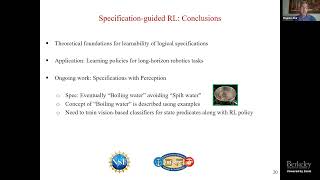
Specification-guided Reinforcement Learning
Explore specification-guided reinforcement learning techniques for synthesizing models and systems, presented by Rajeev Alur from the University of Pennsylvania.
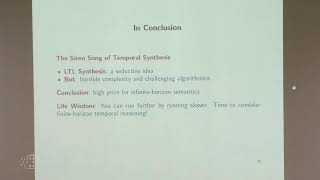
Linear Temporal Logic - From Infinite to Finite Horizon
Explore finite-horizon temporal synthesis in Linear Temporal Logic, its algorithmic advantages, and applications in reactive synthesis and infinite-horizon reasoning.
Synthesis of Privacy-Preserving Systems
Explore privacy-preserving system synthesis, addressing hidden signals, budget constraints, and incomplete information while satisfying specifications and protecting secrets.
Descriptive Complexity for Distributed Computing and Neural Networks
Explore logics capturing distributed computing and neural network models, including graph neural networks. Dive into game-theoretic semantics and computational logic connections.
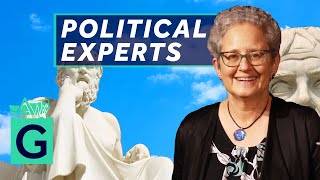
Experts in Politics - Lessons from Socrates and Aristotle
Explore ancient wisdom on expertise in politics, examining Socrates' and Aristotle's insights on expert credibility, public debate, and the role of expertise in democracy.

Forgiveness in Times of Turmoil - Wisdom of Crowds Podcast
Explore the complexities of forgiveness in political confrontations through a thought-provoking discussion with experts, examining its role in reconciliation and societal harmony.
The Question of Happiness
Explore the timeless pursuit of happiness, from ancient philosophies to modern culture, examining its complexities and the ongoing debate about what truly brings fulfillment and joy.

The Second Fifty - Mid-Life and Beyond
Explore strategies for thriving in life's second half, including health habits, social connections, and finding purpose. Experts discuss key questions and tools for meaningful aging.
Journalism, Religion, and Vocation - The Overlooked Force in American Life
Exploring religion's impact on American life and journalism, addressing media blind spots and the importance of religious coverage in newsrooms.
Psychology, Philosophy and Programming
Explore connections between psychology, philosophy, and programming, examining ancient wisdom and modern insights to enhance problem-solving and critical thinking in software development.
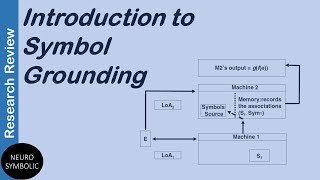
Introduction to Symbol Grounding
Explore the symbol grounding problem, its philosophical roots, and major approaches including representationalist, semi-representationalist, and non-representationalist solutions.
Fundamental Physics: Nonthermal Production Mechanisms in an Expanding Universe - Class 2
Explore nonthermal production mechanisms in an expanding universe, focusing on fundamental physics concepts like Feynman diagrams, phenomenology, and magnetic fields.