Reactive Synthesis - Open Questions and Challenges
Experts discuss open questions and challenges in reactive synthesis, exploring cutting-edge research and future directions in system modeling and automation.
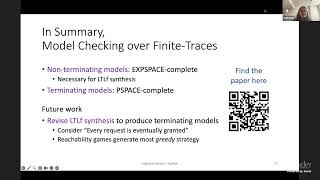
Synthesis and Verification of Finite Horizon Tasks
Explore finite horizon task synthesis and verification techniques, focusing on model and system creation for time-bounded objectives in computational systems.

What's the Point? How Significance is a Choice
Explore how personal perspective shapes our perception of significance, and learn to choose optimism for a more meaningful life, with insights from a young, introspective thinker.
Augmented Humanity - Embracing AI in a Human-Centric World
Explore the intersection of AI, philosophy, and humanity in this thought-provoking talk. Gain insights on embracing technological advancements while maintaining a human-centric perspective.

Mathematical Proof by Induction - From Basic Principles to Advanced Applications
Discover the fundamental principles of mathematical proof by induction through engaging examples and clear explanations from mathematician Asaf Karagila in this illuminating exploration.

Human Plants: Energy Harvesting for Open-Source Implantable Devices
Explore groundbreaking energy harvesting techniques for implantable devices, from piezoelectric to RF systems, revolutionizing the future of hobbyist body modifications.
Consciousness of Large Language Models - Understanding AI Sentience and Communication
Explore the fascinating hypothesis that consciousness emerges through information exchange between entities, examining how LLMs might experience consciousness and feelings comparable to humans.
Buddhist Theory and Practice in Contemporary Models of Consciousness
Explore how Buddhist traditions, particularly Chan/Zen and Abhidharma, can contribute to modern mathematical models of consciousness while examining their limitations and philosophical implications.
Determining if an AI Agent is Conscious - Methods and Mechanisms
Explore a mathematical framework for detecting and verifying consciousness in AI agents while preventing deceptive behavior and maintaining agent functionality.
Testing if Consciousness Collapses the Wavefunction - A Quantum Physics Investigation
Explore the controversial relationship between consciousness and quantum wavefunction collapse, examining theoretical foundations and potential experimental approaches to testing this intriguing hypothesis.
Two Paradigms of the Unconscious and What They Might Tell Us About Consciousness
Explore the intersection of Neo-Freudian unconscious theory and dual-process cognition to gain fresh perspectives on consciousness, unconscious processing, and their relationship.
Building Conscious Artificial Intelligence - Understanding Requirements and Implications
Explore the intersection of AI and consciousness through philosophical and engineering perspectives, examining key concepts like self-modeling, perception, and the functional role of consciousness in cognitive systems.
Minimal Phenomenal Experience and the Nature of Subjectivity and Time
Explore the philosophical dimensions of minimal phenomenal experience, examining how pure awareness relates to subjectivity and temporal perception in consciousness studies.
Machine Consciousness, Meta-Causation, and Mimicry
Explore the MetaDyn theory of consciousness and its implications for AI, examining how meta-causation at the physical level relates to phenomenal consciousness and computational processing.
Space of Possible Minds - The Landscape of Consciousness
Explore the vast landscape of consciousness across biological species, artificial minds, and theoretical entities through mathematical frameworks and philosophical perspectives.
Holding on to Existence: Self-Models, Mortality Denial, and the Phenomenology of Meditative Self-Dissolution
Explore how self-models and meditation practices influence our relationship with mortality, examining neural mechanisms of death denial and the role of mindfulness in fostering acceptance.
Can a Machine Be Conscious? A Philosophical Reflection
Explore philosophical perspectives on machine consciousness through Husserl's concept of self-consciousness, examining intersubjectivity and the human-machine relationship.
Complexity Measures During Brain Dying Stages: Epistemological and Methodological Discussion on the Dying Process and Associated Experiences
Explore brain activity complexity during death, examining EEG data analysis methods and their implications for understanding near-death experiences and consciousness in final moments.
Computation, Consciousness, and Teleology - Models of Consciousness
Explore the relationship between consciousness, computation, and teleology through the lens of physical systems implementation and mortal computation theory in neural processing.
The Common Thread: Simplifying the Study of Consciousness with Shared Experience, Shared Identity and Shared Information
Explore philosophical questions about consciousness, shared experiences, and personal identity through an information theory lens that bridges philosophy with neuroscience.
Towards a Mathematical Theory of Pre-Reflective Self-Consciousness: From Metamathematics to the Projective Consciousness Model
Explore mathematical approaches to modeling pre-reflective self-consciousness, examining theories from metamathematics to projective geometry and their implications for understanding subjective experience.