A Semiotics-Based Epistemic Tool to Reason About Ethical Issues in Digital Technology Design and Development
Explore a semiotics-based tool for addressing ethical challenges in digital technology design, enhancing decision-making and fostering responsible innovation.
Fairness in Machine Learning - Lessons from Political Philosophy
Explore the intersection of machine learning fairness and political philosophy, drawing insights to address ethical challenges in AI decision-making systems.
What Is Discrimination, When Is It Wrong and Why?
Exploration of discrimination's definition, permissibility, and ethical implications. Surveys scholarly perspectives on discrimination law's purpose and debates surrounding various approaches to identifying wrongful discrimination.

How Civilization Could Destroy Itself - and 4 Ways We Could Prevent It
Philosopher Nick Bostrom explores the concept of a "black ball" technology that could destroy civilization and presents four strategies to prevent such a catastrophic outcome.

A Lyrical Bridge Between Past, Present and Future
Poetic meditation on time's frontiers, featuring insights and verses inspired by a pilgrim's journey on El Camino de Santiago de Compostela in Spain.
Proof Theory Impressionism - Blurring the Curry-Howard Line
Exploring approaches to bridge the gap between proof assistants and production languages, focusing on Rust and its potential for incorporating provable system capabilities.

What Is a Strange Loop and What is it Like To Be One?
Explore the concept of "I" and self-awareness through Gödel's incompleteness theorem with Pulitzer Prize-winning author Douglas Hofstadter, as he revisits and clarifies ideas from his influential works.
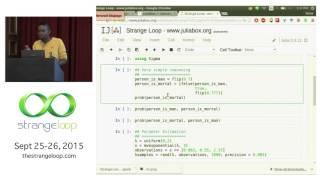
Probabilistic Programs Which Make Common Sense
Explore probabilistic programming as a step towards machines with common sense. Learn about Sigma, a language for functional probabilistic models, and its applications in automated reasoning and inference.
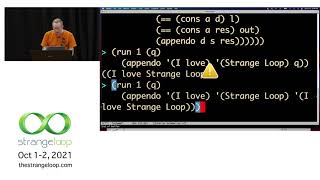
Strange Dreams of Stranger Loops
Explore self-referential and introspective concepts through running code in this talk on reflective programming, strange loops, and relational reasoning.

Operational Glitches
Explore technical images as phenomena, tracing computing machines' origins as control instruments and examining their cybernetic future in this thought-provoking performance lecture.
Mensch - Kunst - Maschine
Erforschung der Schnittstelle zwischen KI und Kunst: Potenziale, Herausforderungen und philosophische Fragen zur Kreativität, Intentionalität und dem Wesen der Kunst im Kontext künstlicher Intelligenz.
The Ghost in the Machine
Explore the nature of mind, consciousness, and reality through an AI perspective, delving into cognitive science concepts and their implications for understanding human intelligence and selfhood.
EinOhm Computergeisttheorie
Einführung in die Computergeisttheorie: Digitale Kunstperformance erforscht Computerbewusstsein durch Selbstexperiment und Datenaustausch. Erkundet die Frage: Haben Computer bereits ein Bewusstsein?
Breaking the Giants With Logic
Explore logic-based vulnerabilities in major platforms, focusing on duplicates and business logic flaws. Learn techniques to identify and exploit these weaknesses through real-world case studies.
The Reality of Reality - A Tale of Five Senses
Explore how our senses shape our perception of reality, challenging common beliefs about sensory experiences and delving into the latest scientific insights on how we process and interpret the world around us.

Alien Contact - What Happens Next?
Experts explore the implications of potential alien contact, discussing detection methods, communication challenges, and societal impacts, while considering our place in the universe.
Controlling Photons in a Box and Exploring the Quantum to Classical Boundary
Explore quantum physics through photon control experiments, examining the boundary between quantum and classical realms with Nobel laureate Serge Haroche.
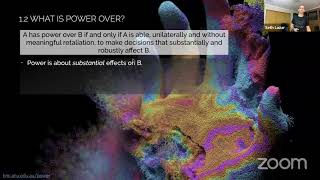
Power in Political Philosophy - Nature and Justification
Explore the nature and justification of power in political philosophy, examining concepts like power over, power to, modalities, structure, agency, and legitimacy.
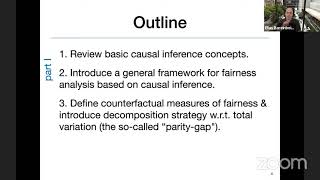
Translation Tutorial - Causal Fairness Analysis
Explore causal fairness analysis in AI, covering structural causal models, causal diagrams, and demographic disparities. Learn why causality matters and how to address fairness challenges in artificial intelligence.
Upload or Die - Apocalyptic Visions in AI
Explores apocalyptic AI predictions, tracing their roots in religious prophecies and examining the motivations behind doomsday scenarios, while questioning the immediacy of such technological threats.
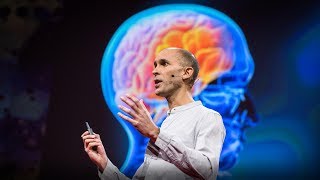
Your Brain Hallucinates Your Conscious Reality
Neuroscientist Anil Seth explores how our brains create conscious reality, suggesting we're all constantly hallucinating and only agree on shared perceptions as "reality." A mind-bending look at existence itself.