Functions and Determinism in Property-based Testing - Lecture 9
Explore property-based testing, its implementation, and advanced techniques. Learn to create robust test suites using generators, determinism, and invariants for more effective software validation.
Rust in Production: Case Studies and Value Proposition - Philly ETE 2016
Explore Rust's value proposition and real-world applications through case studies, focusing on its safety, speed, and concurrency features for systems programming.

LLM Reasoning Limitations: Understanding Linear Order and Logical Hallucinations
Delve into groundbreaking research from Stanford and DeepMind revealing LLMs' limitations in causal reasoning, premise ordering, and mathematical logic, highlighting key challenges in AI development.
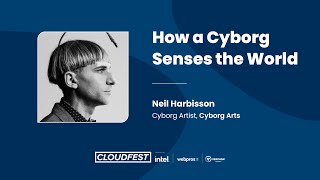
How a Cyborg Senses the World
Experience the fascinating journey of human-machine integration as Neil Harbisson, the world's first cyborg artist, shares insights on sensing colors through sound and expanding human perception.
Getting AI to Do Things I Can't - Automatically Searching and Explaining Patterns in Text
Explore techniques for leveraging AI in complex NLP tasks, including pattern searching and SQL labeling, while enabling effective human oversight and uncovering unexpected insights.

Algorithmic Verification - Session Preview at POPL 2023
Explore algorithmic verification techniques and their applications in program analysis, presented by expert Umang Mathur at POPL 2023's innovative session preview track.

Type Theory Session Preview - POPL 2023
Explore type theory fundamentals and recent advancements in this expert-led session preview for POPL 2023, enhancing accessibility of upcoming talks.

Why Is Bing Unhinged? Let's Talk About Alignment and How to Fix It
Explores AI alignment challenges, focusing on Bing's issues, and discusses potential solutions like cognitive architecture and constitutional AI to ensure benevolent AI development.
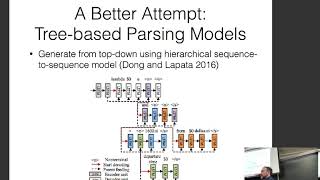
Neural Nets for NLP 2018 - Neural Semantic Parsing
Explore neural semantic parsing techniques, including tree-based models, code generation, weakly supervised learning, and various meaning representations. Learn about graph structures and neural approaches to semantic role labeling.
Proof Mining in Bounded Arithmetic
Explore proof mining in bounded arithmetic, focusing on computational content, complexity classes, and applications in mathematical logic and theoretical computer science.
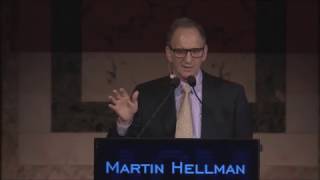
Cybersecurity, Nuclear Security, and Illogical Logic - Keynote by Martin Hellman
Martin Hellman explores cybersecurity, nuclear security, and logical paradoxes, drawing connections between cryptography, national security, and mathematical logic while reflecting on his career and the broader implications of technology.
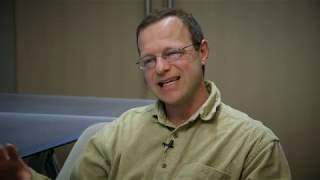
Model Checking and Temporal Logic - E. Allen Emerson's Turing Award Lecture
Explore E. Allen Emerson's journey to the Turing Award, from early influences to groundbreaking work in model checking and temporal logic in computer science verification.

Cryptography and Public Key Encryption - Martin Hellman Interview
Explore Martin Hellman's life, from ancestry to groundbreaking cryptography research, early retirement, and personal growth, in this in-depth interview with the Turing Award recipient.
AI and Artificially Enhanced Brains - With Susan Schneider
Exploring the philosophical and ethical implications of merging human brains with AI, including consciousness in robots, mind-machine interfaces, and the future of human intelligence.
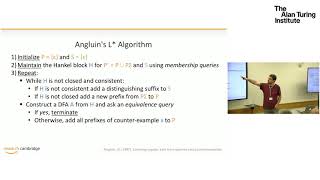
Learning Automata with Hankel Matrices - Borja Balle, Amazon Research Cambridge
Explore a unified framework for learning automata using Hankel matrices, covering query learning, spectral learning, and matrix completion algorithms with practical applications.
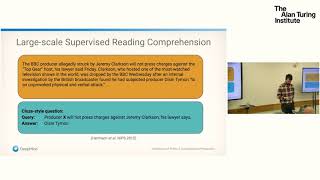
Recurrent Neural Networks and Models of Computation - Edward Grefenstette, DeepMind
Exploring recurrent neural networks and memory-enhanced architectures, analyzing their computational capabilities and efficiency in relation to traditional models of computation.
Alan Turing and the Other Theory of Computing and Can a Machine Be Conscious?
Explore Turing's lesser-known 1948 paper on numerical computation and its impact on complexity theory. Discover how it unifies two major traditions in computational theory.
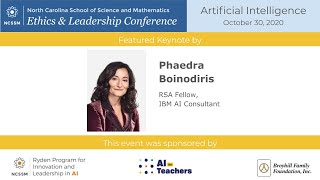
Ethics and Leadership in AI: Addressing Bias and Shaping the Future - 2020 NCSSM Conference Keynote
Explore AI ethics, bias, and societal impact with tech leader Phaedra Boinodiris. Gain insights on data privacy, future skills, and the role of education in shaping ethical AI development and implementation.
Deep Learning with Neural Networks and TensorFlow Introduction
Introduction to deep learning with neural networks, covering theory, models, optimization, and TensorFlow. Explore biologically-inspired machine learning techniques and their evolution in the field of artificial intelligence.
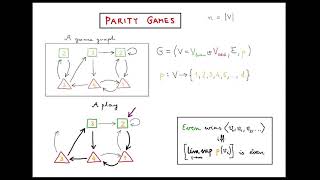
Games: From Logic and Automata to Algorithms
Explore the intersection of logic, automata, and algorithms through game theory, focusing on theoretical foundations and computational applications.
Money, Circuits, Mythic Figures, and More - Theory in the Allen School
Diverse theoretical computer science research: algorithms, data structures, complexity, combinatorics, and economics. Insights from UW Allen School's theory group on cutting-edge topics.