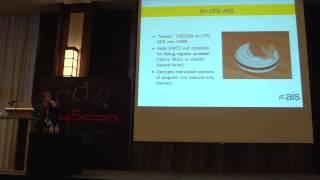
HARES - Hardened Anti Reverse Engineering System
Explore HARES, an advanced anti-reverse engineering system. Learn about TLB splitting, program verification, and security implications for Windows kernel protection.
The Limits of Sandboxing and Next Steps
Exploring sandboxing limitations in Chrome security, discussing OS constraints, and introducing memory safety as a complementary approach to enhance software resilience.
What Have We Lost?
Explore forgotten operating systems like IBM i, Interlisp, OpenGenera, and TRON. Discover unique features and innovative designs that challenge our current computing paradigms.
STACKLEAK - A Long Way to the Linux Kernel Mainline
Explore STACKLEAK, a Linux kernel security feature mitigating stack leak bugs, uninitialized variable attacks, and stack depth overflow. Learn its history, implementation, and impact.
Speeding Your Linux Development with Debian and OpenEmbedded on DragonBoard 410c
Learn strategies for Linux development on DragonBoard 410c using Debian and OpenEmbedded. Explore OS options, package support, build sizes, development tools, and long-term support for efficient prototyping and production.
Porting U-Boot and Linux on New ARM Boards - A Step-by-Step Guide
Step-by-step guide for porting U-Boot and Linux to new ARM boards, covering architecture, configuration, device trees, and troubleshooting. Ideal for developers seeking practical insights.
Cilium - Container Security and Networking Using BPF and XDP
Explore Cilium's innovative use of BPF for container networking and security, covering performance, DDoS mitigation, and microservices protection in cloud-native environments.
BPFTrace - Finally Dtrace Replacement for Linux
Explore BPFTrace, a powerful Linux instrumentation tool. Learn its capabilities, advantages over GTrace, and practical applications for system performance analysis and debugging.
PlutoSDR - The Making of an Ultra Low Cost, High Performance Linux Based Software Defined Radio
Explore the creation of PlutoSDR, a low-cost, high-performance software-defined radio based on Linux. Learn about its hardware, software stack, and innovative features for efficient data transport and system management.
Kernel Runtime Security Instrumentation
Explore extensible Linux security with eBPF programs, enabling custom security and auditing solutions without kernel modifications. Learn design, interfaces, and practical applications.
What's New with U-Boot?
Explore U-Boot's latest features for embedded systems, including driver model, Kconfig, logging, sandbox, EFI, and verified boot. Learn about recent advancements and future possibilities.
Breaking and Protecting Linux Kernel Stack
Explore Linux kernel stack vulnerabilities, existing protections, and potential improvements like RANDOMIZE_KSTACK_OFFSET. Gain insights into security measures and performance implications.

How to Write a Linux Security Module
Comprehensive guide to creating Linux Security Modules, covering infrastructure, interfaces, and best practices for implementing additional kernel security mechanisms.
Bluetooth Mesh and Zephyr
Explore Bluetooth Mesh fundamentals and implementation on Zephyr RTOS. Learn about models, messages, publish/subscribe, node composition, and security keys. Includes code examples and potential live demos.
A Zephyr User Story
Explore the decision-making process for RTOS selection and implementation in IoT startups, focusing on Zephyr's features, board support, and subsystems for industrial applications.
Developing Open-Source Software RTOS with Functional Safety in Mind
Explore integrating open-source RTOS development with functional safety standards, focusing on Zephyr project's innovative approach using public tools to meet safety requirements.
An Introduction to EdgeX Foundry
Explore EdgeX Foundry, an open-source IoT platform addressing interoperability challenges while enabling value-add. Learn its architecture, ecosystem, and role in solving edge computing complexities.
Kernel Hardening - Protecting the Protection Mechanisms
Explore kernel hardening techniques to protect critical Linux subsystems. Learn about read-only and rare-write memory allocation, and how to integrate these features into popular data structures for enhanced security.
Kernel Analysis Using eBPF
Explore eBPF's powerful in-kernel virtual machine for gathering debug and tuning information. Learn low-level mechanisms, dissect examples, and discover userspace tools for high-level eBPF programming.
The End of Time, 19 Years to Go
Explore the 2038 time_t overflow issue in Linux, its impact on various systems, and ongoing efforts to address it. Learn about kernel updates, remaining challenges, and future steps for user space solutions.

Linux and Zephyr - Talking to Each Other in the Same SoC
Explore inter-core communication between Linux and Zephyr on hybrid multiprocessors using RPMsg, with practical demonstrations and insights for real-time applications.