Building Trusted Systems on Top of Leaky Abstractions
Exploring secure system design in complex tech stacks. Covers side-channel attacks, browser security, and trusted execution environments. Insights on building robust systems against known and unknown threats.
LBM - A Security Framework for Peripherals within the Linux Kernel
Explore a security framework for Linux kernel peripherals, focusing on defending against malicious devices and understanding self-encryption techniques and potential vulnerabilities.
How to Backdoor the Linux Kernel and Fail - Security Measures in Kernel Development
Explore potential Linux kernel backdoor methods and existing security measures. Investigate weak points in the trust chain and learn about kernel release protection strategies.
HotBPF++ - A More Powerful Memory Protection for the Linux Kernel
Explore HotBPF++, an advanced Linux kernel memory protection system. Learn about its automatic deployment, on-the-fly enabling, and lightweight design for preventing and detecting various memory corruptions beyond heap exploitation.
MPK/PKS Linux Kernel Compartmentalization
Explore Intel's PKS-based kernel compartmentalization strategy to enhance security, reduce attack surfaces, and mitigate vulnerabilities in Linux systems.

Linux Security Module (LSM) Maintainers Panel Discussion
Panel discussion on recent Linux Security Module developments, featuring insights from key maintainers on significant security advancements in LSMs and the Linux Kernel, with audience Q&A.
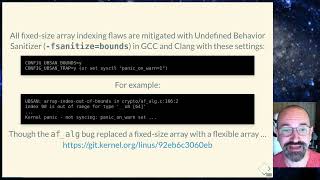
Meaningful Bounds Checking in the Linux Kernel - Addressing Buffer Overflows
Exploring buffer overflow vulnerabilities in the Linux kernel and innovative solutions for enhanced security through improved bounds checking and compiler optimizations.
HotBPF - On-demand and On-the-fly Memory Protection for the Linux Kernel
On-demand, on-the-fly Linux kernel memory protection mechanism: lightweight, hardware-independent, and deployable without rebooting. Enhances security during vulnerability disclosure to remediation window.

Mitigating Use-after-frees in the Linux Kernel
Explore techniques for mitigating use-after-free vulnerabilities in the Linux kernel, covering performance trade-offs, pointer checks, and RCU implementation strategies.
Demystifying the Linux Kernel Security Process
Explore the Linux kernel security process with Greg Kroah-Hartman. Learn about vulnerability management, change propagation, and maintaining system security in this insightful session.

Security Features Status Update for Linux Kernel Toolchains
Comprehensive update on Linux kernel security features across GCC and Clang, discussing toolchain parity, open problems, and new features like CFI, LTO, and overflow protection.
Thwarting Unknown Bugs - Hardening Features in the Mainline Linux Kernel
Explore Linux kernel hardening techniques to mitigate vulnerabilities, including debug features, read-only data, stack protection, memory segregation, and address sanitization.

Kernel Self-Protection Project: Eliminating Bug Classes and Blocking Exploitation Techniques
Overview of Kernel Self-Protection Project's progress, highlighting security defenses implemented in Linux kernels 4.19-5.3, ongoing developments, and areas needing assistance in enhancing kernel security.
Syzbot and the Tale of Thousand Kernel Bugs
Explore Linux kernel bug detection tools and their impact on system security. Learn about syzbot, syzkaller, and sanitizers for improving kernel stability and reliability.
Overview of the Linux Kernel Security Subsystem
Explore Linux kernel security: history, components, and community involvement. Learn about access control, capabilities, auditing, and security modules from a Microsoft expert.

Does Making the Kernel Harder Make Making the Kernel Harder?
Explore Linux kernel hardening techniques, their security benefits, and development impacts. Learn about refcount_t, variable length arrays removal, and LSM infrastructure improvements.
Kernel Self-Protection Project: Overview and Recent Developments
Explore recent developments in Linux kernel security, including defenses against vulnerabilities, bug lifetime analysis, and ongoing challenges in the Kernel Self-Protection Project.
Linux Kernel Security Contributions by ANSSI
Explore ANSSI's contributions to Linux kernel security, including Landlock LSM and CLIP Linux. Learn about the benefits of open-source collaboration for government agencies and enterprises.
Overview and Recent Developments: Seccomp and Small Linux Security Modules
Explore Linux kernel security: seccomp syscall filtering, Yama ptrace-restriction LSM, and LoadPin kernel-file-reading restriction LSM. Learn history, usage, and recent developments from Google engineer Kees Cook.

A New Proposal for Protecting Kernel Data Memory
Propuesta para proteger la memoria de datos del kernel mediante segmentación del espacio de direcciones vmalloc y codificación de propiedades, reduciendo la sobrecarga de verificación y allanando el camino para el endurecimiento de las tablas de páginas.

CVEHound - Auditing Kernel Sources for Missing CVE Fixes
Explore CVEHound, a tool for auditing kernel sources to identify missing CVE fixes, enhancing security and vulnerability management in Linux systems.