Will Large-Scale Automated Scanning Stop Malware on OSS Repositories?
Explore challenges of automated malware scanning in open-source repositories, focusing on PyPI's experience. Learn why current approaches fall short and discover emerging solutions for effective package security.
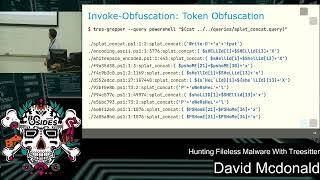
Hunting Fileless Malware with Treesitter
Explore advanced techniques for detecting obfuscated, fileless malware using Treesitter parser generator library. Learn to create scalable and accurate detections for malicious PowerShell and Bash payloads.
Monitoring Malware Behavior Through Kernel Syscall Tracing
Explore kernel syscall tracing techniques for monitoring malware behavior, presented by security experts at a major cybersecurity conference in Eastern Europe.
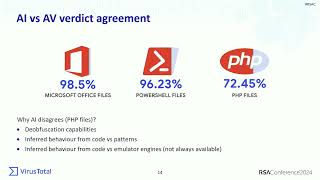
How AI Is Changing the Malware Landscape
Explore AI's impact on malware detection, including insights from VirusTotal's AI engines, strengths and weaknesses in analysis, and emerging AI-evasion techniques in cybersecurity.
Leveraging macOS Networking Frameworks for Heuristic Malware Detection
Explore open-source methods for building network state enumerators and advanced monitors on macOS to detect sophisticated malware through unauthorized network access detection.

EDR Reloaded - Exploiting Endpoint Security Vulnerabilities for Remote Data Erasure
Unveils critical vulnerability allowing remote data deletion in endpoint security products. Demonstrates attack vectors, explains root cause, and showcases bypass of Microsoft patch, impacting databases and system logs.
Blackbox Android Malware Detection Using ML and Evasion Attacks Techniques
Explore machine learning techniques for Android malware detection and evasion attacks, presented by an expert at a leading cybersecurity conference in Cluj-Napoca.

PLSE Seminar Series - Alessandra Gorla - Mining Android Apps for Anomalous Behavior
Techniques for detecting suspicious behavior in Android apps by clustering based on advertised functionality and identifying outliers in API usage, with applications in malware detection.

Forensic Analysis of Container Checkpoints
Explore forensic container checkpointing in Kubernetes, learning tools and methods to analyze checkpoints and extract crucial information for uncovering potential malicious activity.
Purple Teaming and Adversary Emulation in the Cloud with Stratus Red Team
Explore cloud-native adversary emulation with Stratus Red Team. Learn to identify and reproduce malicious activities in AWS and Kubernetes, enhancing threat detection capabilities for cloud environments.
Operation Triangulation: Uncovering a Sophisticated Zero-Click Attack on iPhones
Unveiling a sophisticated zero-click iOS attack chain: discovery, analysis, and implications of Operation Triangulation, a highly advanced spyware targeting researchers' iPhones.

Discovering Dark Matter - Towards Better Android Malware Heuristics
Explore advanced Android malware detection techniques and heuristics to uncover hidden threats in mobile applications, enhancing cybersecurity practices for the Android ecosystem.

Building Realistic Machine Learning Systems for Security
Explore building robust machine learning systems for malware detection, addressing challenges like low false positive rates, polluted data, and realistic adversarial attacks in security applications.

Classifiers Under Attack: Evasion Techniques and Defensive Strategies
Exploring vulnerabilities in machine learning classifiers for security applications, demonstrating evasion techniques, and discussing methods to enhance robustness against adversarial attacks.

Adversarial Examples in Machine Learning - Crafting and Defending Against Attacks
Explore machine learning vulnerabilities, adversarial examples, and their impact on system security. Learn crafting techniques and defenses through practical tutorials and real-world applications.

Enforcing Runtime Integrity with Maat
Explore Maat: an open-source framework for runtime integrity measurement in Linux systems, enabling continuous security checks and malware detection throughout system execution.

K8s Post-Exploitation: Privilege Escalation, Sidecar Container Injection, and Runtime Security
Explore post-exploitation scenarios in Kubernetes, including privilege escalation, sidecar container injection, and runtime security. Learn detection techniques and security measures to protect your cluster.

Hide Android Applications in Images
Discover a technique to conceal malicious payloads in Android packages, manipulating encrypted data to appear as genuine images while evading detection and reverse engineering attempts.

Static Detection of Novel Malware Using Transfer Learning with Deep Neural Networks
Explore innovative malware detection techniques using transfer learning and deep neural networks for enhanced cybersecurity and threat prevention.

Bundles of Joy - Breaking macOS via Subverted Applications Bundles
Explore macOS vulnerability CVE-2021-30657, its impact on security features, and methods for detection and prevention. Gain insights into reversing Apple's patch and analyzing related malware.
A New Trend for the Blue Team - Using a Symbolic Engine to Detect Evasive Forms of Malware - Ransomware
Explore symbolic engines for detecting evasive malware and ransomware, enhancing blue team capabilities in reverse engineering and threat analysis.