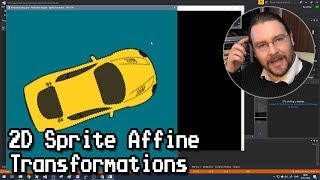
2D Sprite Affine Transformations - Rotation, Translation, Scaling, and Shearing
Learn to transform 2D sprites using matrices for rotation, translation, scaling, and shearing. Implement these techniques in a practical programming context.

Pen Tool Explained - Affinity Photo Tutorial
Master the Pen Tool in Affinity Photo: Learn to create curves, shapes, selections, gradients, and glow effects. Discover versatile applications beyond illustration and vector graphics.
Affinity Photo - Beginner's Basic Tutorial - How to Get Started
Learn Affinity Photo basics: adjustment layers, filters, masks, layers, pixels vs. vectors, image sizing for print/screen. Essential knowledge for beginners in an easy-to-follow format.

Least Square Method and Curve Fitting - Straight Line Problems in Numerical Methods
Master curve fitting and least square method techniques for straight line problems through practical numerical examples and statistical applications.
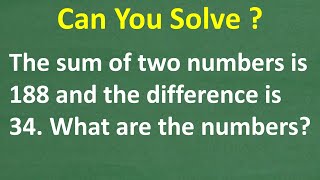
Solving Two-Variable Linear System Word Problems - Addition and Subtraction
Master solving two-variable linear systems through a practical word problem. Learn step-by-step techniques to find unknown numbers using addition and subtraction relationships.
Sphere Packings with Forbidden Distances
Delve into the mathematical exploration of sphere packing configurations, examining forbidden distances and their implications in geometric number theory through advanced analytical approaches.
Spectral Analysis of LoRA vs Full Fine-Tuning in Language Models
Delve into the technical comparison between LoRA and full fine-tuning methods for language models, exploring their structural differences, spectral properties, and impact on model performance.
Linear Models and Their Geometry in Machine Learning - Lecture 5
Explore the fundamental concepts and geometric principles behind linear classifiers, a cornerstone of machine learning algorithms and classification techniques.
Refuting Spectral Compatibility of Quantum Marginals
Delve into quantum marginal problem's spectral compatibility through a mathematical framework using symmetry-reduced semidefinite programming hierarchy for detecting incompatible spectra in quantum states.
Qubit-Efficient Randomized Quantum Algorithms for Linear Algebra
Explore quantum algorithms for matrix sampling and linear algebra operations using minimal qubits, focusing on efficient methods without quantum data structures for practical quantum computing applications.
Sample-Optimal Quantum Process Tomography with Non-Adaptive Incoherent Measurements
Delve into quantum process tomography theory, exploring sample complexity bounds for learning quantum channels using non-adaptive incoherent measurements and diamond norm approximations.
Quantum Mass Production Theorems - Implementing Multiple Copies of Quantum Circuits
Delve into quantum circuit optimization through mass production theorems, exploring efficient implementations of multiple copies of quantum transformations and their theoretical implications.
Efficient Tomography of Non-Interacting Fermion States
Delve into quantum state tomography algorithms for non-interacting fermion systems, exploring efficient methods for state reconstruction and measurement through theoretical frameworks and error analysis.
Improved Approximations for Extremal Eigenvalues of Sparse Hamiltonians
Discover advanced approximation techniques for eigenvalues in sparse Hamiltonians, exploring new methods for quantum systems with q-local terms and improved mathematical approaches for k-sparse configurations.
Influences of Fourier Completely Bounded Polynomials and Classical Simulation of Quantum Algorithms
Delve into quantum query algorithms through new polynomial characterizations, exploring influential variables in Fourier completely bounded polynomials and their implications for classical simulations.
What's New in Calculus and Algebra - Upcoming Wolfram Language Features
Explore upcoming calculus and algebra features in Wolfram Language, including performance improvements, new functions, and algorithmic advances for symbolic and numerical computations.
Structured Arrays in Wolfram Language: Representation and Computation
Explore efficient representation and computation with structured arrays in Wolfram Language, focusing on matrices and their applications.
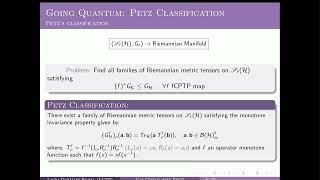
Can Cencov Meet Petz - Unifying Classical and Quantum Information Geometry
Explore the unification of Cencov's and Petz's theorems through W*-algebra formulations of classical and quantum information geometry.
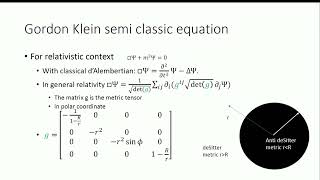
Unitarity Excess in Schwarzschild Metric
Explore eigenvalues in Gordon Klein equation with Schwarzschild metric, examining implications for black hole information paradox and eternal black holes.
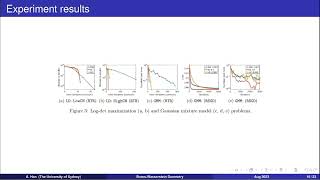
Learning with Symmetric Positive Definite Matrices via Generalized Bures-Wasserstein Geometry
Explore advanced mathematical concepts in symmetric positive definite matrices and their applications using generalized Bures Wasserstein geometry.
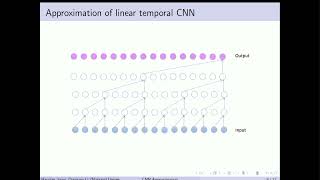
Forward and Inverse Approximation Theory for Linear Temporal Convolutional Networks
Explore approximation theory for linear temporal convolutional networks, examining forward and inverse approaches to enhance understanding of network behavior and capabilities.