
Sampling for Linear Algebra, Statistics, and Optimization I
Explore randomized numerical linear algebra techniques for efficient data analysis, covering sampling methods, matrix multiplication, and regression algorithms.

Foundations of Data Science II
Explore advanced data science concepts including SVD, Gaussian mixtures, and Markov chains. Learn about randomized algorithms and low-rank approximations for efficient data handling.
Quantum-Inspired Classical Linear Algebra
Explore quantum-inspired classical algorithms for linear algebra, including sketching, sampling, and low-rank approximation techniques in this advanced computational talk.
Learning-Based Low-Rank Approximations - IPAM at UCLA
Explores learning-based algorithms for low-rank matrix approximation, focusing on optimizing sketching matrices using training data to significantly reduce approximation errors in efficient computational methods.
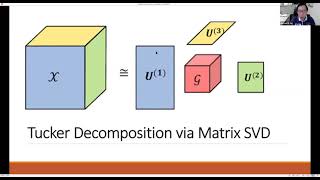
Low Rank Tensor Completion and Its Applications
Explore low rank tensor completion methods using framelet, dictionary coding, deep plug-and-play prior, and more. Gain insights into theoretical and numerical results for solving complex imaging problems.
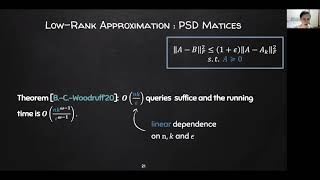
Robust and Sample Optimal Algorithms for PSD Low-Rank Approximation
Explore efficient algorithms for positive semidefinite low-rank approximation, focusing on robustness and sample optimality in matrix computations.
When Your Big Data Seems Too Small: Accurate Inferences Beyond the Empirical Distribution - Part 2
Explore advanced techniques for accurate distribution inferences with limited data. Learn to de-noise empirical distributions, estimate population spectra, and recover low-rank matrix approximations.
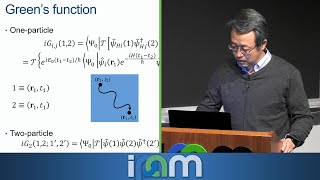
Low Rank Approximation in Electron Excitation Calculations - IPAM at UCLA
Explore low rank approximation techniques for efficient electron excitation calculations, focusing on the Interpolative Separable Density Fitting method and its applications in quantum mechanics.
Arbitrary Tensor Network Algorithm: Theory, Methods and Applications
Explore arbitrary tensor network algorithms for complex systems modeling, covering theory, methods, and applications in probabilistic graphical models and quantum circuit simulations.
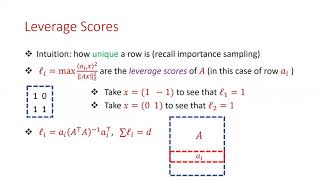
Near Optimal Linear Algebra in the Online and Sliding Window Models
Explore near-optimal linear algebra techniques for streaming and sliding window models, focusing on randomized algorithms and their applications in data analysis.
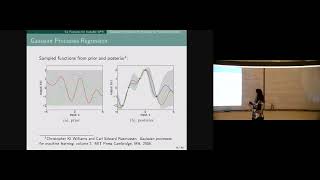
Gauss-Legendre Features for Scalable Gaussian Process Regression
Discover how Gauss-Legendre features enable efficient scaling of Gaussian process regression through low-rank kernel matrix approximation, offering faster computation for large datasets with poly-logarithmic feature requirements.
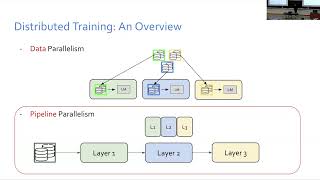
Efficient Language Models - Tutorial
Explore efficient language model techniques with JHU researcher Tianjian Li, covering optimization strategies and cutting-edge approaches for improved NLP performance.
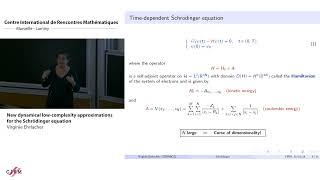
New Dynamical Low-Complexity Approximations for the Schrödinger Equation
Delve into advanced mathematical analysis of time-dependent Schrödinger equations, exploring new variational formulations and low-rank approximations for many-body electronic systems.