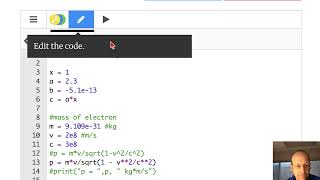
How to Use Python as Your Calculator in Physics Class
Harness Python's power as a versatile calculator for physics calculations, mastering vector operations and streamlining problem-solving.
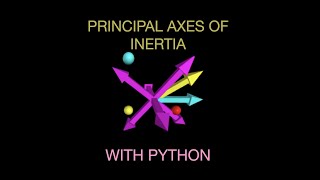
Finding the Principal Axes of Inertia With Python
Learn to calculate principal axes of inertia for mass systems using Python, applying numerical methods to solve complex physics problems efficiently.
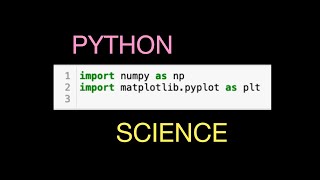
Physics Python Warm Up Questions Using Numpy
Master Python for physics: import libraries, create arrays, plot data, manipulate matrices, calculate eigenvalues, and handle complex data structures.
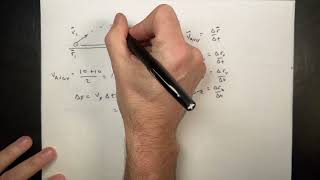
Projectile Motion With Vectors and Python
Explore projectile motion using vectors and Python, solving for flight time, distance, and maximum height of a launched ball.
Angular Momentum and Moment of Inertia Tensor for 3 Masses - Python Tutorial
Calculate center of mass, moment of inertia tensor, and angular velocity vector for three masses using Python. Includes code implementation and mathematical concepts.
Angular Momentum in Physics - Lecture Chapter 11
Explore angular momentum principles, torque, cross products, and related concepts in physics through clear explanations and examples.
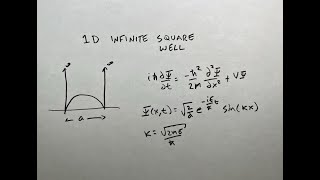
Solution for the 1D Infinite Square Well in Quantum Mechanics
Solve the Schrödinger equation for a one-dimensional infinite square well, exploring quantum mechanics fundamentals and wave function behavior.
Solving Schrödinger's Equation as an Eigenvalue Problem with Numpy
Explore numerical solutions to the 1D infinite square well using Python's NumPy library and the finite difference method for Schrödinger's equation.
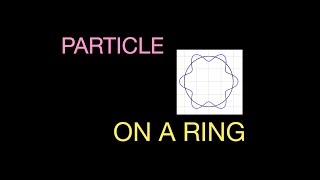
Quantum Mechanics: Wave Function for a Particle on a Ring
Explore wave functions for particles confined to rings, including normalized solutions and Python plotting code.
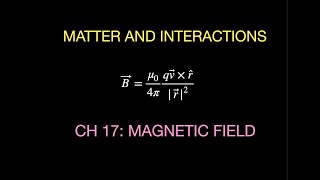
Matter and Interactions: Magnetic Field - Chapter 17 Summary
Explore magnetic fields, currents, and dipoles through interactive demos and key concepts in electromagnetism.
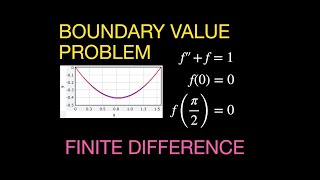
Solving a Boundary Value Problem with the Finite Difference Method - Python
Implement finite difference method in Python to solve boundary value problems for differential equations. Learn practical numerical techniques.
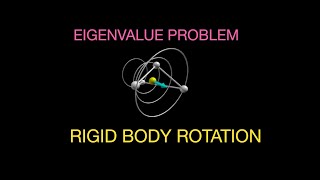
The Eigenvalue Problem: An Example with Rigid Body Rotations and Python
Explore rigid body rotations using Python, solving the eigenvalue problem to find principal axes and animating results with Web VPython.

Parallel Algebraic Multigrid in Julia with PartitionedArrays.jl - JuliaCon 2024
Explore parallel algebraic multigrid methods in Julia using PartitionedArrays.jl. Learn about recent updates, implementation strategies, and advantages over traditional MPI-based approaches for large-scale linear solvers.
Composite Rotation Matrix and Relative Orientations
Explore composite rotation matrices and relative orientations in aerospace engineering, enhancing understanding of aircraft dynamics and control systems.

Jack Dongarra's Perspective on the Exascale Computing Project
Explore computing pioneer Jack Dongarra's insights on the Exascale Computing Project's progress, achievements, and future impact on scientific research and high-performance computing.
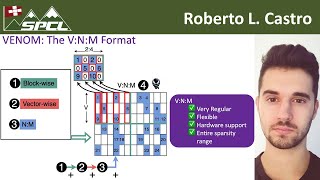
VENOM: A Vectorized N:M Format for Unleashing the Power of Sparse Tensor Cores
Explore VENOM, a vectorized N:M format for sparse tensor cores. Learn about high-performance sparse libraries and second-order pruning techniques for efficient deep learning model sparsification.
Julia Community Reshapes Computation in Geosciences
Explore Julia's impact on geosciences: ecosystem tools, hardware acceleration, and collaborative initiatives revolutionizing Earth observation and software development in the field.
Measuring and Deleting One Qubit of Several - Quantum Computer Programming - Lesson 68
Explore the mathematical principles behind measuring or deleting a single qubit in multi-qubit quantum states, enhancing your understanding of quantum systems.
Planes of Rotation for IncrL - Quantum Computer Programming - Lesson 88
Explore the decomposition of space into 2D planes for incrementing numbers modulo L in quantum computing, examining rotation angles and their significance.
Verifying the First Steering Wheel Vector Properties - Quantum Computer Programming - Lesson 90
Verifying properties of a steering wheel vector in 2D rotation planes for IncrL, part of a quantum computing programming series.
IncrL's Rotation Planes: Perpendicular - Quantum Computer Programming - Lesson 93
Explore perpendicular rotation planes for Increment-mod-L operation in quantum computing, completing a crucial concept in the series.