The Shape of Music - Mathematical Order in Western Tonality
Exploring the mathematical structure of Western music, revealing hidden geometries and patterns that connect diverse musical styles from Bach to The Beatles, and their relation to complex systems science.
Thoughts on Rational Inference - Is Information Theoretic Inference Rational?
Exploring rational inference approaches for incomplete information in complex sciences. Discusses defining and implementing rational methods, handling misspecifications, and addressing model uncertainty and robustness.
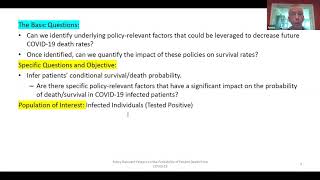
Effect of Universal TB Vaccination and Other Factors on Probability of Patient Death from COVID-19
Explore how universal TB vaccination, air pollution, and health expenditure impact COVID-19 survival rates across countries, with quantified probability changes by age and sex using information-theoretic methods.
Combining Historical and Philosophical Approaches to Understand the Concept of Information in Animal Behavior
Exploring how biologists use "information" in animal studies, examining experimental practices, historical context, and debates to clarify its meaning and implications for comparing animal and machine behavior.
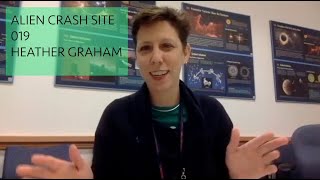
Detecting Agnostic Biosignatures in Space Exploration - Interview with Heather Graham
Exploring agnostic biosignatures and life detection methods with NASA researcher Heather Graham, discussing challenges in recognizing extraterrestrial life and innovative approaches to astrobiology.
Semantic Information and the Physics of Meaning
Exploring the physics of meaning, this talk delves into semantic information, examining how systems process and organize information, and the fundamental constraints on energy required for information processing.
Introducing Alien Crash Site - A New SFI Podcast
Explore hypothetical alien technologies with scientists, artists, and athletes in this intriguing podcast inspired by sci-fi. Guests discuss potential discoveries and their implications for human knowledge and capabilities.
Calling Bullshit: The Art of Skepticism in a Data-Driven World
Learn to navigate the tidal wave of misinformation in our data-driven world. Discover techniques for skepticism, identifying fake news, and understanding the role of networks in spreading disinformation.
The Information Theory of Biology and Origins of Life - Sara Imari Walker Interview
Exploring information theory's role in understanding life's origins and nature. Discusses complex systems, the relationship between information and matter, and how this perspective reshapes our approach to defining and detecting life.
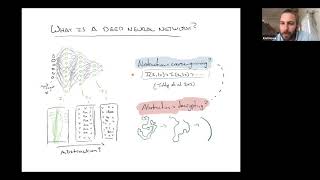
Swimming Without a Lifeguard in the Ocean of Ideas - Abstraction and Unsupervised Deep Learning
Explore unsupervised deep learning techniques for discovering hierarchical latent feature spaces, improving interpretability and performance in downstream tasks, and bridging neural and symbolic learning systems.
Complexity as Seen Through Modern Statistical Mechanics - New Perspectives
Explore nonextensive statistical mechanics and its applications in studying complex systems across various fields, with insights from Constantino Tsallis on recent developments and q-triplets.
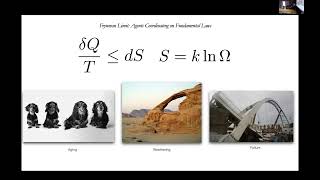
Feynman, Shannon, and Darwin Worry About Understanding
Explore how Feynman, Shannon, and Darwin's ideas intersect in the pursuit of understanding complex systems and scientific knowledge.
Complex Conceptions of Time - Exploring Scientific and Literary Perspectives
Exploring time through physics, philosophy, and science fiction. Experts discuss metaphors, mathematical concepts, and narrative approaches to understanding time, challenging conventional perceptions and exploring its complexities.
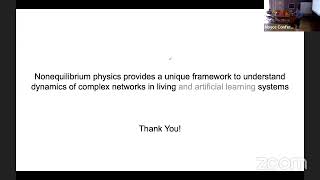
Nonequilibrium Physics in Living Systems
Explore the fascinating intersection of physics and biology, uncovering how nonequilibrium principles shape living systems and their complex behaviors.
The Thermodynamics of Communication - Exploring Energy and Information Limits
Exploring the fundamental relationship between energy, information, and matter in communication processes. Discusses nonlinear dynamics of communication channels and their implications for collective intelligence and limits to human knowledge.
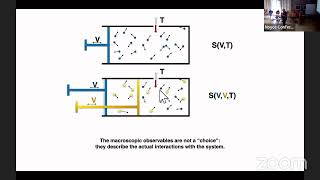
What Makes the Past Different from the Future?
Explore the fundamental differences between past and future, examining scientific concepts and philosophical implications in this thought-provoking lecture on time's arrow.
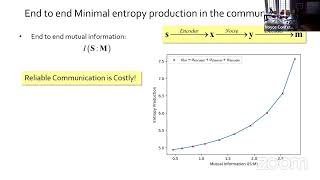
Minimal End-to-end Thermodynamic Costs of Communication Channels
Explore the thermodynamic costs of communication channels, examining minimal end-to-end requirements and their implications for information transfer efficiency.
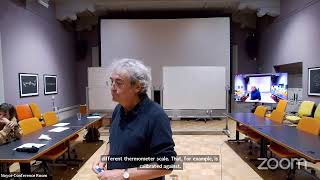
Death and Resurrection of the Zeroth Principle
Explore the intriguing concept of the Zeroth Principle, its demise, and potential revival in this thought-provoking lecture from the Santa Fe Institute.
Thermodynamics - Classical to Statistical
Comprehensive exploration of thermodynamics, from classical concepts to statistical mechanics, covering fundamental principles, applications, and advanced problem-solving techniques.
Phase Equilibrium Thermodynamics
Explore thermodynamic principles, phase equilibria, and solution behavior. Learn about laws, entropy, Gibbs energy, P-v-T relationships, chemical potential, fugacity, and ideal/non-ideal solutions.
Introduction to Statistical Mechanics
This is an introductory course in classical and quantum statistical mechanics which deals with the principle of ensembles, Classical, Fermi and Bose ideal gases, Pauli paramagnestim, Debye and Einstein’s theory of specific heat and the 1D Ising model.