WEAVE: Building Complex HPC Workflows - Tutorials 2024
Explore WEAVE's integrated tools for building complex HPC workflows, enhancing productivity and scientific quality through common infrastructure and tool integration.
Ascent: In Situ Visualization and Analysis for HPC Simulations - Tutorial 2024
Learn to use Ascent, an open-source in situ visualization and analysis tool for HPC simulations. Explore its capabilities for multi-physics applications on many-core architectures.
Small but Mighty: Subset Selection and Knowledge Distillation
Explore cost-efficient AI training methods, focusing on subset selection and knowledge distillation techniques to address challenges in large language model development.
Distributed Training for Efficient Machine Learning - Part I - Lecture 17
Explore distributed training techniques for machine learning, focusing on data and model parallelism strategies to enhance efficiency and scalability.
Distributed Training - Part I - Lecture 17
Explore distributed training techniques for efficient machine learning, covering key concepts and strategies for scaling ML models across multiple devices.
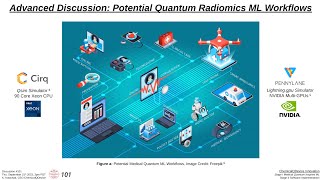
Advanced Discussion: Potential Quantum Radiomics ML Workflows
Explore quantum machine learning workflows for medical imaging, focusing on efficient state vector circuits, pure state representations, and exact expectation values. Discover recent advancements in large-scale quantum simulations.
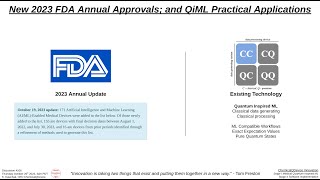
New 2023 FDA Annual Approvals and QiML Practical Applications
Explore FDA's 2023 AI/ML medical device approvals and quantum-inspired machine learning applications in healthcare, focusing on practical R&D potential for medical submissions.
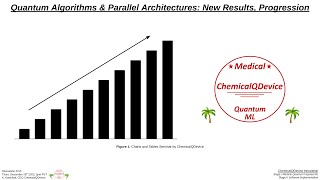
Quantum Algorithms and Parallel Architectures - New Results and Summary
Explore new findings in quantum algorithms and parallel architectures, comparing methods and machine learning parameters for advanced computational approaches.
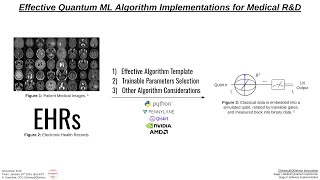
Effective Quantum ML Algorithm Implementations for Medical R&D
Explore quantum AI algorithms for medical R&D, focusing on embeddings, variational layers, and GPU implementations to enhance traditional approaches.
Vectorized Query Execution Using SIMD - Lecture 6
Explore vectorized query execution using SIMD in advanced database systems, focusing on performance optimization techniques and modern hardware utilization.
Introduction to CUDA Programming for Physicists - Lecture 3
Explore GPU architecture, memory operations, CUDA kernels, and reduction operations. Learn to accelerate critical code sections using GPUs for physics computations.
Introduction to CUDA Programming for Physicists - Lecture 2
Explore GPU architecture, memory operations, CUDA kernels, and reduction techniques for physicists. Learn to accelerate critical code sections using GPUs and leverage specialized libraries.
The Myth of AI Breakthroughs - Cutting Through Hype in Neural Network Research
Explore AI realities, efficient model training, and cutting-edge research with Jonathan Frankle. Gain insights on facial recognition, the lottery ticket hypothesis, and navigating AI hype.
Research Ops - Challenges and Practical Solutions for Distributed Scientific Computing
Explore challenges and practical solutions for distributed scientific computing in research operations, focusing on advanced cyberinfrastructure.
Exascale Computing: From Shared Memory to GPU Architecture
Explore exascale computing, HPC architectures, and GPU programming with Dr. Meifeng Lin from Brookhaven National Laboratory.
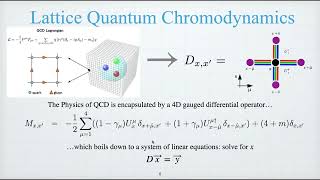
GPU Computing and Krylov Solvers
Explore GPU computing and Krylov solvers for advanced numerical computations, enhancing problem-solving skills in high-performance computing environments.
Template Task Graphs: An Introduction to Parallel Programming for Irregular Data Sets
Explore the Template Task Graph programming paradigm for expressing task parallelism in algorithms with irregular data sets. Learn installation and integration techniques.
Investing in Code Reviews for Better Research Software
Explore code review benefits for scientific software: improved quality, teamwork, and knowledge transfer. Learn approaches to facilitate effective reviews.
Lab Notebooks for Computational Mathematics, Sciences and Engineering
Explore lab notebooks' adaptation to computational research, with examples addressing challenges in transitioning from experimental to computational sciences.
Our Road to Exascale: Particle Accelerator and Laser-Plasma Modeling
Explore the journey to exascale computing in particle accelerator and laser-plasma modeling, featuring WarpX's development and the 2022 ACM Gordon Bell Prize.
Facilitating Electronic Structure Computations on GPU-based Exascale Platforms
Explore GPU-based electronic structure computations for exascale platforms using PROGRESS and BML libraries. Learn implementation strategies, performance optimization, and scaling techniques.