Building Your Own ChatGPT-style LLM AI Infrastructure with Kubernetes
Explore building AI infrastructure with Kubernetes, covering open-source LLMs, data engineering, and cost optimization. Gain insights on deployment, scalability, and choosing the right tools for AI-enabled applications.
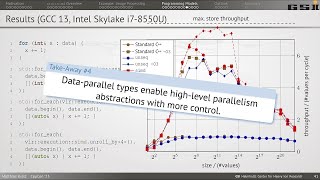
std::simd - Expressing Inherent Parallelism Efficiently Via Data-parallel Types
Explore efficient data-parallelism using std::simd in C++26, learning to optimize compute-intensive workloads and design data structures for high-throughput execution.
Parallelism Safety-Critical Guidelines for C++
Explore parallelism safety guidelines for C++, covering challenges in multicore architectures and potential issues with newer features. Gain insights into future rules for safety-critical software development.
Implementing Understandable World Class Hash Tables in C++ - CppCon 2022
Explore world-class hash table implementation in C++, focusing on Robin Hood hashing, parallel computation, and SIMD operations. Learn to optimize performance while maintaining code clarity and understandability.
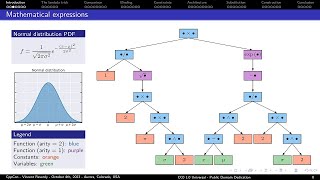
Symbolic Calculus for High-performance Computing From Scratch Using C++23
Explore symbolic calculus implementation in C++23 for high-performance computing. Learn techniques for compile-time derivatives, integrals, and optimized linear algebra computations.
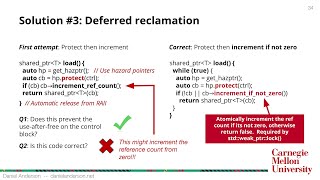
Lock-free Atomic Shared Pointers Without a Split Reference Count - Implementation Strategies
Explore lock-free atomic shared pointers implementation without split reference count. Learn an elegant solution using hazard pointers for improved performance in concurrent C++ programming.
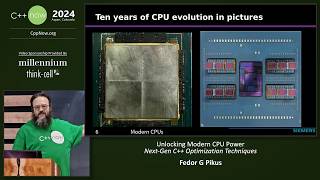
Unlocking Modern CPU Power - Next-Gen C++ Optimization Techniques
Explore cutting-edge C++ optimization techniques for modern CPUs, covering architecture changes, benchmarking challenges, and practical strategies to enhance code performance on latest processors.
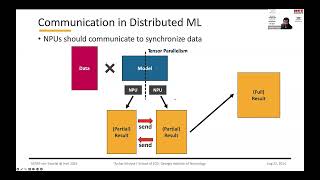
ASTRA-sim and Chakra - Co-design Exploration for Distributed Machine Learning Platforms
Explore co-design methodologies for distributed ML platforms using ASTRA-sim and Chakra frameworks, focusing on system optimization and performance analysis.
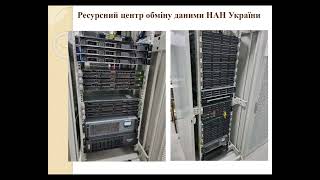
Ресурсний центр для грід- та хмарних технологій
Дізнайтеся про сучасні грід- та хмарні технології, їх застосування в науковій роботі та особливості функціонування ресурсного центру обміну даними в ІТФ НАН України.
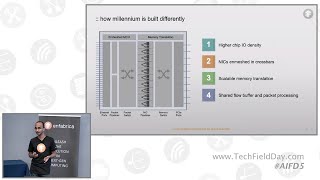
Solving I/O Scaling Challenges in Accelerated Compute with Networking Silicon
Discover how Enfabrica's Accelerated Compute Fabric revolutionizes I/O scaling in compute clusters through innovative networking silicon integration, optimizing data movement and enhancing GPU communication efficiency.
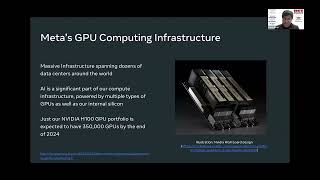
Powering Llama 3 - A Peek into Meta's Massive Infrastructure for Generative AI
Dive into Meta's advanced infrastructure powering Llama 3, exploring the technological backbone and innovative systems behind their next-generation generative AI development.

Tensor Query Processing - Accelerating Database Analytics with AI Hardware
Discover how Microsoft's framework compiles SQL to tensor abstractions, enabling efficient database analytics on GPUs and exploring the fusion of SQL with machine learning capabilities.

Temporality and Thingness - Towards Manyworlding Futures in Anthropology
Explore how algorithmic environments and technological infrastructures reshape human perception of time, space, and reality through ethnographic research at CERN and other scientific institutions.
Pre-training Mixtral MoE Model with SageMaker HyperPod - Fine-Tuning and Continued Pre-Training
Master advanced techniques for pre-training and fine-tuning Mixtral MoE models using AWS SageMaker HyperPod and SLURM, covering implementation strategies and continued pre-training approaches.

Принципи роботи HPC на прикладі комп'ютерного кластеру
Дізнайтеся про принципи роботи високопродуктивних обчислень (HPC) на реальному прикладі комп'ютерного кластера, його архітектуру та практичне застосування.
Foundation of GPU Programming
Explore GPU architecture, performance sources, and programming models. Gain insights into SIMD processing, DRAM parallelism, and software/memory hierarchies for confident GPU utilization.
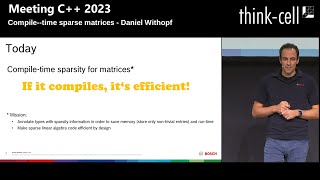
Compile-Time Sparse Matrices - Optimizing Memory and Performance
Explore compile-time sparse matrices for efficient memory use and performance in C++ linear algebra. Learn to incorporate sparseness information, reduce storage, and optimize operations automatically.
RADIUSS and HPCIC: Outreach Through Open-Source Software in the Exascale Era
Explore LLNL's open-source HPC software portfolio and learn about collaboration opportunities in the exascale era. Gain insights into innovative tools addressing emerging challenges in high-performance computing.
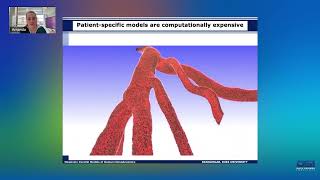
Using Data Science to Advance the Impact of Vascular Digital Twins in Medicine
Explore high-resolution digital twins of vascular anatomy to inform disease treatment. Learn how data science and physics-based modeling combine to address personalized medicine challenges.
Caliper, Hatchet, and Thicket: Open-Source Tools for HPC Performance Analysis
Explore open-source tools for integrating performance profiling, analyzing hierarchical data, and optimizing application performance on supercomputers. Learn to leverage Caliper, Hatchet, and Thicket for HPC environments.
BLT (Build, Link, Test) Tutorial for HPC Software Development - 2024
Explore BLT, a CMake-based foundation for HPC applications. Learn to build, link, and test across various compilers, operating systems, and technologies for streamlined development.