LLVM in HPC: Enabling Performance Portability, Interoperability, and Novel Features - Part 2
Explore recent LLVM efforts for HPC: portable CUDA, debugging at scale, GPU execution of legacy codes, automatic differentiation, ML in compilers, and static information impact.
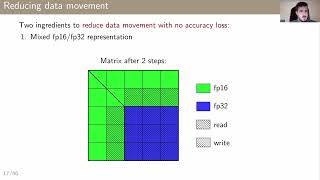
Mixed-Precision Computing: An Overview
Explore mixed-precision computing techniques for high performance and accuracy. Learn about refinement, modularity, and adaptivity in algorithms combining multiple precisions.
Processing Very Large Image Volumes with the Adaptive Particle Representation
Explore advanced techniques for processing massive image datasets using adaptive particle representation, enabling efficient visualization and analysis of terabyte-scale biomedical data.
Bridging Domain Science and HPC with Julia
Explore Julia's potential in HPC, combining scientific ecosystem with high performance. Gain insights on its strengths, limitations, and notable international projects from an experienced user.
Quantum Computing at the DLR Institute of Software Technology - Algorithms and Applications
Explore quantum computing activities at DLR, covering low-level algorithms, optimization, quantum simulation, and hybrid computing across the entire software stack from hardware to applications.
Mixing Precisions in Numerical Algorithms - HPC Perspective with Modern Hardware Context
Explore mixed precision algorithms in HPC, focusing on convergence properties and performance considerations for modern hardware implementations of floating-point arithmetic.
Rapidly Deploying and Delivering a Sustainable National Exascale AI Research Resource - Isambard-AI Case Study
Explore the rapid deployment and sustainability of Isambard-AI, a national Exascale AI research resource in the UK, including its architecture, applications, and impact on AI research.
Gotta Go Fast: How We Started the Ubuntu High-Performance Computing Team
Explore the formation of Ubuntu's HPC community team, their collaborative efforts in developing Charmed HPC, and strategies for addressing challenges in open-source HPC ecosystem engagement.
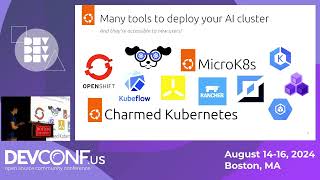
Charmed HPC: Your Own Personal Supercomputer Within 15 Minutes
Deploy a personal supercomputer in 15 minutes using Charmed HPC, an open-source infrastructure stack for cloud and on-premises. Explore integrated services, automated lifecycle events, and multi-cloud deployment options.
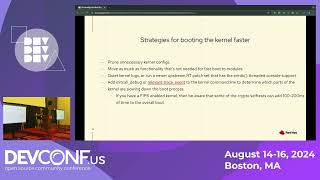
Accelerating Linux Boot Time: Techniques and Strategies for Optimal Performance - Lecture
Explore strategies to accelerate Linux boot time, from measuring performance to optimizing systemd, kernel, and filesystem configurations. Gain comprehensive understanding of achieving faster boot times.

Coroutine Intuition in C++ - Lecture
Gain intuition on coroutines in C++20. Explore stackless asyncrony, generators, and senders/receivers through concise examples to improve code readability, maintainability, and composability.
Understanding Allocator Impact on Runtime Performance in C++
Explore challenges in analyzing local memory allocators' performance impact on C++ runtime. Learn to choose tools, overcome instrumentation limitations, and design effective visualizations.
MDSPAN - A Deep Dive Spanning C++, Kokkos and SYCL - Lecture 2022
Explore MDSPAN's evolution, C++ standardization, and future in SYCL. Gain insights into multidimensional array references and their impact on distributed and high-performance computing.
Fast C++ Using SIMD Types with Generic Lambdas and Filters - Lecture
Optimize C++ performance using SIMD types, generic lambdas, and filters. Learn to generate high-performance code competitive with standard libraries, exploring vectorization techniques and branching strategies.
Architecting Multithreaded Robotics Applications in C++ - CppCon 2022
Explore multithreaded robotics application architecture in C++. Learn to design, implement, and evaluate solutions for efficient parallel execution in robotics engineering.
Thinking Functionally in C++ - Applying Functional Programming Concepts
Explore functional programming techniques in C++, enhancing code performance, reusability, and security. Learn to apply functional thinking to existing codebases using views, lambdas, and ranges.
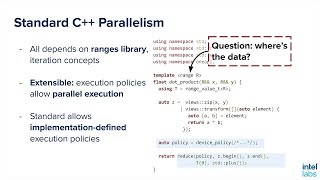
Distributed Ranges: A Model for Building Distributed Data Structures, Algorithms, and Views
Explore distributed ranges for building scalable data structures and algorithms across clusters. Learn to implement generic, interoperable distributed computing solutions using modern C++ features.
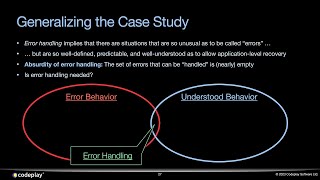
The Absurdity of Error Handling: Finding a Purpose for Errors in Safety-Critical SYCL
Explore error handling challenges in safety-critical SYCL, examining the concept of safety and rethinking error scenarios in C++ software development for critical systems.
Optimizing Code on Arm: VectorCamp's Approach to SVE and SVE2 Intrinsics
Explore VectorCamp's optimization techniques for SVE and SVE2 intrinsics, enhancing code performance on Arm architecture.

Hardware and its Concurrency Habits - Kernel Recipes 2023
Explore hardware structure, physics limitations, and synchronization mechanisms in modern computer systems for improved concurrent software design.

Very Few Parameter Fine-Tuning with ReFT and LoRA
Explore advanced fine-tuning techniques ReFT and LoRA for efficient parameter optimization in transformer models. Learn implementation, comparison, and practical tips for improved model performance.