Exascale Computing Project Applications: Lessons Learned
Explore key insights and lessons learned from Exascale Computing Project applications development with Erik Draeger, deputy director of Application Development.
Exascale Computing Project's Software Technology Accomplishments and Futures - Lecture
Explore Exascale Computing Project's software technology achievements and future directions with Mike Heroux, senior scientist at Sandia National Laboratories.
Legion: Programming Heterogeneous, Distributed Parallel Machines
Explore hierarchical data organization and computation in parallel programming, focusing on Legion's design for complex machine architectures.
The Exascale Computing Era - Reflections on Progress and Challenges
Explore the dawn of exascale computing, focusing on the Frontier system, its applications, and the challenges overcome in developing exascale-capable software and technologies.
Trillion Parameter Foundation Models as Discovery Accelerators - Lecture 10
Explore how advanced AI and foundation models can accelerate scientific discovery, revolutionizing research infrastructure and collaboration.
Programming Novel AI Accelerators for Scientific Computing - Part 2 - Tutorial 5
Explore advanced techniques for programming AI accelerators in scientific computing, focusing on optimization and performance enhancement.
LLMs on Polaris - Tutorial 5
Explore large language model deployment on Polaris supercomputer, focusing on efficient scaling and performance optimization techniques.
SambaNova DataScale SN30 and Platform Architecture - Tutorial 5
Explore SambaNova DataScale SN30 architecture and platform features for advanced AI computing solutions.
Programming Novel AI Accelerators for Scientific Computing - Part 1 - Tutorial 5
Explore programming techniques for AI accelerators in scientific computing, focusing on novel approaches and optimization strategies.
Cerebras Systems - Tutorial 5
Explore cutting-edge AI hardware with Cerebras Systems, focusing on their innovative wafer-scale engine for accelerated deep learning and high-performance computing.
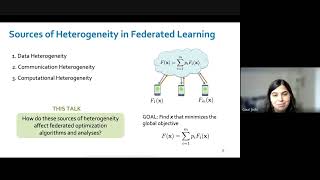
Heterogeneity-Aware Algorithms for Federated Optimization
Explore heterogeneity-aware algorithms for federated optimization, addressing data, communication, and computational challenges in distributed learning environments.
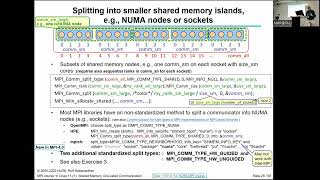
New Features in MPI 4.0
Explore new features in MPI 4.0, including large-count routines, persistent collectives, and the Sessions Model. Learn about hardware-based communicator splitting and improvements in error handling.
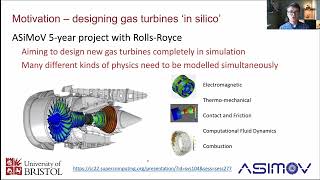
Enabling Next-Generation Processor Simulations with SimEng - NHR PerfLab Seminar
Explore next-gen processor simulations with SimEng. Learn about cycle-level modeling, microarchitecture research, and design space exploration for advanced CPUs and GPUs.
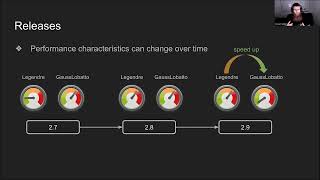
Configuration-Aware Performance Analysis for High-Performance Computing Frameworks
Explore configuration-aware performance analysis for HPC frameworks, focusing on feature selection impact and identifying performance regressions across software releases.
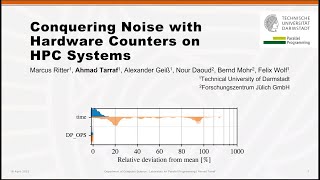
Conquering Noise with Hardware Counters on HPC Systems
Explore hardware counter noise resilience in HPC systems. Learn to select appropriate counters for accurate performance modeling and scaling behavior analysis.
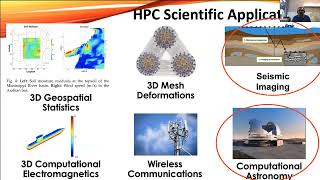
The Comedy Club of High-Performance Computing: Low-Rank Matrix Approximation Takes the Stage
Explore high-performance computing implementation of Tile Low-Rank Matrix-Vector Multiplication, its applications in seismic processing and astronomy, and performance advantages over dense implementations.
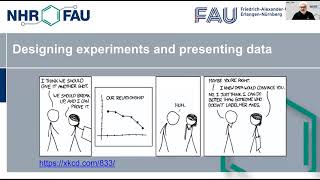
Experiments and Data Presentation in High Performance Computing
Learn effective techniques for conducting experiments and presenting data in high performance computing. Master key aspects of scientific benchmarking, statistical analysis, and data visualization for HPC research.
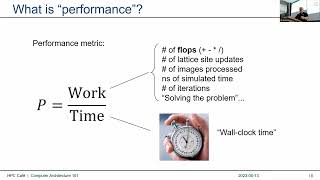
Computer Architecture 101 for Scientists and Its Impact on Cluster Jobs
Explore core concepts of parallel computer architecture and their impact on cluster job performance. Gain insights to optimize resource allocation and improve efficiency in supercomputing tasks.
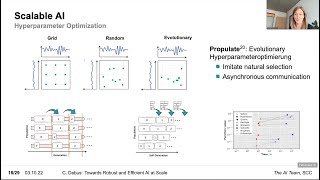
Towards Robust and Efficient AI at Scale
Explore robust, efficient AI for scientific time series forecasting. Learn scalable transformer architectures, energy optimization, and balancing performance with sustainability in large-scale AI applications.
DGEMM on Integer Tensor Cores - NHR Perflab Seminar
Explore double-precision matrix multiplication using Int8 Tensor Cores and the Ozaki scheme, focusing on high-precision computation with lower-precision hardware for machine learning applications.
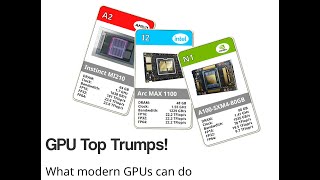
GPU Top Trumps - Comparing HPC Graphics Processing Units
Explore the capabilities and differences of various HPC GPUs, comparing NVIDIA models, examining competitors, and understanding new developments like APUs.