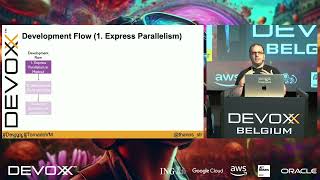
TornadoVM - Write Once, Run Everywhere Everywhere
Explore TornadoVM's capabilities for accelerating Java applications on heterogeneous hardware, enabling efficient execution across diverse computing platforms.
Incredible Things You Can Do with Micronaut & GraalVM
Explore innovative applications of Micronaut and GraalVM technologies, showcasing their powerful capabilities and potential for enhancing software development and performance.
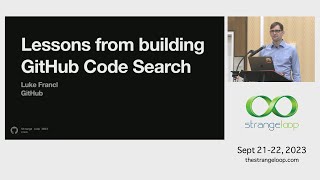
Lessons from Building GitHub Code Search
Insights into building GitHub's high-performance code search engine, covering strategies like deduplication, repository similarity, and load balancing to handle massive scale and improve developer productivity.
MELF - Multivariant Executables for a Heterogeneous World
Explore MELF: a novel approach for including multiple function variants in a single binary, enabling runtime switching for optimized performance across heterogeneous systems.
Towards Iterative Relational Algebra on the GPU
Explores GPU-based iterative relational algebra for high-performance data analytics, presenting a novel hash-join implementation with optimizations for memory access and deduplication, outperforming existing solutions.
MSRL - Distributed Reinforcement Learning with Dataflow Fragments
Explores MSRL, a distributed reinforcement learning system using fragmented dataflow graphs for flexible execution on GPU clusters, offering improved performance and adaptability.
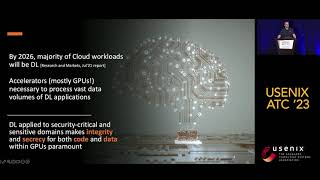
SAGE - Software-based Attestation for GPU Execution
Explore SAGE, a software-based attestation mechanism for secure GPU execution, offering code integrity, computation integrity, and data protection without hardware support.
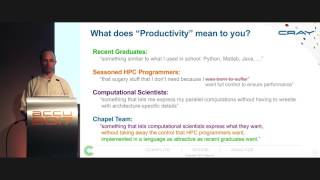
The Audacity of Chapel - Scalable Parallel Programming Done Right
Explore scalable parallel programming with Chapel, a language designed for productivity and portability. Learn its motivating themes, key features, and challenges in modern parallel computing.
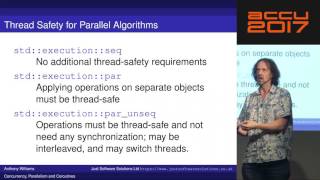
Concurrency, Parallelism and Coroutines
Explore C++17's parallel algorithms, concurrency, and coroutines. Learn how these features interrelate and can be leveraged for efficient, parallel programming in modern C++ applications.
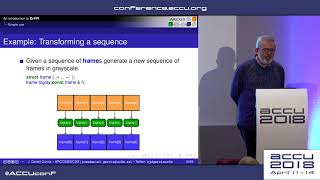
Parallel Design Patterns and Stream Parallelism
Explore parallel design patterns and stream parallelism using GrPPI, an experimental library for expressing parallelism through patterns, with focus on composability and multiple back-end support.
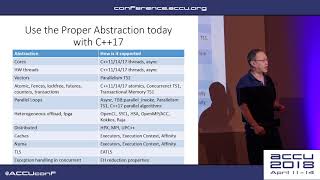
Heterogeneous Programming in C++ Today
Explore the evolving landscape of heterogeneous parallelism in C++, including standards, specifications, and future applications in IoT, self-driving cars, and machine learning.
Best Practices When Accessing Big Data or Any Other Data
Explore best practices for efficient data access on local and shared file systems, backed by real-world examples. Learn to improve performance, reliability, scalability, and portability in data-intensive applications.

The Cell as a Computer - Turing Complete and Massively Parallel
Explore biological computing: cells as Turing-complete devices, biocomputers, and parallels between cellular processes and computer components. Gain insights into nature's 4-billion-year-old computing paradigm.
C++ and Linear Algebra
Explore the proposal for adding linear algebra support to C++'s standard library, discussing its importance, requirements, and potential applications in geometry and color manipulation.

A Tour of Julia
Explore Julia's high-performance capabilities, JIT compilation, and unique features like meta-programming and multiple dispatch. Learn how it combines Python-like productivity with C/C++-level performance.
Embracing the Noexcept Operator and Specifier Safely
Explore the noexcept operator and specifier in C++, their benefits for high-performance computing, potential pitfalls, and proposed improvements for C++23 with expert John Lakos.
The Genius of RISC-V Microprocessors
Explore RISC-V's revolutionary design, its advantages over x86 and ARM, and its impact on embedded systems, high-performance computing, and machine learning hardware.
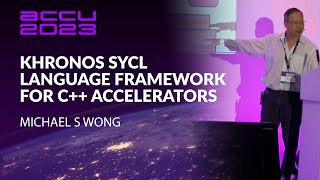
Khronos Sycl Language Framework for C++ Accelerators - Take Advantage of All the MIPS
Explore SYCL, a C++ framework for heterogeneous computing, enabling efficient use of various accelerators. Learn its features, applications, and advantages for high-performance computing and AI/ML development.
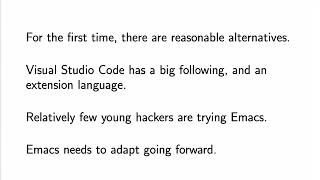
Emacs - The Editor for the Next Forty Years
Exploring Emacs' future: modernizing with Rust, enhancing HTML rendering, integrating developer tools, and expanding functionality while preserving its essence as a powerful, extensible editor.
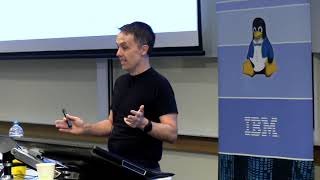
Climbing the Summit with Open Source and POWER9
Explore the journey of building Summit, the world's fastest supercomputer, using POWER9 and open source. Learn about architectural innovations, challenges, and collaborative efforts in creating this groundbreaking system.

But Mummy I Don't Want to Use CUDA - Open Source GPU Compute
Explore alternatives to CUDA for GPU computing, focusing on open-source options like OpenCL, SPIR-V, and SYCL. Discuss challenges and potential solutions for a vendor-neutral Linux compute stack.