
Quarkus - The Supersonic and Subatomic Java
Discover Quarkus: a revolutionary Java framework for ultra-fast, lightweight web applications. Learn techniques for optimizing performance, reducing resource usage, and enhancing developer experience with familiar technologies.
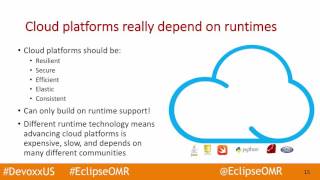
Eclipse OMR - A Modern, Open-Source Toolkit for Building Language Runtimes
Explore Eclipse OMR, an open-source toolkit for building high-performance language runtimes. Learn about its components, applications, and how to leverage this technology in your projects.
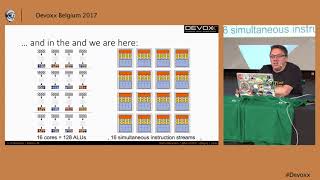
Java on the GPU - Where Are We Now?
Explore GPU utilization in Java, covering OpenGL, CUDA, and OpenCL for massive computations. Learn advantages and drawbacks of GPU computing in desktop and cloud environments.
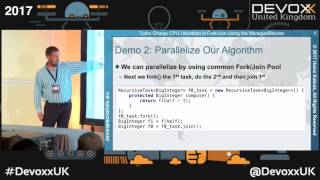
Turbo Charge CPU Utilization in Fork - Join Using the ManagedBlocker
Optimize Fork/Join CPU usage with ManagedBlocker: Learn to implement reserved caching, reduce wasted cycles, and maintain parallelism in recursive decomposition algorithms.
Mnemosyne - A Distributed Bitmapped Indexing Layer for Big Data
Explore building a distributed indexing layer for big data, covering design principles, data ingestion, storage, modeling, and in-memory computing techniques for scalable, real-time querying.
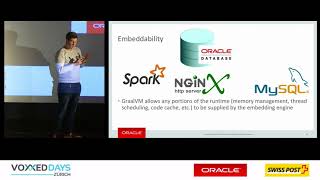
Graal - High-Performance Polyglot Runtime
Explore Graal, a high-performance polyglot runtime that enables seamless language interoperability and world-class performance for Java, JavaScript, Ruby, R, and more, with integrated compilation and execution infrastructure.
Solving Hard Problems with Quantum & High-Performance Computing in The Cloud
Explore quantum computing's integration with high-performance computing in the cloud, its applications in chemistry, logistics, and finance, and learn about Kvantify's approach to solving complex industry problems.

Java and GPU - Are We Nearly There Yet?
Explore recent and proposed JDK features enabling Java-GPU collaboration, offering insights into the future of GPGPU in Java development.
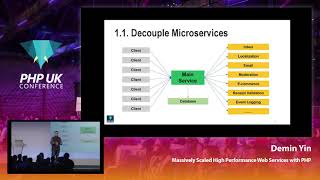
Massively Scaled High Performance Web Services with PHP
Discover how PHP powers high-performance web services for a top mobile game, handling massive user loads and requests. Learn strategies for scalability, development, testing, and deployment in large-scale applications.
Web Assembly
Exploring Web Assembly's potential to revolutionize web development by enabling high-performance native code execution in browsers, enhancing security and portability.

Mutation Testing in Python
Explore mutation testing in Python to validate test suites, detect unnecessary code, and improve coverage analysis. Learn about algorithms, mutations, and tools like Cosmic Ray for enhancing software quality.
Solving Classical Data Analytic Task by Using Modern Distributed Databases
Explore modern distributed databases for efficient data analytics, overcoming NoSQL limitations and Hadoop performance issues. Learn about fast parallel query engines and their applications.
Array Thinking Escaping The Groove
Explore array programming concepts from APL and J languages to enhance parallelization and improve coding efficiency. Learn alternative approaches to traditional loops and branching.

Component Programming in the D Programming Language
Explore component programming in D, focusing on creating reusable, robust software components. Learn techniques for building modular, high-performance code with easy customization and optimization.

Responding in a Timely Manner
Explore design patterns and algorithms for building responsive systems that meet predictable response time guarantees, regardless of load or dataset size, even during burst traffic and partial failures.
Mythbusting Modern Hardware to Gain Mechanical Sympathy
Demystifying modern hardware components for developers to optimize software performance, covering CPUs, memory, networking, and storage I/O.
Liquid Metal - Taming Heterogeneity
Explore IBM's Liquid Metal project for heterogeneous computing, unifying parallel programming paradigms and simplifying development for multicores, GPUs, and FPGAs.
Designing for Performance
Explore high-performance software design principles, focusing on achieving optimal system performance through effective architecture, algorithms, and implementation strategies.

Low Latency Java in the Real World - LMAX Exchange & the Zing JVM
Explore low latency Java techniques used by LMAX Exchange with Azul's Zing JVM. Learn about high-performance strategies for real-world financial trading systems.

How Go is Making Us Faster
Explore how Go programming language enhances web performance, enabling real-time auctions and ad serving at 2.3 million queries per second. Learn about Go's features, tools, and benefits for high-performance systems.
Engineering You
Explore characteristics of effective software engineers, challenges in the field, and strategies for improvement. Insights on programming paradigms, experimentation, and the importance of reducing code complexity.