Circles and Spheres via Dot Products II - Wild Linear Algebra A
Explore 3D Euclidean dot products, quadrance, linear functionals, and spheres. Learn about projections, Pythagoras' theorem, and perpendicularity in three-dimensional space.
Dot Products, Pythagoras' Theorem, and Generalizations - Wild Linear Algebra A - NJ Wildberger
Algebraic approach to metrical geometry using dot products and quadrance. Introduces symmetric bilinear forms for understanding relativistic geometry, with applications to linear algebra and physics.
Geometry with Linear Algebra - Wild Linear Algebra A - NJ Wildberger
Explore the connection between linear algebra and geometry, focusing on Pythagoras' theorem and perpendicularity. Learn how linear algebra provides a solid framework for understanding Euclidean and other geometries.
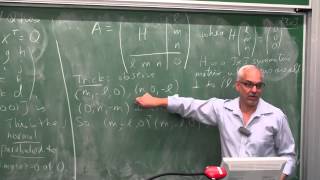
Curvature for the General Paraboloid - Differential Geometry - NJ Wildberger
Novel approach to surface curvature using projective geometry and linear algebra. Explores paraboloid curvature through characteristic polynomials, offering insights for higher-dimensional generalizations.
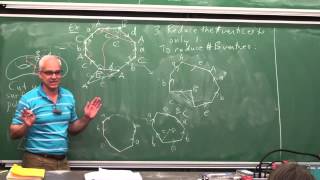
Classification of 2-Manifolds and Euler Characteristic - Differential Geometry
Explore the classification of compact, oriented 2-manifolds and their Euler characteristics through combinatorial methods, cut-and-paste operations, and topological invariants in differential geometry.
The Area of a Triangle and Archimedes' Formula - Famous Math Problems
Novel approach to calculating triangle area using rational trigonometry, avoiding unnecessary irrationalities in Heron's formula. Presents a clearer solution based on Pythagoras' theorem and Triple quad formula, with practical applications.
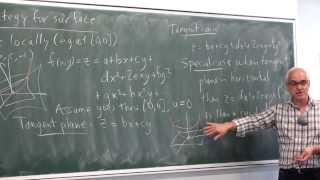
Paraboloids and Associated Quadratic Forms - Differential Geometry
Explore paraboloids and quadratic forms in differential geometry, covering diagonalization, eigenvalues, and Dupin's indicatrix. Learn key concepts for understanding surface curvature.
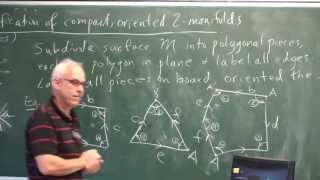
Manifolds, Classification of Surfaces and Euler Characteristic - Differential Geometry
Informal introduction to manifolds, focusing on 2D surfaces. Explores charts, orientation, and classification using Euler characteristic. Highlights key concepts in differential geometry.
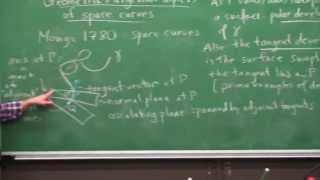
Geometric and Algebraic Aspects of Space Curves - Differential Geometry
Explore geometric and algebraic aspects of space curves, including tangent vectors, normal planes, curvature, torsion, and associated surfaces. Learn about Monge's contributions and invariant properties.
The Frenet Serret Equations - Differential Geometry
Explore the Frenet-Serret equations, describing space curves' behavior using vector-valued derivatives. Learn about tangent, normal, and bi-normal vectors, curvature, and torsion in 3D space.
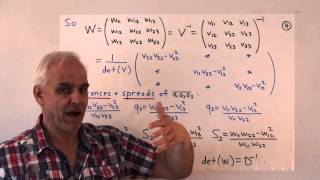
Trigonometry in Elliptic Geometry II - Universal Hyperbolic Geometry - NJ Wildberger
Explore elliptic trigonometry laws, including Spread, Cross, and Dual cross, using linear algebra. Learn proofs for Thales', Pythagoras', and Triple Quad formulas in elliptic geometry.
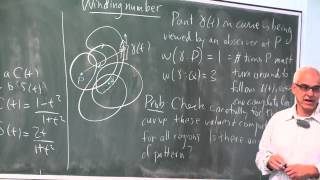
Curvature, Turning Numbers and Winding Numbers - Differential Geometry
Explores advanced concepts in planar curvature, including turning numbers, winding numbers, and parametric curves. Connects to complex analysis and circular motion, offering insights into differential geometry.
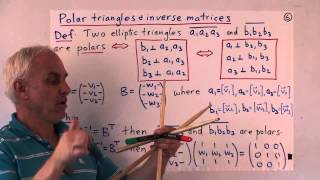
Trigonometry in Elliptic Geometry - Universal Hyperbolic Geometry
Explore elliptic geometry's trigonometry, including projective points, quadrances, and spreads. Learn key laws connecting triangles and their polar counterparts in this fundamental mathematical realm.
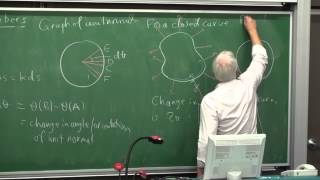
Curvature, Turning Numbers and Winding Numbers - Differential Geometry
Explore curvature, turning numbers, and winding numbers in planar curves. Learn about irrational numbers and transcendental functions from an applied perspective using rational turn angles.
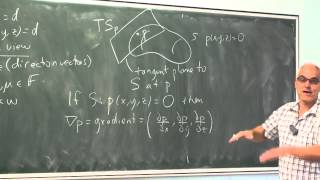
An Introduction to Surfaces - Differential Geometry
Explore surfaces in differential geometry, covering orientability, algebraic and parametric surfaces, and examples like quadrics and the Oloid. Gain insights into this fundamental area of mathematics.
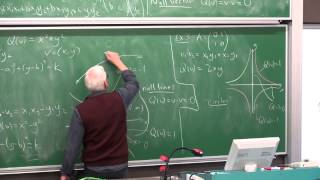
Metrical Structure and Curvature of a Parabola - Differential Geometry
Explore metrical structures and curvature in differential geometry, focusing on parabolas. Learn about symmetric bilinear forms, relativistic geometries, and their applications in physics.
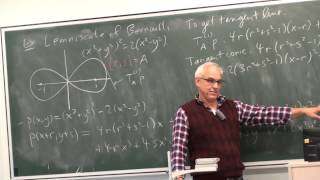
The Differential Calculus for Curves - Differential Geometry
Exploring advanced differential calculus for algebraic curves, including tangent lines, conics, and point classification. Extends to 3D surfaces, offering a comprehensive view of curve analysis.
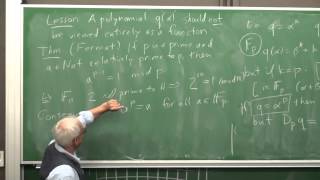
Differential Geometry With Finite Fields - Differential Geometry
Exploring differential geometry in finite fields, introducing arithmetic in prime fields, polynomial operations, and tangent conics to cubics. Highlights unique patterns and combinatorial structures in finite calculus.
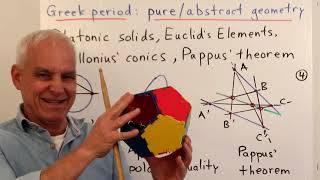
A Brief History of Geometry - Sociology and Pure Mathematics
Explore geometry's evolution from ancient times to 1400 AD, covering key theorems, Platonic solids, and applications in astronomy, surveying, and construction. Highlights include Islamic contributions to spherical geometry.
Euclid Book 1 Props VI-VIII - A Foundation for Geometry - Sociology and Pure Maths - N J Wildberger
Examines Euclid's Elements Book 1 Propositions VI-VIII, discussing proofs, logical issues, and questioning its suitability as a foundation for modern geometry. Explores alternatives and implications for mathematics.
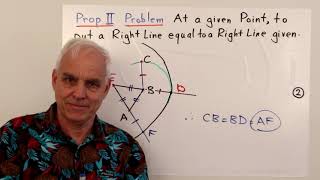
Euclid Book 1 Props I - V - A Critical Review - Sociology and Pure Mathematics - N J Wildberger
Critical review of Euclid's Book 1 Propositions I-V, examining logical foundations and constructions. Explores historical significance and questions modern interpretations of Euclidean geometry.