
Geometry - An Interactive Journey to Mastery
Explore geometric concepts like polyhedrons, volume, and surface area through interactive lessons. Master logical reasoning and problem-solving skills applicable to various fields and everyday life.

Einstein, The Big Bang, and the Expansion of the Universe
Explore Einstein's theory of relativity, the Big Bang, and cosmic expansion through visual explanations and essential mathematics, offering a fresh perspective on the universe's origins and evolution.

Curvature and Parallel Motion
Explore Einstein's theory of gravity through curvature mathematics. Brian Greene introduces key concepts and equations, offering insights into the universe's fundamental nature.

Calculus 1 Lecture - An Introduction to Limits
Comprehensive introduction to limits in calculus, covering key concepts like slope, tangents, and area under curves. Ideal for beginners seeking a solid foundation in calculus fundamentals.

Using Sum and Difference Formulas in Trigonometry
Learn to apply sum and difference formulas in trigonometry, covering inverse functions, unit circle applications, and phase shift identity proofs for sine and cosine.

Finding Sides and Angles with Right Triangle Trigonometry
Learn to solve right triangles using sine, cosine, and tangent functions. Master techniques for finding missing sides and angles in various scenarios.
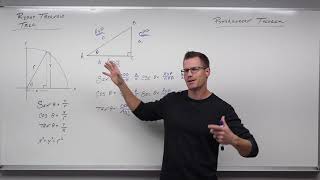
Introduction to Right Triangle Trigonometry - Precalculus Trigonometry
Learn right triangle trigonometry: sine, cosine, tangent, and reciprocal functions. Explore co-function relationships, identities, and practical applications in this comprehensive introduction.

Basic Properties of Trigonometric Functions - Precalculus - Trigonometry
Explore trigonometric functions' properties, ranges, and periods. Learn techniques to simplify angles and discover common misconceptions in this comprehensive trigonometry lesson.

How to Use the Unit Circle in Trigonometry
Master the unit circle for evaluating trigonometric functions, including sine, cosine, tangent, and more. Learn to find angles, handle negative angles, and apply Pythagoras theorem.

The Power of Mathematical Visualization - Visualizing Ways to Multiply
Explore unconventional multiplication methods, including graphical approaches, and uncover the geometric foundations of multiplication while solving mathematical mysteries like why negative times negative is positive.
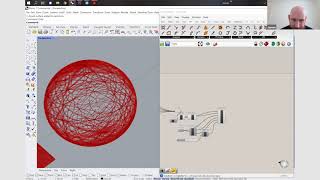
Designing with Complex Geometry - Class 3
Explore advanced techniques in Grasshopper for creating complex geometries, including grids, cells, and surface morphing. Hands-on exercises reinforce learning and practical application of concepts.
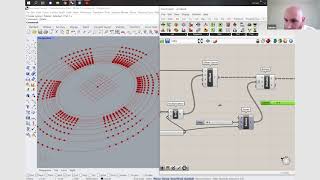
Designing with Complex Geometry - Class 2
Explore advanced geometric design techniques, including curve types, point manipulation, mathematical expressions, and 3D transformations to create complex floral patterns.
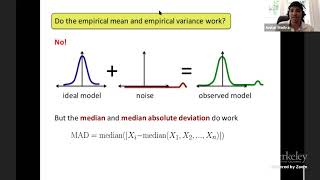
Recent Progress in High-Dimensional Learning
Explore recent advancements in high-dimensional learning, covering robust estimation, maximum likelihood, and algorithmic approaches for handling noise and adversarial scenarios.

Remarks on the Discrete Cube
Explore probability theory on the discrete cube, covering Fourier analysis, Poisson inequality, and random walks, with applications in high-dimensional geometry and computation.
The Big Mathematics Divide - Between "Exact" and "Approximate" - Sociology and Pure Maths
Explores the divide between exact and approximate theories in pure mathematics, challenging conventional views on arithmetic, algebra, topology, and number theory, including the Riemann Hypothesis.
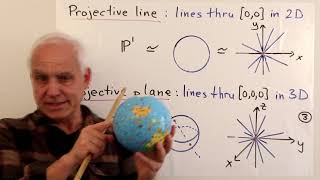
History of Geometry IV - The Emergence of Higher Dimensions - Sociology and Pure Maths
Explore the emergence of higher dimensions in 19th-century geometry, including projective geometry, cyclography, and spaces of lines and curves, revolutionizing our understanding of mathematical spaces.
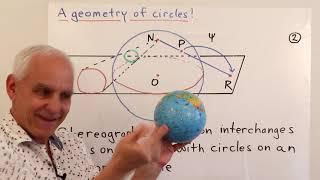
A Brief History of Geometry III - The 19th Century - Sociology and Pure Mathematics
Explore the golden age of geometry in the 19th century, covering inversive, projective, non-Euclidean, and complex geometries. Understand key developments and their impact on modern mathematics.
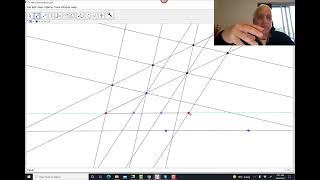
Calculus and Affine Geometry of the Magical Parabola - Algebraic Calc and DCB Curves 3 - Wild Egg
Explore affine geometry and the parabola's unique properties in algebraic calculus, focusing on parallelism and linear algebra concepts without relying on traditional Euclidean definitions.
The Language of Geometry - Math Terminology
Comprehensive review of geometry terminology for university students, covering Euclidean concepts, shapes, transformations, 3D geometry, and coordinate systems. Includes subtitles and supplementary materials.

The Relativistic Dot Product - Wild Linear Algebra B
Explore the relativistic dot product in Einstein's Special Relativity, comparing it to the Euclidean dot product and examining its applications in geometry and physics.
Simple Groups, Lie Groups, and the Search for Symmetry I - Math History - NJ Wildberger
Explore the history of group theory, from simple groups to Lie groups, and their role in describing symmetry in geometry. Discover remarkable mathematical objects and the classification of finite simple groups.