Floating Bodies and Duality in Spaces of Constant Curvature
Explores p-affine surface area and floating bodies in curved spaces, extending Meyer & Werner's Euclidean results to spherical and hyperbolic geometries. Examines limiting behavior as curvature approaches zero.
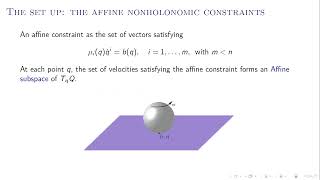
Virtual Affine Nonholonomic Constraints
Explore virtual affine nonholonomic constraints in mechanical systems, examining their mathematical foundations and practical applications in robotics and control theory.
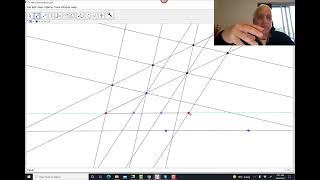
Calculus and Affine Geometry of the Magical Parabola - Algebraic Calc and DCB Curves 3 - Wild Egg
Explore affine geometry and the parabola's unique properties in algebraic calculus, focusing on parallelism and linear algebra concepts without relying on traditional Euclidean definitions.
Geometry with Linear Algebra - Wild Linear Algebra A - NJ Wildberger
Explore the connection between linear algebra and geometry, focusing on Pythagoras' theorem and perpendicularity. Learn how linear algebra provides a solid framework for understanding Euclidean and other geometries.
Affine and Projective Geometry, and the Problem of Lines
Explore affine and projective geometry, focusing on points, vector spaces, and lines in 2D. Learn to solve geometric problems using projective coordinates and understand curve representation.
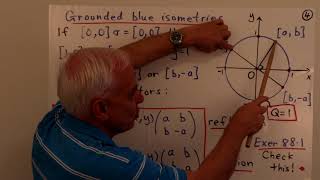
Isometry Groups in Planar Geometry - WildTrig: Intro to Rational Trigonometry - N J Wildberger
Explore isometry groups in Euclidean and relativistic geometries, focusing on grounded isometries, reflections, and rotations using an algebraic approach without infinite operations.
Seminar - Some Fundamental Formulas from Metrical Algebraic Geometry
Explore fundamental formulas in metrical algebraic geometry, connecting classical theorems to modern discoveries. Gain insights into affine and projective variants applicable across various fields.
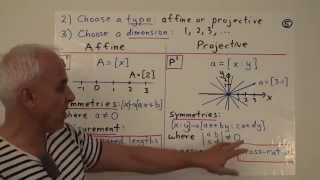
NJ's Pizza Model for Organizing Geometry - Rational Geometry Math Foundations
Explore a systematic approach to organizing metrical geometry using a pizza-making analogy. Learn about various geometries, their interconnections, and key concepts in this comprehensive overview.
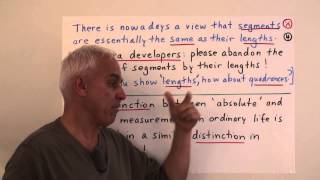
Absolute Versus Relative Measurements in Geometry - Rational Geometry Math Foundations
Explore the distinction between absolute and relative measurements in geometry, focusing on proportions and ratios. Learn about ancient Greek approaches and their relevance to modern mathematics.
Area and Volume - Wild Linear Algebra A | NJ Wildberger
Explore area and volume in linear algebra using bi-vectors and tri-vectors. Learn algebraic formulations, geometric proofs, and applications in physics and electromagnetism.
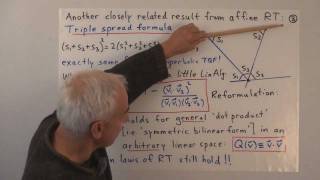
The Triple Quad Formula in Universal Hyperbolic Geometry
Explores the Triple quad formula in hyperbolic geometry, its proof, and related concepts. Compares with Euclidean geometry and discusses algebraic challenges, providing exercises for deeper understanding.
The Circle and Projective Homogeneous Coordinates - Universal Hyperbolic Geometry Lecture 7a
Introduction to projective geometry and its relation to universal hyperbolic geometry, exploring concepts like affine spaces, perspective, and one-dimensional projective geometry.
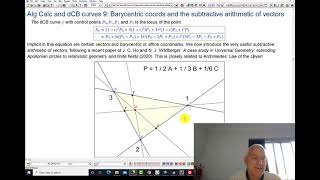
Barycentric Coordinates and Subtractive Arithmetic of Vectors - Algebraic Calculus and dCB Curves 9
Explore barycentric coordinates and vector arithmetic in affine geometry, enhancing understanding of de Casteljau Bezier polygons and curves. Gain insights into advanced mathematical concepts and their applications.
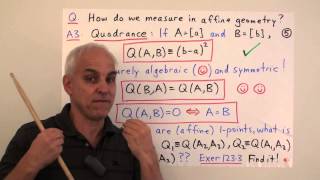
Affine One-Dimensional Geometry and the Triple Quad Formula - Math Foundations 123
Explore the Triple Quad Formula, a fundamental theorem in mathematics, through affine geometry. Learn its derivation, significance, and applications in measuring point separation and collinearity.
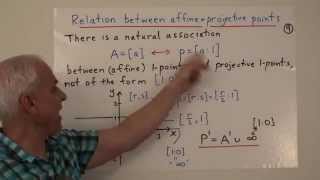
Mathematical Space and Basic Duality in Geometry - Rational Geometry Math Foundations 122
Exploring fundamental concepts of mathematical space, including the duality between affine and projective views, Cartesian geometry, and the relationship between affine and projective lines.
The Rational Number Line and Irrationalities - Famous Math Problems 19b
Geometric approach to modeling the continuum using the rational number line. Explores properties, projective view, and introduces irrationalities through Euclidean geometry and polynomial equations.
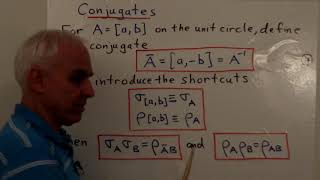
The Geometry of Euclidean Reflections and Rotations - Grounded Case
Explore Euclidean reflections and rotations using rational geometry. Learn about complex number multiplication, group structures, and a visual notation for describing transformations.
Dylan Langharst: Higher-Order Affine Isoperimetric Inequalities
Explores extensions of geometric inequalities to higher-order bodies, including projection, centroid, LYZ, and radial mean bodies, with proofs of associated inequalities in convex geometry.
The Funk Metric in Convex Geometry and Related Fields
Explore the Funk metric's connections to convex geometry, affine geometry, and combinatorics. Discover its projective invariance and relations to various conjectures and theorems.
Affine and Euclidean Geometry - The Modern Approach
Explore modern approaches to affine and Euclidean geometry, with applications to electrodynamics and relativity theory in this advanced physics lecture.