John Keil's Preface to Euclid - Sociology and Pure Mathematics
Exploration of John Keil's 1723 preface to Euclid's Elements, discussing its historical context and significance in geometry, including comparisons to Isaac Barrow's version.
The Geometry of the Dihedrons and Quaternions - Famous Math Problems
Explore the geometry of Dihedrons and Quaternions, comparing their properties and connections to relativity, linear algebra, and complex numbers. Gain insights into fundamental mathematical structures.
Computing Cyclotomic Polynumbers - Famous Math Problems
Explore cyclotomic polynomials, their factorization, and applications in algebra and number theory. Learn about Mersenne primes and the Schoenemann-Eisenstein criterion for irreducibility.
The Perspective Image of a Square III - The Solution
Explore the solution to projecting a square onto a quadrilateral, delving into geometry, perpendicularity, and perspective. Gain insights into mathematical problem-solving and related concepts.
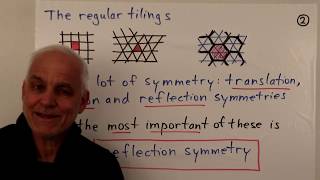
Mirror Symmetry for Young Students - Elementary Mathematics Explained
Explore mirror symmetry through visual mathematics, focusing on regular tilings and their symmetry lines. Ideal for teachers and parents to introduce geometric concepts to young learners.
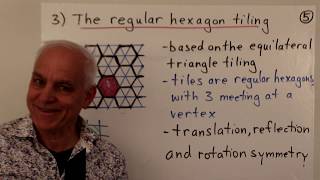
Regular Tilings of the Plane - Elementary Mathematics Explained
Explore the fascinating world of regular tilings, including square, equilateral, and hexagon patterns. Learn their properties, historical significance, and practical applications in various fields.

Polygonal Shapes - Elementary Mathematics Explained
Introduction to polygonal shapes in geometry, covering triangles, rectangles, parallelograms, and pentagons. Explores types of quadrilaterals and triangles, emphasizing the importance of geometry in early mathematics education.
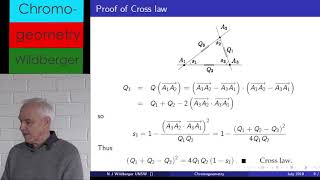
How Chromogeometry Transcends Klein's Erlangen Program for Planar Geometries - N J Wildberger
Discover chromogeometry's three-fold symmetry in planar geometry, unifying Euclidean and relativistic geometries. Explore rational trigonometry, colored Pythagoras theorems, Euler lines, and novel perspectives on conic sections.
Measuring Weight - Elementary Mathematics Explained
Explore the fundamentals of weight measurement, from ancient techniques to modern systems. Learn about scales, metric units, and practical applications in everyday life and science.
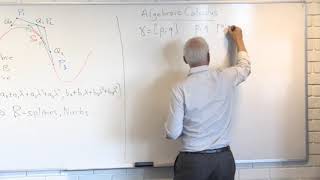
De Casteljau Bezier Curves in Algebraic Calculus - N J Wildberger
Exploring de Casteljau Bezier curves and extending Archimedes' Parabolic Area Formula to cubic curves using Algebraic Calculus, without relying on real numbers or infinite processes.
Affine and Projective Geometry, and the Problem of Lines
Explore affine and projective geometry, focusing on points, vector spaces, and lines in 2D. Learn to solve geometric problems using projective coordinates and understand curve representation.
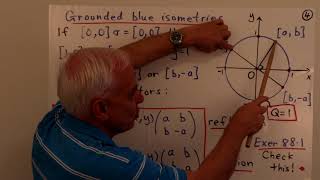
Isometry Groups in Planar Geometry - WildTrig: Intro to Rational Trigonometry - N J Wildberger
Explore isometry groups in Euclidean and relativistic geometries, focusing on grounded isometries, reflections, and rotations using an algebraic approach without infinite operations.
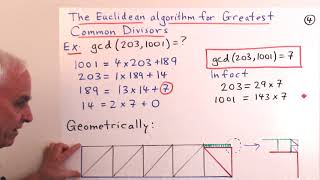
Turn Angles, Continued Fractions and Approximate Geometry - WildTrig: Intro to Rational Trigonometry
Explore turn angles and continued fractions to approximate geometry, using the Euclidean algorithm for angles and circular arcs. Learn about the natural unit of angle and its applications.
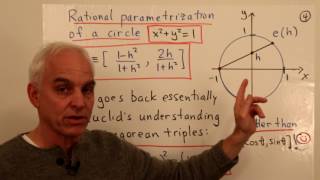
Rational Trigonometry and Mathematics Education - WildTrig: Intro to Rational Trigonometry
Innovative approach to teaching geometry and trigonometry, emphasizing rational methods for Year 9-10 students. Covers shapes, transformations, circle geometry, and challenges traditional concepts.
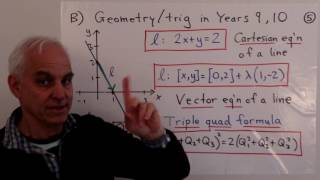
Maths Education and Rational Trigonometry - WildTrig: Intro to Rational Trigonometry
Innovative approach to teaching geometry and trigonometry, emphasizing rational trigonometry for Year 9-10 students. Covers progression from basic shapes to advanced topics, including circle geometry and 'pi'.
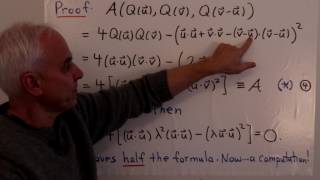
The General Rational Laws of Trigonometry - WildTrig: Intro to Rational Trigonometry
Explore general rational trigonometry laws in a planar setting, deriving elegant algebraic formulas without transcendental functions or real numbers. Learn key mathematical principles efficiently.
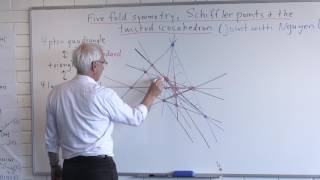
Seminar- Five-Fold Symmetry, Schiffler Points and the Twisted Icosahedron
Explore five-fold symmetry, Schiffler points, and the twisted icosahedron in this advanced geometry seminar. Delve into projective and triangle geometry, dihedral orderings, and remarkable conics arising from five points in the plane.
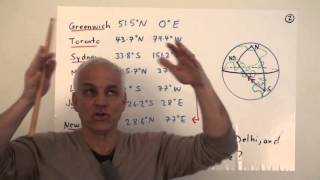
Applications of Rational Spherical Trigonometry II - Universal Hyperbolic Geometry
Explore spherical trigonometry to calculate distance and bearing between two points on Earth, comparing classical and modern rational methods for solving real-world navigation problems.
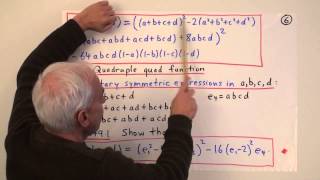
The Circumquadrance of a Cyclic Quadrilateral - Rational Geometry Math Foundations - NJ Wildberger
Explore a rational approach to cyclic quadrilateral geometry, avoiding transcendental quantities and extending to other fields and geometries. Learn Parameshvara's formula and its non-convex counterpart.
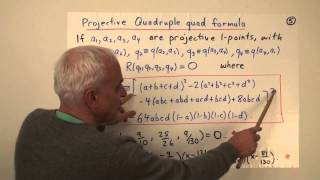
The Projective Quadruple Quad Formula - Rational Geometry Math Foundations
Explore the projective Quadruple quad formula and its connection to cyclic quadrilateral geometry, advancing beyond classical trigonometry to a more powerful approach applicable to general fields.
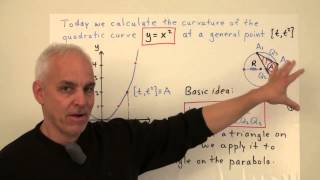
The Curvature of a Parabola, Without Calculus - Rational Geometry Math Foundations
Algebraic approach to calculate parabola curvature without calculus, using circle circumquadrance and triangle properties. Demonstrates wider applicability to various algebraic curves.