
Nucleolus of Cooperative Games
Explore fair profit distribution in cooperative games through the concept of nucleolus, focusing on weighted voting and matching games. Learn computational methods for this ancient fairness principle.
A General Theory for Discrete-Time Mean-Field Games
Comprehensive theory of discrete-time mean-field games, covering perfect and imperfect information structures, existence of equilibria, and extensions to risk-sensitive scenarios and hierarchies.
Computational Methods for Mean-Field Games
Explore computational methods for mean-field game systems, including finite-difference, convex optimization, Lagrangian, and machine-learning techniques for solving high-dimensional Hamilton-Jacobi PDEs.
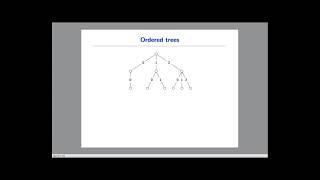
Beyond Value Iteration for Parity Games - Strategy Iteration with Universal Trees
Explores strategy iteration framework for parity games using universal trees, aiming to overcome quasi-polynomial barriers and improve upon value iteration algorithms for efficient game solving.
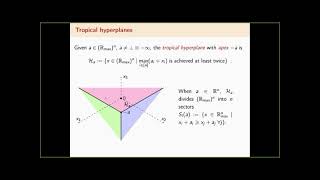
Marianne Akian- Tropical Linear Regression and Mean Payoff Games or How to Measure the Distance to Equilibria
Explore tropical linear regression, its connection to mean payoff games, and applications in auction theory. Learn about equilibrium prices and quantifying market distances.
The Master Equation for Mean Field Games
Explore the mathematical foundations of mean field games and their master equation, delving into advanced concepts and applications in game theory and optimization.

Strategies Without Frontiers - Game Theory in Security
Explore game theory concepts and strategies, from classic dilemmas to real-world applications. Learn about equilibrium, signaling, and iterated games in this comprehensive overview.
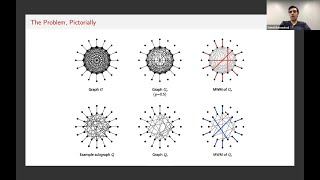
Algorithmic Game Theory - Session 8C
Explore algorithmic game theory concepts and applications in this IEEE conference session, focusing on cutting-edge research and developments in the field.
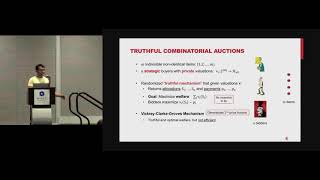
Improved Truthful Mechanisms for Combinatorial Auctions with Submodular Bidders
Explore advanced mechanisms for combinatorial auctions, focusing on submodular bidders and improved truthful strategies in complex market environments.

Algorithmic Game Theory - Session 2B
Explore key concepts and applications of Algorithmic Game Theory, examining strategic decision-making in computational settings and its impact on various fields.
The Coordination of Centralised and Distributed Generation - René Aid, Université Paris-Dauphine PSL
Explores mean-field games for optimizing energy production and storage, focusing on coordinating centralized and distributed generation systems in the energy industry.
Some Aspects of the Mean-Field Stochastic Target Problem - Boualem Djehiche, KTH, Stockholm
Explores mean-field stochastic target problems, focusing on theoretical aspects and potential applications in high-dimensional distributed optimization for energy and environmental challenges.
Turnpike Theory for Mean-Field Games - Connecting Stationary and Dynamic Solutions
Explores turnpike theory in mean-field games, connecting stationary and dynamic solutions. Part of a workshop on MFG applications in energy and environmental optimization.

A Full Classification of Finite Adversarial Partial Monitoring - Tor Lattimore
Explore finite adversarial partial monitoring, its classification, and implications for multi-armed bandit problems and full-information games. Learn about regret dependence on game structure.
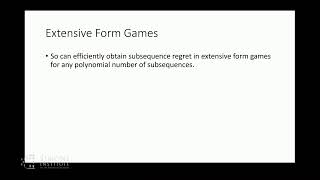
High Dimensional Calibration for Rational Decision Making
Explore statistical forecasts in high-dimensional settings, focusing on properties that incentivize rational decision-making and efficient algorithms for strategic environments.
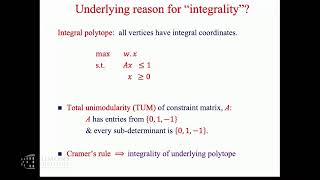
LP-Duality and the Cores of Games
Explore LP-duality's role in game theory, focusing on new matching-based games, extended core concepts, and approximate cores for general graph matching games. Gain insights into algorithmic fairness and game theory applications.

Strict Core Stability and Strategy-Proofness for Hedonic Games with Friend-Oriented Preferences
Explore hedonic coalition formation with friend-oriented preferences, examining strict core stability and strategy-proofness in the context of the strongly connected components mechanism.
Stability and Learning in Strategic Games
Explores strategic user behavior in games, focusing on traffic routing and online auctions. Discusses recent developments in repeated games with carry-over effects, particularly in queuing systems.

How to Win Games and Beat People - The Science Behind Winning
Discover the science behind winning games with insights from experts in various fields, from aerodynamics to game theory, offering surprising strategies for success in competitions.
The Extraordinary Theorems of John Nash
Explore John Nash's revolutionary contributions to game theory and geometric analysis with Fields Medal winner Cédric Villani, delving into the world of mathematical genius and groundbreaking theorems.
An Alternative View on AI: Collaborative Learning, Incentives, and Social Welfare - Lecture 2
Explore collaborative AI systems where intelligence emerges from agent interactions. Discusses economic incentives, social welfare, and dynamics in learning-based systems beyond traditional autonomous AI paradigms.