
Nash Equilibrium - Bad Fashion and Bank Runs - Game Theory Lecture 5
Explore Nash equilibrium, its applications, and coordination problems in game theory. Learn how communication can solve issues in social settings and investment scenarios.

Backward Induction: Chess, Strategies, and Credible Threats in Game Theory - Lecture 15
Explore game theory concepts like Zermelo's theorem, perfect information, and Nash equilibria in sequential games. Learn about backward induction and its implications for strategic decision-making.

Evolutionary Stability: Cooperation, Mutation, and Equilibrium in Game Theory - Lecture 11
Explore evolutionary stability in game theory, examining cooperation, mutation, and equilibrium concepts. Learn how biological strategies relate to economic principles like Nash equilibrium and domination.

Nash Equilibrium - Location, Segregation and Randomization in Game Theory
Explore game theory concepts like Nash equilibrium, segregation, and mixed strategies through candidate-voter models, Schelling's location game, and rock-paper-scissors, revealing how individual choices impact societal outcomes.

Best Responses in Game Theory - Soccer Penalties and Business Partnerships
Explore game theory concepts through soccer penalty kicks and business partnerships, focusing on best responses and introducing Nash Equilibrium.

Subgame Perfect Equilibrium: Matchmaking and Strategic Investments - Lecture 19
Explore subgame perfect equilibrium through examples in trust games, matchmaking scenarios, and strategic investment decisions, enhancing understanding of game theory concepts.

Subgame Perfect Equilibrium - Wars of Attrition in Game Theory - Lecture 20
Explore game theory's "wars of attrition" in competitive scenarios. Analyze long, costly conflicts using rational strategies, equilibria, and probabilities. Gain insights into trench warfare, strikes, and business rivalries.

Imperfect Information: Information Sets and Sub-game Perfection in Game Theory - Lecture 18
Explore game theory concepts like information sets, imperfect information games, and subgame perfection. Learn to analyze complex strategic interactions and refine equilibrium notions in sequential games.

Strategy: An Introduction to Game Theory
Comprehensive introduction to game theory, covering key concepts, strategies, and applications in economics, politics, and decision-making through diverse examples and mathematical models.

Game Theory and Economics
The course would introduce to the fundamental tools of game theory, a few equilibrium concepts, apart from numerous exercises and applications.

How Can We Understand Our Complex Economy?
Explore complex systems approach to economics, blending insights from physical and natural sciences to predict and mitigate economic crises, offering a new perspective on global financial challenges.

Game Theory
The aim of this course is to introduce the following topics at a basic level: combinatorial games, zero-sum games, non-zero sum games and cooperative games. At the end of the course, the student should be able to • Model and analyse conflicting situation…

On Difference Games in Infinite-Horizon
Explore infinite-horizon difference games governed by difference equations or inequalities in this 55-minute webinar presented by Naila Hayek from Université Panthéon-Assas, Paris II, France. Delve into various Nash-equilibrium concepts and examine Pontr…
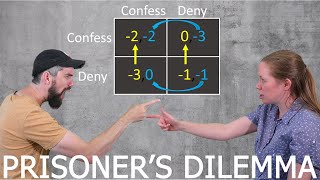
Game Theory
Explore game theory's powerful applications in economics, biology, and politics, from basic concepts to advanced strategies like Nash Equilibrium and the Evolution of Cooperation.

Understanding Game Theory
Explore key economic concepts in bite-sized explanations, from game theory to market dynamics. Gain insights into complex financial theories and real-world economic scenarios through concise, accessible breakdowns.

Designing Size Inclusive Fashion Assortments
Explore innovative strategies for balancing revenue and size inclusivity in fashion retail assortments. Gain insights into advanced analytics, choice modeling, and fairness measures to optimize product offerings.

Price and Quality Competition While Envisioning a Quality-Related Product Recall
Explorez les stratégies de prix et de qualité des entreprises face au risque de rappel de produits. Analysez un jeu de Nash à deux étapes modélisant la concurrence et les impacts sur le marché.

On the Existence of Equilibrium in a Dynamic Supply Chain Game with Vertical Coordination, Horizontal Competition and Cournot Complementary Goods
Explore dynamic supply chain competition with vertical coordination and horizontal competition in a differential linear-quadratic game setting, focusing on equilibrium existence and strategies.

Network Games with Large Populations: Non-uniqueness and Learning Dynamics
Explore network interactions in large-scale socio-economic systems, focusing on random graph models, multiple equilibria, and learning dynamics in time-varying settings.
Large Network-Coupled Mean Field Games and Associated Network Centralities
Explore large-scale linear quadratic stochastic games with network couplings, examining graphon mean field game models, Nash equilibrium characterization, and low-complexity solution methods.

Dynamic Games Played over Event Trees with Coupling Constraints
Explorez les jeux dynamiques sur arbres d'événements avec contraintes de couplage, illustrés par un modèle d'approvisionnement concurrentiel avec contraintes de capacité.