
Reflexive Theory of Mind Reasoning in Games
Explore reflexive theory-of-mind reasoning in games, examining how players build predictive mental models of co-players based on experience and context, challenging traditional game-theoretic assumptions.
Mean Field Games and Smart Grids - Distributed Control Solutions for the Future Power Network
Explore mean field games for distributed control in smart grids, covering energy arbitrage, thermostatically controlled loads, and transmission expansion planning. Gain insights into optimizing future power networks.
Role of Flexible Demand Technology in Modern Electricity Markets - A Game-Theoretic Perspective
Explores flexible demand technology's role in modern electricity markets using game theory, focusing on decarbonization challenges, system benefits, and impacts on market dynamics and investment planning.

Managing Grid Frequency Using Noisy On-Off Appliances - Simon Tindemans, Imperial
Explore innovative techniques for managing grid frequency using household appliances, focusing on flexible refrigeration and stochastic balancing in power systems.
An Optimization Perspective on Mean-Field Games - Wei Zhang, Ohio State University
Explore mean-field games from an optimization perspective, covering theory, applications in energy and environment, and connections to distributed optimization problems.
Equilibrium Computation and Machine Learning
Exploring the intersection of Game Theory and Machine Learning, focusing on equilibrium computation challenges and opportunities for advancing both fields.

The Math of Being a Greedy Pig - Numberphile
Explore the mathematics behind the dice game "Pig" with Ben Sparks. Learn optimal strategies, analyze probabilities, and discover the balance between risk and reward in this engaging mathematical exploration.
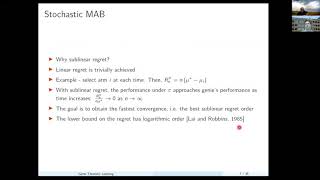
Game Theoretic Learning and Spectrum Management - Part 2
Explore game theory in signal processing, covering multi-arm bandits, adaptive algorithms, and reinforcement learning for spectrum management and network optimization.

Algorithms for Rank-1 Bimatrix Games
Explore algorithms for solving rank-1 bimatrix games efficiently, including polynomial-time methods for finding Nash equilibria and path-following techniques. Discusses complexity, uniqueness, and parameterized approaches.
Introduction to NetLogo by Bill Rand
Learn agent-based modeling with NetLogo to simulate complex systems, explore emergence, and understand when to use ABM for research in social sciences and economics.
Where Does the Statistics of Complex Systems Come From?
Explore the origins of complex systems statistics through sample space reducing processes, Zipf's law, and network diffusion. Gain insights into driven non-equilibrium systems and their statistical properties.

Analysis of Mean-Field Games - Lecture 1
Explore static mean-field games, Nash equilibria, and convergence theorems in large symmetric systems. Learn key concepts and proofs in this advanced applied probability lecture.
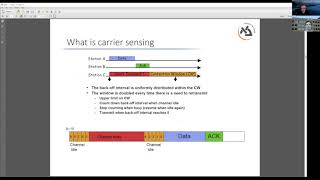
Game Theoretic Learning and Spectrum Management - Part 3
Explore advanced concepts in game theoretic learning and spectrum management, focusing on signal processing applications and cutting-edge research developments.
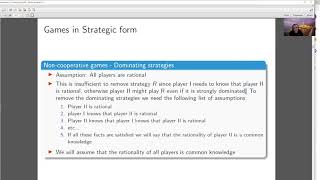
Game Theoretic Learning and Spectrum Management - Part 1
Explore game theoretic learning and spectrum management principles with experts Amir Leshem and Kobi Cohen in this IEEE Signal Processing Society presentation.

The Evolution of Cooperation - Iterated Prisoner's Dilemma
Explore game theory and the evolution of cooperation through iterated prisoner's dilemma, examining strategies like tit-for-tat and their impact on fostering collaborative behavior over time.
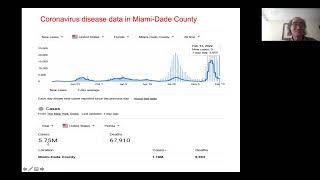
The Influence of Human Behavior and Social Factors on the Spread of Infectious Diseases
Explore how human behavior and social factors impact infectious disease spread, covering topics like social inequality, anti-vaccine movements, and psychological influences on public health.
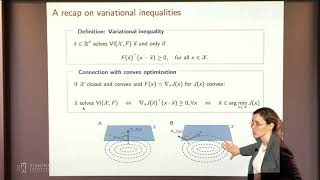
A Variational Inequality Framework for Network Games
Explore a variational inequality framework for network games, covering game theory connections, Jacobian properties, and sufficient conditions for Nash equilibria in symmetric networks.

Risk-Averse Selfish Routing
Explores traffic congestion with uncertain conditions, comparing risk-averse and risk-neutral equilibria in routing games. Analyzes efficiency and price of risk aversion for various scenarios.

Game Theory Applied to Mining Pools, Token Offering, DAO, and Consensus Protocols
Explore game theory applications in blockchain, including mining pools, token offerings, DAOs, and consensus protocols. Gain insights into economic models and strategic decision-making in cryptocurrency ecosystems.

Economics and Learning
Explore the intersection of economics and machine learning, focusing on game theory, recommendation systems, and decentralized models in data science.
A Unifying Framework for Analyzing Complex Systems
Explore complex systems analysis through genetic algorithms, agent-based models, network analysis, and time series analysis. Learn quantitative methods for social sciences and economics research.