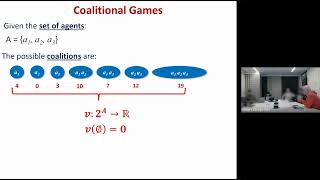
Improved Feature Importance Computation for Tree Models Based on the Banzhaf Value
Explore advanced feature importance computation for tree models using the Banzhaf value, offering faster algorithms and improved numerical robustness compared to Shapley value-based methods.

Statistical Foundations of Common Knowledge
Explore statistical foundations of common knowledge in game theory with Eduardo Faingold's insightful seminar presentation.
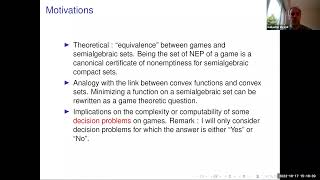
Zero-Sum Structure of Nash Equilibria Sets in Finite Games - Applications to Game Theory Decision Problems
Explore zero-sum structures in Nash equilibria sets of finite games and their implications for complexity in game theory decision problems.
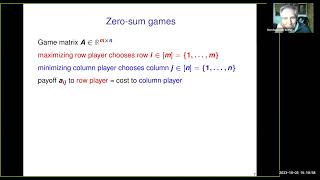
Zero-Sum Games and Linear Programming
Explore zero-sum games and their connection to linear programming in this insightful mathematical seminar by Bernhard von Stengel.
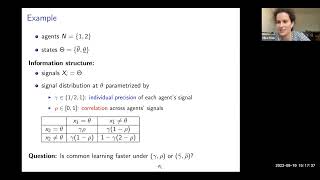
Learning Efficiency of Multi-Agent Information Structures
Explore multi-agent information structures and their learning efficiency in game theory, presented by Mira Frick at the One-World Mathematical Game Theory Seminar.
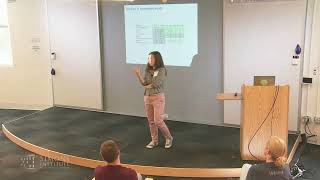
Reaching Collective Decisions in Voting Systems - Game Theory Perspective
Explore game-theoretic analysis of voting scenarios, examining stable outcomes and convergence of iterative processes in collective decision-making for socio-economic and technological systems.

Deciding Regular Games - A Playground for Exponential Time Algorithms
Explore exponential time algorithms for deciding regular games, examining their applications and implications in system design and analysis.
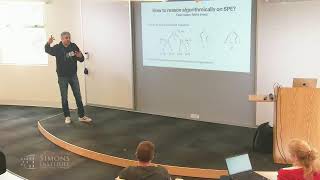
Subgame Perfection in Infinite Duration Graph Games
Explore algorithms for manipulating subgame perfect equilibria in infinite duration graph games, with insights on recent developments and applications in system design and analysis.

Controller Synthesis Beyond the Worst Case
Explore automatic control strategy synthesis for challenging environments, connecting decision and game theory to achieve best-effort control under overwhelming disturbances.

Stochastic Games with Neural Perception Mechanisms
Explore strategic reasoning in multi-agent systems using partially-observable stochastic games and neural perception mechanisms for optimal strategy synthesis in complex environments.

New Models of Games with Imperfect Information
Explores innovative approaches to modeling imperfect information in infinite games using finite-state automata, comparing observation-based and indistinguishability-relation models for enhanced expressiveness and strategy synthesis.

Games of Imperfect Information - Designing Signaling Strategies
Explore strategies for designing signaling in games with asymmetric information, focusing on principal-agent interactions and their applications in real-world scenarios.
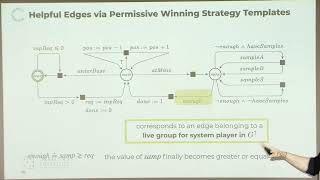
Localized Attractor Computations for Infinite-State Games
Explore symbolic methods for solving infinite-state games, focusing on localized attractor computations in sub-games to enhance efficiency and tackle complex problem instances.
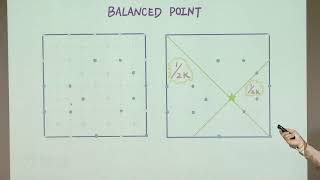
Computing a Fixed Point of Contraction Maps in Polynomial Queries
Efficient algorithm for computing fixed points of contraction maps, with potential implications for solving simple stochastic games and related computational problems.

Status Concern and Environmental Awareness in Common Access Resource Games - Heterogeneous Agents
Explore status concern and environmental awareness in common access resource games with heterogeneous agents, examining effects on extraction and resource management.

Connections between POMDPs and Partially Observed N-Player Mean-Field Games
Explore connections between POMDPs and partially observed n-player mean-field games. Gain insights into discrete-time models, mean-field observability, and equilibrium existence in symmetric settings.
Environmental Regulation under Sequential Competition
Explore environmental regulation's impact on polluting industries with Stackelberg competition, analyzing output advantages and regulatory inefficiencies in dynamic game theory.

Tight Bounds for the Price of Fairness
Explore tight bounds for the Price of Fairness in resource allocation, balancing efficiency and fairness criteria for optimal decision-making in various scenarios.

Stability and Learning in Strategic Queueing Systems
Explore stability and learning in strategic queueing systems with Éva Tardos. Discover how selfish behavior affects packet routing and server capacity in this insightful seminar on optimization and data analysis.
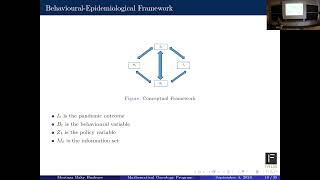
Understanding Pandemic Dynamics Through the Lens of Human Behavior
Explore how human behavior influences pandemic dynamics, integrating mathematical modeling with behavioral insights for more effective public health strategies and disease control.

Fair Omega-Regular Games
Explore two-player games with fairness constraints, focusing on fair α/β games. Learn about determinacy, polynomial reduction techniques, and symbolic algorithms for solving these complex game structures.