How to Use Real Computer Science in Your Day Job
Discover practical applications of advanced computer science concepts in everyday software development, enhancing problem-solving skills and job satisfaction.
Turning an Incident Report into a Design Issue with TLA+
Explore how modeling-driven techniques and TLA+ can enhance postmortem analysis, uncover root causes, and improve system design in distributed database architectures.
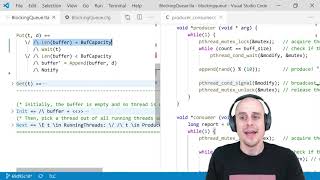
Weeks of Debugging Can Save You Hours of TLA+
Explore TLA+ for reliable system design through a hands-on approach, solving a subtle concurrency issue to demonstrate its power in preventing critical failures and reducing debugging time.
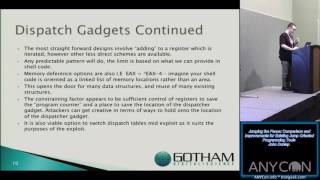
Jumping the Fence - Comparison and Improvements for Existing Jump Oriented Programming Tools
Explore Jump Oriented Programming, comparing tools and discussing improvements. Covers gadget search, comprehension strategies, and architecture support for various platforms including ARM and AVR.
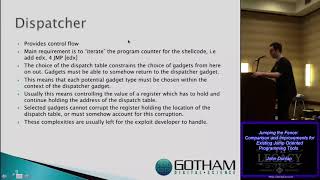
Jumping the Fence - Comparison and Improvements for Existing Jump Oriented Programming Tools
Exploring Jump Oriented Programming tools, comparing techniques, and discussing improvements. Covers dispatcher gadgets, functional gadgets, and AVR support with demos and practical insights.
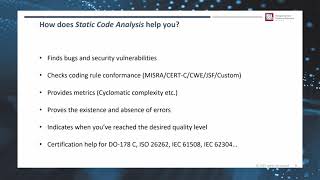
Implementing Innovations in a Safe and Secure Way
Explore automated static code analysis for software safety and security. Learn to prove absence of runtime errors using formal methods and tools like Polyspace for exhaustive testing.
Formal Methods for Kernel Hackers
Discover how formal methods can benefit kernel development, find bugs, and improve design choices in Linux, with practical examples using PlusCal and TLA+.
Kubernetes Operators - Safety First Through Model Checkers
Explore model checkers like TLA+ and Alloy for enhancing Kubernetes Operators' safety. Learn how these tools can improve system design and catch inconsistencies in critical infrastructure management.
Data Security - Theoretical and Real World Approaches to Compartmentalization
Explore theoretical and practical approaches to data security in cloud environments, covering formal methods, secure languages, and container-based storage solutions for enhanced protection and reliability.
Reactive Synthesis - Open Questions and Challenges
Experts discuss open questions and challenges in reactive synthesis, exploring cutting-edge research and future directions in system modeling and automation.
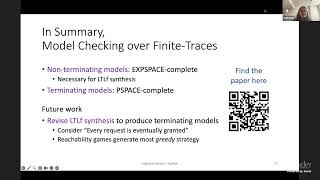
Synthesis and Verification of Finite Horizon Tasks
Explore finite horizon task synthesis and verification techniques, focusing on model and system creation for time-bounded objectives in computational systems.
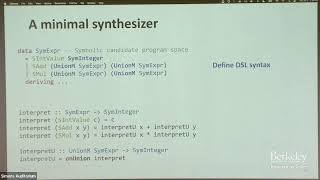
Grisette: Symbolic Compilation as a Functional Programming Library
Explore symbolic compilation techniques in functional programming with Grisette, enhancing model and system synthesis capabilities for advanced software development.
Deductive Verification of Parameterized Embedded Systems Modeled in SystemC
Explore deductive verification for parameterized embedded systems in SystemC, focusing on formal encoding, automated transformation, and novel invariant construction for global properties.

Automated Ambiguity Detection in Layout-Sensitive Grammars
Explore automated ambiguity detection in layout-sensitive grammars using SMT solving. Learn about local ambiguity, reachability conditions, and their application to language design.
Osiris: An Iris-Based Program Logic for OCaml
Explore Osiris, an Iris-based program logic for OCaml, enabling code verification using Separation Logic. Learn about its features, limitations, and future development plans.
Deconstructing Firewalls - Automated Rules in Distributed SDN Networks
Explore automated firewall management through Software Defined Networking and SMT solvers, enabling scalable security solutions that integrate with IDS systems without compromising network performance.
Wisening Assertions: A Live Bayesian Reasoning System for Probabilistic Correctness
Explore a novel approach to run-time assertions that balances robustness and scalability, gradually transitioning from "on" to "off" as confidence in code correctness increases over time.

Translating Canonical SQL to Imperative Code in Coq
Explore a mechanically verified compiler translating SQL to imperative code, addressing implementation challenges and leveraging formalization advances in query compilation.
Dafny Test Generation - Automated Testing for Verified Programs
Explore automated testing of Dafny programs with DTest. Learn to generate system-level tests, identify dead code, and ensure verified properties hold at runtime, enhancing confidence in code execution.
Sound Gradual Verification with Symbolic Execution
Explore sound gradual verification using symbolic execution techniques. Learn about optimized run-time check generation and its implementation in verification tools.
Iris-Wasm: Robust and Modular Verification of WebAssembly Programs
Explore robust and modular verification of WebAssembly programs using Iris-Wasm, a mechanized higher-order separation logic for specifying and verifying individual modules with strong isolation guarantees.