Distributed Controller Synthesis for Deadlock Avoidance
Explore advanced techniques for synthesizing distributed controllers to prevent deadlocks in complex systems, enhancing system reliability and performance.
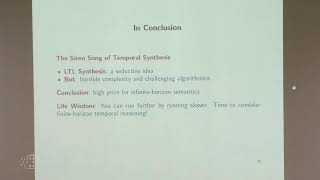
Linear Temporal Logic - From Infinite to Finite Horizon
Explore finite-horizon temporal synthesis in Linear Temporal Logic, its algorithmic advantages, and applications in reactive synthesis and infinite-horizon reasoning.
Synthesis of Privacy-Preserving Systems
Explore privacy-preserving system synthesis, addressing hidden signals, budget constraints, and incomplete information while satisfying specifications and protecting secrets.
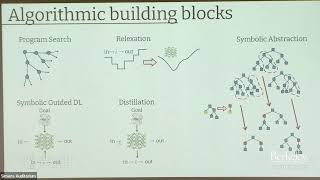
A Tutorial on Neurosymbolic Techniques
Explore neurosymbolic techniques for synthesizing models and systems, blending neural networks with symbolic reasoning to enhance AI capabilities.
Building Confidence in Concurrent Code with a Model Checker
Explore model-checking with TLA+ to detect concurrency errors at design time, enhancing code quality and confidence in concurrent systems beyond conventional practices.
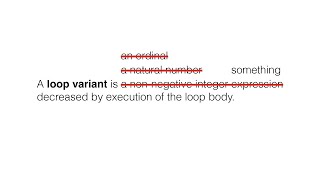
Why Loops End in C++
Explore the principles behind loop termination in C++, learning to express and communicate reasons for loop endings formally within source code.
Verifying a Concurrent File System with Sequential Reasoning
Explore a verified, concurrent file system using GoTxn and Dafny. Learn about crash safety, concurrency, and combining interactive and automated proofs for robust systems software.
Melocoton: A Program Logic for Verified Interoperability Between OCaml and C
Explore Melocoton, a groundbreaking program logic for verifying interactions between OCaml and C components through OCaml's foreign function interface, mechanized in Coq using Iris.
Declarative Programming via a Relational Algebra - PhD Defense
Explore declarative programming through relational algebra in this PhD defense presentation, delving into advanced concepts and research findings.
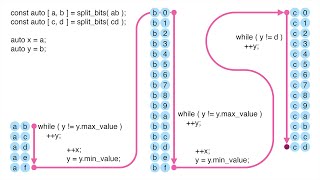
Why C++ Loops End - Midnote
Explore reasons for loop termination in C++ and learn to formally express them in code. Gain insights into stability, substitutability, and repeatability principles for robust loop design.
Liquid Type Systems - Understanding Type Theory and SMT Solvers
Explore the innovative Liquid Types system, combining traditional type theory with SMT solvers to enhance type system expressivity while maintaining practical usability in programming languages.

The Hidden Assumptions Behind Software Systems | Karan Kumar Singh | TEDxGreenfield Women
We trust large software systems because they are fast, reliable, and always available. But does working at scale mean they are actually correct? In this talk, the speaker explores how hidden assumptions inside modern systems can cause them to quietly drift away from the behavior we expect without c