VMSL: A Separation Logic for Mechanised Robust Safety of Virtual Machines Communicating Above FF-A
Explore VMSL, a novel separation logic for reasoning about virtual machine communication and security in hypervisor systems, with focus on Arm's FF-A hypercall ABIs.
Putting Weak Memory in Order via a Promising Intermediate Representation
Explore an in-order shared-memory concurrency model for C/C++, supporting non-atomic accesses and compiler optimizations while maintaining soundness between source and intermediate representation.
Parameterized Verification of Disjunctive Timed Networks
Explore new techniques for parameterized verification of disjunctive timed networks, including efficient algorithms and summary construction for arbitrary-sized systems.
Verification of a Subgraph Construction Algorithm for Geometric Graphs - VMCAI 2024
Explore automated verification of a subgraph construction algorithm, focusing on geometric graph properties, edge removal, and connectivity preservation in Euclidean plane representations.
A Probabilistic Choreography Language for PRISM
Explore a choreographic framework for modeling and analyzing concurrent probabilistic systems using PRISM. Learn about a new choreography language and its encoding into PRISM for enhanced system reliability.
Formalizing DRAGSTERS - Compiling Computations for Semiring Value Multiplication and Aggregation
Explore the impact of formal methods on compiling computations involving semiring value multiplication and aggregation in positive algebra over K-relations.
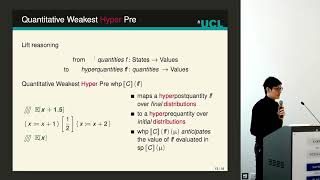
Quantitative Weakest Hyper Pre Calculus for Non-Deterministic Programs
Explore a novel weakest pre calculus for quantitative hyperproperties, enabling reasoning about hyperquantities in non-deterministic programs and extending hyper Hoare logic.
Specifying Smart Contracts with Hax and ConCert
Explore high-assurance smart contracts using Hax toolchain and ConCert for embedding, specifying security properties, and verification in Rust.
Inductive Program Synthesis via Iterative Forward-Backward Abstract Interpretation
Explore a novel approach to inductive program synthesis using iterative forward-backward abstract interpretation, enhancing search space pruning and improving synthesis efficiency.
An Automata-Based Framework for Verification and Bug Hunting in Quantum Circuits
Explore a novel automata-based approach for analyzing quantum circuits, enabling efficient verification and bug detection in large-scale quantum systems using tree automata and algebraic representations.
Automated Expected Value Analysis of Recursive Programs
Explore automated inference of expected result values in probabilistic programs with recursion, procedures, and local variables. Learn about term representation and first-order constraints for analysis automation.
Mostly Automated Proof Repair for Verified Libraries
Explore automated proof repair for higher-order imperative functions, combining dynamic program alignment, enumerative invariant synthesis, and proof-driven testing to maintain verified software efficiently.
Fair Operational Semantics - Theory for Expressing and Reasoning About Fairness Properties
Explore Fair Operational Semantics (FOS), a novel theory for expressing and reasoning about fairness properties in program verification, with applications in concurrent systems and weak memory models.
Formally Verified Samplers from Probabilistic Programs with Loops and Conditioning
Explore Zar: a verified compiler for discrete probabilistic programs, transforming cpGCL to executable samplers. Learn about choice-fix trees, interaction trees, and sampling equidistribution theorem.
Merging Inductive Relations for Improved Program Specification
Explore an algorithm for merging inductive relations, improving automatic generation performance and simplifying mechanized proofs in proof engineering tools like QuickChick for Coq.
CQS: A Formally-Verified Framework for Fair and Abortable Synchronization
Explore a formally-verified framework for fair and abortable synchronization, enabling efficient implementation of various primitives with modular proofs and improved performance.
LiDO: Linearizable Byzantine Distributed Objects with Refinement-Based Liveness Proofs
Explore LiDO, a consensus model enabling safety and liveness verification in Byzantine fault-tolerant protocols through refinement. Learn about mechanized proofs for Jolteon in Coq, advancing blockchain technology.
Qubit Recycling Revisited - Optimizing Quantum Circuit Width
Explore qubit recycling optimization for quantum circuits, focusing on complexity, algorithms, and verification using qubit dependency graphs and matrix triangularization techniques.
Hyper Hoare Logic: Proving and Disproving Program Hyperproperties
Explore Hyper Hoare Logic, a generalized proof system for program hyperproperties. Learn to reason about sets of states, proving and disproving properties beyond traditional Hoare logics.

A Proof Recipe for Linearizability in Relaxed Memory Separation Logic
Explore a novel proof recipe for linearizability in relaxed memory, using object modification order to simplify event reordering and enable proof reuse in concurrent libraries.
Testing Specifications in Dafny - Dafny'24
Explore techniques for testing specifications in Dafny, including automatic mutation testing and Spec-Testing Proofs, to enhance trust in formal verification processes.