
Hardware and Software Development Tools for Qudit Experiments
Explore hardware and software tools for qudit experiments, enhancing your understanding of quantum technology development.
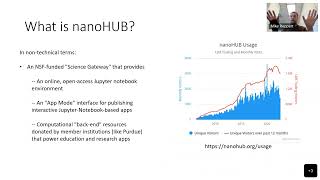
Hands-on Teaching with Jupyter Notebooks on nanoHUB
Explore hands-on teaching using Jupyter Notebooks on nanoHUB for chemistry courses. Learn to create interactive simulations, visualizations, and programming projects for enhanced student engagement and learning.
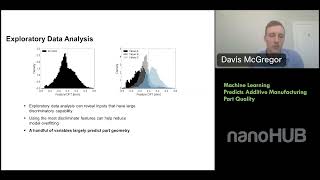
Machine Learning for Predicting Additive Manufacturing Part Quality - Tutorial on Support Vector Regression
Learn to predict additive manufacturing part quality using support vector regression. Explore data analysis, hyperparameter tuning, and cross-validation techniques for machine learning in 3D printing applications.
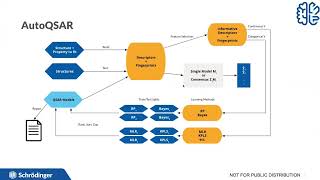
Machine Learning Models for Ionic Conductivity with Schrödinger's AutoQSAR - Hands-On Workshop
Explore machine learning for ionic conductivity prediction using Schrödinger's AutoQSAR tool. Gain hands-on experience with MS Maestro interface to create and implement models for materials science applications.

The Role of Machine Learning in Facilitating Fusion Energy Research
Explore machine learning applications in fusion energy research, including turbulence simulation speed-ups and predicting rare events. Gain insights into ML's potential to accelerate progress towards clean, abundant fusion energy.
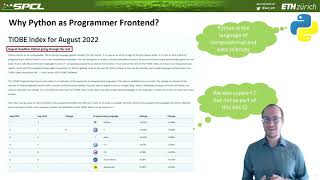
Portable High-Performance Python on CPUs, GPUs, and FPGAs
Optimize Python for high performance on CPUs, GPUs, and FPGAs. Learn HPC-oriented extensions, automatic optimizations, and portable performance techniques across architectures.

AI Sovereignty in the Global Industrial Economy - The Leadership Perspective
Explore AI sovereignty's role in the $25T industrial economy. Learn to integrate AI into business strategy using specialized tools like OpenSSA for customized, agile solutions in the AI-driven era.

Augmenting the Prediction of Extubation Failure Using Measures of Complexity
Explore innovative techniques for predicting extubation failure in critical care using complexity measures and advanced data analysis methods.

Interpretable and Structure-Preserving Data-Driven Methods for Physical Simulations
Explore interpretable, structure-preserving data-driven methods for physical simulations. Discover techniques like DMD, LaSDI, and ROMs to accelerate and improve accuracy in various scientific applications.

ME3255 - Rocket Science Solutions with Python
Explore rocket science solutions using Python, covering advanced concepts and practical applications in aerospace engineering.

Quantum Algorithms Recap: Hadamard Transform - Lesson 97
Recap quantum algorithms involving the Hadamard Transform, exploring key concepts and applications in quantum computing.

Arduino Plug and Make Kit Review and Unboxing
Unboxing and review of Arduino Plug and Make Kit, exploring projects and assessing its value for electronics and robotics enthusiasts.

Digital Twins in Mechanics and Medicine - Data-Centric Engineering Webinar
Professor Stéphane Bordas explores digital twins in mechanics and medicine, highlighting data science applications for improving engineered systems' reliability, safety, and efficiency.
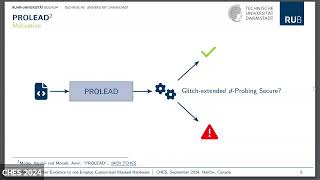
Masking in RISC-V Architecture - CHES 2024
Explore cutting-edge masking techniques for RISC-V architecture in this CHES 2024 session, focusing on enhancing cryptographic security and side-channel attack resistance.
Fault Resistance I
Explore cutting-edge fault resistance techniques in cryptographic hardware at CHES 2024, chaired by Pascal Sasdrich. Gain insights into latest research and advancements in this critical field.
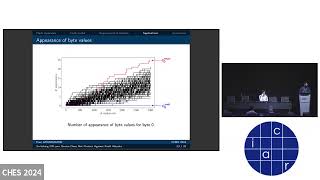
Faults in Symmetric Cryptography - CHES 2024 Session
Explore symmetric fault analysis techniques and their applications in cryptography at this CHES 2024 session, chaired by Nicky Mouha.
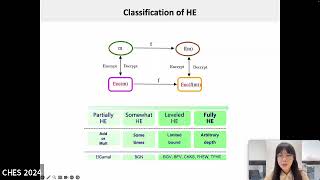
Post-Quantum Cryptography VI - Speed Optimization - CHES 2024
Explore post-quantum cryptography advancements and speed optimizations in this CHES 2024 session, chaired by Robert Primas.
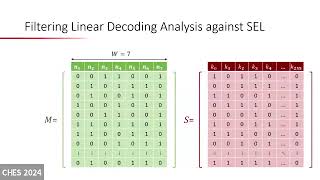
Whitebox Cryptography Theory - CHES 2024
Explore theoretical aspects of whitebox cryptography in this CHES 2024 session, chaired by Bart Preneel, delving into advanced security concepts and research findings.
KubeEdge DeepDive - Extending Kubernetes to the Edge with Real-World Industry Use Cases
Explore KubeEdge's architecture and real-world applications in edge computing, including smart cities, industrial IoT, and edge AI. Learn about its integration with Kubernetes and advancements in technology and community governance.

Using Julia as Part of an Anomaly Detection Pipeline
Explore Julia's role in anomaly detection pipelines, integrating data analysis, algorithm development, and real-time processing with Java-based web applications for efficient business solutions.
Modeling and Simulation of Sampled-Data Systems
Explore modeling and simulation of sampled-data systems, including discrete-time partitions, clocks, and interactions between continuous and discrete components using ModelingToolkit in Julia.