Geometry of Nonequilibrium Reaction Networks
Explore geometric interpretations of nonequilibrium reaction networks, extending Hill-Schnakenberg theory to hypergraphs and analyzing cycles, cocycles, and stochastic models.
Generalized Density Profiles in Single-File Systems
Explore single-file transport and bath-tracer correlations in confined systems, focusing on the Symmetric Exclusion Process and its applications to non-equilibrium situations.
Fluctuations in the Fourier Coefficient of Current in Periodically Driven Systems
Explore probability current fluctuations in periodically driven stochastic systems, focusing on Fourier component statistics and cumulant generating function analysis.
Classical Identification of Emergent Geometries in AdS Spacetimes and Quantum Projector Detection
Explore quantum projector identification in AdS/CFT, examining complexity in symmetric group algebras and holographic implications for half-BPS states in N=4 SYM.
A Quiescent Regime for Big Bang Formation
Explore stable big bang formation in general relativity, covering recent results and a new condition for big bang formation in Einstein-non-linear scalar field settings.
Perturbation at Blow Up of Self-Similar Solution for Modified Korteweg-de Vries Equation
Explore stability and perturbation of self-similar solutions' blowup dynamics in the modified Korteweg-de Vries equation, with applications to fluid dynamics and vortex patch formation.
Weakly Turbulent Solution to the Schrödinger Equation on the 2D Torus with Potential
Explore a smooth solution to the linear Schrödinger equation on a 2D torus, examining logarithmic H^1 Sobolev norm growth and infinite-time blowup using adapted CKSTT techniques.
Shear-Induced Dynamics and Mechanical Responses in Biological Tissues
Explore computational models of biological tissue mechanics under shear forces, examining solidification, thickening, plasticity, and multilayered responses in developmental processes.
Exploring Cell Tissue Dynamics in Reciprocal Space: A Differential Dynamic Microscopy Approach
Explore cell tissue dynamics using differential dynamic microscopy in reciprocal space, uncovering non-equilibrium processes in physics and biology.
The New Jersey Heat Vulnerability Index: Understanding and Applying the Tool
Explore the Heat Vulnerability Index for New Jersey, its construction, application, and importance in identifying at-risk communities during extreme heat events.

Geometric Algebra Transformers: Revolutionizing Geometric Data
Explore GATr's revolutionary approach to geometric data processing, enhancing computer vision, robotics, chemistry, and physics with efficient 16-dimensional vector space representations and E(3) equivariance.

Mastering Controllable AI - Ensuring Safe Autonomy
Explore innovative norm-based control mechanisms for autonomous systems, focusing on social laws, norms, and sanctions to ensure safe AI behavior and desirable outcomes.
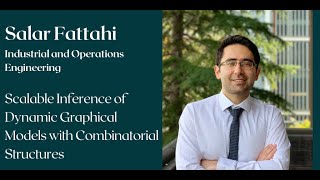
Scalable Inference of Dynamic Graphical Models with Combinatorial Structures
Explore scalable inference techniques for dynamic graphical models with combinatorial structures, focusing on industrial and operations engineering applications.
Trillion Parameter Foundation Models as Discovery Accelerators - Lecture 10
Explore how advanced AI and foundation models can accelerate scientific discovery, revolutionizing research infrastructure and collaboration.
Programming Novel AI Accelerators for Scientific Computing - Part 2 - Tutorial 5
Explore advanced techniques for programming AI accelerators in scientific computing, focusing on optimization and performance enhancement.
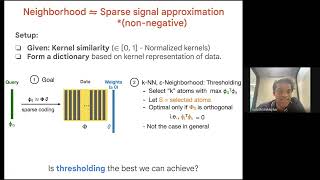
Revisiting Nearest Neighbors from a Sparse Signal Approximation View
Explore nearest neighbor methods from a sparse signal approximation perspective, uncovering improved neighborhood definitions and their applications in graph-based signal processing and machine learning.
Resiliency at the Edge - Automated Health Checks and Recovery for Remote Devices
Explore greenboot framework for Edge device resilience, including health checks and OS rollback. Learn implementation, see a demo, and discover future plans.
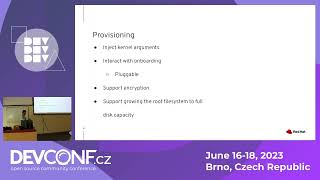
Device Provisioning at the Edge
Explore efficient and secure device provisioning for Edge systems, including requirements, tools, and lessons learned from RHEL and Fedora IoT teams.
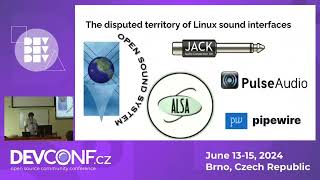
Music Production on Linux Desktops
Explore Linux-based music production tools, workflows, and software ecosystem. Discover viable alternatives for audio workstations and experience live signal processing demonstration.
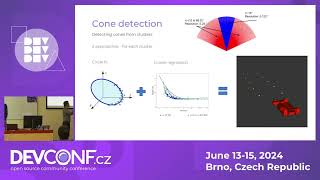
Design and Development of Autonomous Racecar
Explore autonomous racecar development: perception, localization, mapping, path planning, and vehicle control. Gain insights into creating self-driving vehicles using advanced technologies.
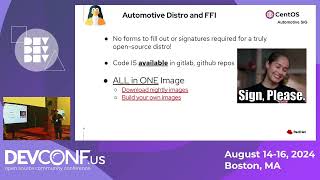
Paving the Way for Uninterrupted Car Operations
Explore Freedom of Interference in containers and its impact on next-gen vehicles and embedded devices. Witness the future of mobility with enhanced efficiency, safety, and performance.