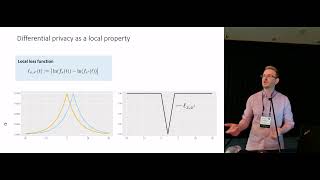
Statistical Quantification of Differential Privacy - A Local Approach
Explore a local approach to statistically quantify differential privacy, enhancing data protection and privacy in statistical analysis and machine learning.
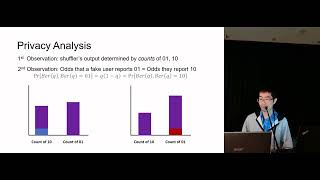
Differentially Private Histograms in the Shuffle Model from Fake Users
Explore innovative techniques for creating privacy-preserving histograms using fake users in the shuffle model, enhancing data protection and analysis capabilities.
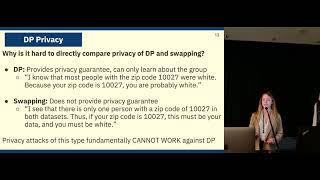
Differential Privacy and Swapping - Examining De-Identification's Impact on Minority Representation and Privacy Preservation in the U.S. Census
Explore differential privacy and swapping techniques in the U.S. Census, examining their effects on minority representation and data protection.
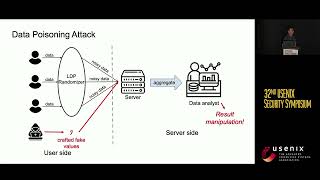
Fine-Grained Poisoning Attack to Local Differential Privacy Protocols for Mean and Variance Estimation
Explores a new fine-grained attack on local differential privacy protocols, allowing manipulation of mean and variance estimations. Discusses security-privacy consistency and proposes a defense method.
Practical Data Privacy
Explore practical data privacy implementation with open-source libraries, privacy-enhancing technologies, and strategies for balancing privacy and utility in software development and data science projects.
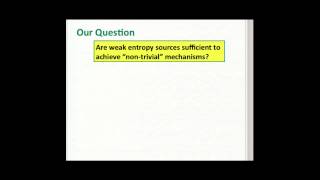
Differential Privacy with Imperfect Randomness
Explore the concept of differential privacy and its application in scenarios with imperfect randomness, examining challenges and potential solutions in data privacy.
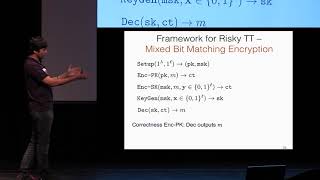
Hardness of Non Interactive Differential Privacy from One Way Functions and Risky Traitor Tracing
Explore cryptographic techniques for differential privacy and traitor tracing, examining their hardness and implications for data security and privacy protection.

Differential Privacy and the People's Data
Explore differential privacy mechanisms, applications, and challenges in data protection. Insights from Cynthia Dwork on privacy-preserving techniques, real-world implementations, and future directions.
Advanced Cryptography on the Way to Practice
Overview of recent developments in advanced cryptography, focusing on secure multiparty computation, zero knowledge, and differential privacy, with emphasis on practical implementations and efficiency improvements.
Workshop - Matches Made in Heaven
Explore differential privacy, adaptive data analysis, and computational techniques for privacy-preserving data science in this comprehensive workshop on advanced statistical methods.
Privacy-Preserving Methods - Building Secure Projects
Explore privacy-preserving techniques for secure data handling and machine learning, including anonymization and pseudonymization methods to protect user information while maintaining data utility.
Practical Privacy-Preserving Machine Learning in Python
Explore privacy-preserving machine learning techniques in Python, including federated learning and encrypted data algorithms, to build accurate models while protecting user privacy.
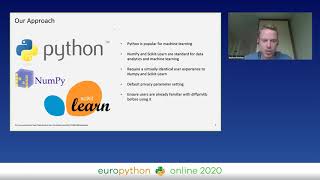
Diffprivlib - Privacy-Preserving Machine Learning with Scikit-Learn
Explore differential privacy in machine learning using Diffprivlib, a tool for training accurate models with robust privacy guarantees, seamlessly integrating with scikit-learn and numpy.
Protecting Sensitive Data in Huge Datasets - Cloud Tools You Can Use
Explore tools and techniques for protecting sensitive data in large datasets, including PII detection, k-anonymity, and data transformation methods for responsible public data release.
Privacy Engineering: Not Just for Privacy Engineers
Explore Uber's collaborative approach to privacy engineering, blending data analysis with robust privacy measures to enhance services while ensuring regulatory compliance and user protection.

Protecting Privacy with Math - Census Bureau Collaboration
Explore mathematical techniques for protecting privacy in data analysis, focusing on differential privacy and its applications in census data collection and statistical safeguards.
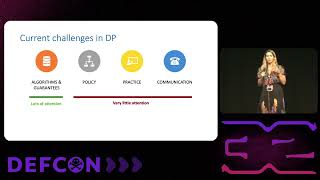
Differential Privacy Beyond Algorithm: Challenges for Deployment
Explore the practical challenges of implementing differential privacy systems, from explaining technical guarantees to non-experts to preventing misuse and integrating with existing security tools.
HasTEE: Programming Trusted Execution Environments with Haskell
Explore HasTEE, a Haskell-embedded DSL for programming Trusted Execution Environments. Learn how it simplifies TEE application development with automatic partitioning and enhanced security features.
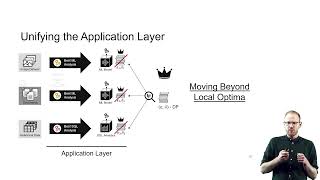
Managing Differential Privacy in Large Scale Systems - Lecture 574
Explore techniques for implementing differential privacy in large-scale systems, focusing on practical challenges and effective management strategies.
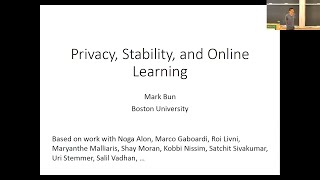
Privacy, Stability, and Online Learning
Explore the intersection of privacy, stability, and online learning, focusing on sample complexity, private learnability, and mistake-bounded learning in classification algorithms.
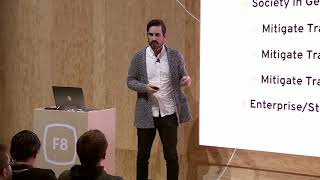
A Sneak Peek of Udacity's New Machine Learning Course on Privacy and Federated Learning
Explore cutting-edge machine learning concepts like differential privacy and federated learning in this preview of Udacity's new course, presented by OpenMined's Andrew Trask.