
Koopmans Functionals in Practice - QE Tutorial 2022
Explore Koopmans functionals in Quantum ESPRESSO, focusing on practical applications and advanced techniques for electronic structure calculations.
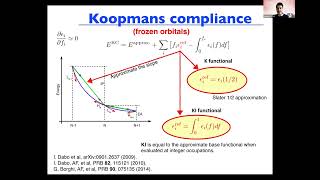
Koopmans Functionals and Spectral Potential in Quantum ESPRESSO - Tutorial 2
Explore Koopmans functionals in quantum mechanics, focusing on spectral potential connections and applications in materials science.

QE Tutorial 2022 - First-Principles Calculation of Hubbard Parameters
Explore first-principles Hubbard parameter calculations in quantum materials, focusing on chromium oxide and practical applications in advanced quantum simulations.
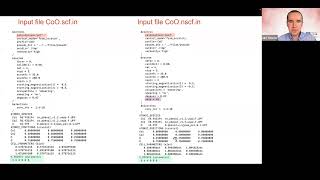
DFT+U and DFT+U+V: How Does It Work? - Hands-on Tutorial
Explore DFT+U and DFT+U+V methodologies in Quantum ESPRESSO through hands-on exercises, enhancing understanding of Hubbard-corrected density functional theory.
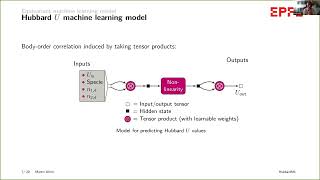
Accelerating the Calculation of Hubbard Parameters Using Machine Learning - QE Tutorial 2022
Learn advanced techniques for accelerating Hubbard parameter calculations in Quantum ESPRESSO using machine learning, with a focus on linear response methods and transferability.
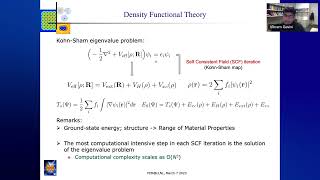
Fast, Accurate and Large-scale Ab-initio Calculations for Materials Modeling
Explore advanced computational methods for large-scale density functional theory calculations using adaptive finite-element discretization, enhancing materials modeling capabilities.
Competing Magnetisms and Onset of Static Magnetic Order in Sr2RuO4
Explore competing magnetic instabilities in Sr2RuO4, their link to superconductivity, and the onset of static magnetic order under strain using first-principles and self-consistent renormalization theories.

Scalable Molecular Simulation of Electrolyte Solutions with Quantum Chemical Accuracy
Explore advanced molecular simulation techniques for electrolyte solutions using neural network potentials and DFT, achieving quantum chemical accuracy and revealing novel insights in solution behavior.

Q-Chem 6 Generation: Features and Developments in Quantum Chemistry Software
Explore cutting-edge features in Q-Chem 6, including spectroscopy modeling, energy decomposition analysis, DFT improvements, quantum mechanochemistry, and nuclear-electronic orbital methods.
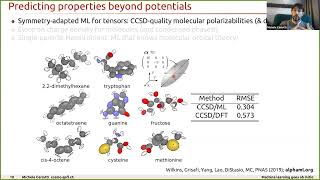
Machine Learning in Condensed Matter and Materials Physics
Explore how machine learning enhances simulations of matter, from electronic to molecular structures, boosting computational methods and potentially leading to new physical insights and exotic materials.
Efficient Calculation of the Absolute Molecular Entropy
Learn efficient methods for calculating absolute molecular entropy, combining DFT and semi-empirical approaches to achieve chemical accuracy in free energy computations for realistic chemical reaction modeling.
Probing Water-2D Material Interfaces: Quantum and Classical Simulations on Defective and Rough Surfaces
Explore quantum and classical simulations of water-2D material interfaces, focusing on defects and roughness in hexagonal boron nitride. Gain insights into wettability, slip length, and interfacial properties for desalination and sensing applications.
Simulating Thousands of Atoms Using Linear Scaling BigDFT - Applications in Large-Scale Quantum Systems
Explore linear-scaling DFT for simulating thousands of atoms using BigDFT. Learn about localized support functions, fragment approaches, and applications in large-scale quantum simulations.
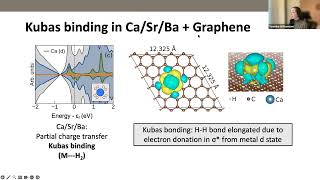
Using QMC to Understand Hydrogen Storage in Metal Decorated Graphene - 14/18
Explore quantum Monte Carlo techniques for analyzing hydrogen storage in metal-decorated graphene, enhancing understanding of advanced energy storage solutions.

Advanced Quantum ESPRESSO Tutorial: Hubbard and Koopmans Functionals - Day 2 Discussion
Explore advanced Quantum ESPRESSO concepts: Hubbard and Koopmans functionals from linear response in this in-depth tutorial discussion.

Advanced Quantum ESPRESSO School: Hubbard and Koopmans Functionals - Lecture 1.1
Explore advanced Quantum ESPRESSO concepts: Hubbard and Koopmans functionals from linear response in this comprehensive lecture.
Magnetocrystalline Anisotropy of Heavy Rare-Earth Atoms on Graphene
Explore magnetocrystalline anisotropy of heavy rare-earth atoms on graphene using DFT+U method. Uncover electronic and magnetic properties, predict quantum stability, and investigate strain effects.
Helical Ground State and Magnetoelectric Properties of Two-Dimensional Nb3Cl8
Explore helical ground state and magnetoelectric properties of 2D Nb3Cl8, examining ferrovalley coupling, magnetic states, and electric field effects on phase transitions.
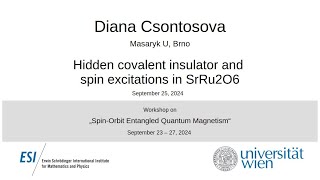
Hidden Covalent Insulator and Spin Excitations in SrRu2O6
Explore theoretical study of SrRu2O6, combining DFT and DMFT to investigate its antiferromagnetic properties, spin excitations, and the nature of its paramagnetic state.
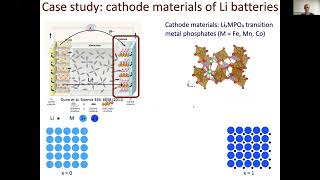
DFT+U and DFT+U+V: Basic Concepts and Applications - Advanced Quantum ESPRESSO Tutorial 2022
Explore DFT+U and DFT+U+V concepts, applications in materials science, and their impact on electronic localization and energetics in various systems.
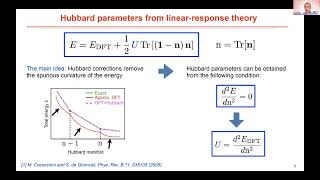
First-Principles Calculation of Hubbard Parameters Using Linear-Response Theory - Tutorial 2022
Learn advanced techniques for calculating Hubbard parameters using linear-response theory in DFT+U(+V) approach. Explore applications in materials science, including battery voltages and vacancy formation energies.