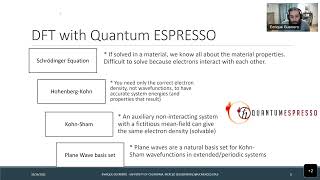
Interactive Modeling of Materials with DFT Using Quantum ESPRESSO - MIT Atomic Scale Toolkit
Explore interactive modeling of materials using density functional theory with Quantum ESPRESSO in the MIT Atomic-Scale Modeling Toolkit. Learn to compute and analyze various material properties through hands-on examples.
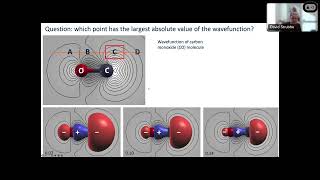
DFT with SIESTA, Data Visualization, and Sophomore-level CURE Using MIT Atomic-Scale Modeling Toolkit
Explore density functional theory, data visualization, and undergraduate research experiences using the MIT Atomic-Scale Modeling Toolkit for modern physics and condensed matter studies.
The Equation of State Between Nuclear Structure and Astrophysics - Lecture 4
Explore nuclear physics concepts, focusing on the equation of state and its connections to nuclear structure and astrophysics in this advanced lecture.
The Equation of State Between Nuclear Structure and Nuclear Astrophysics and Beyond - Lecture 1
Explore the interplay between nuclear structure and astrophysics, focusing on the equation of state and its implications for understanding cosmic phenomena.
Getting from DaFT to DeFT: An Introduction to Using DFT for 2D Materials
Comprehensive introduction to Density Functional Theory for 2D materials, covering fundamental concepts, applications, and practical implementation techniques.
Engineering 2D Electron and Hole Gases at Si/SiGe Interfaces - Insights from DFT
Explore DFT insights on engineering 2D electron and hole gases at Si/SiGe interfaces, part of a workshop on emergent phenomena in 2D quantum materials and heterostructures.
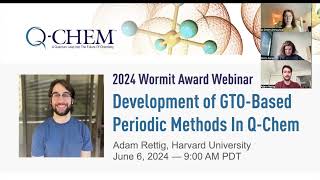
PBC Development in Q-Chem - 2024 Wormit Award
Explore advancements in Q-Chem's PBC package for periodic systems, including hybrid DFT speedup and MPI parallelization. Learn about current functionality and future development directions.
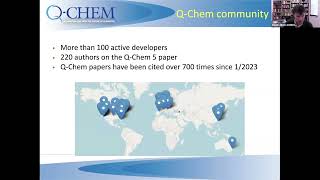
Q-Chem: An Engine for Innovation - 2024 Virtual Winter School in Computational Chemistry
Explore recent developments and new features in Q-Chem code with Martin Head-Gordon from UC Berkeley, highlighting advancements in computational chemistry software.
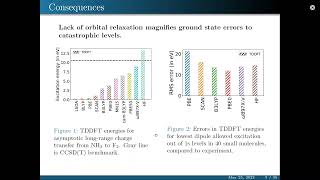
OO-DFT for Core-level Excitations and Applications to Molecular Symmetry Breaking - 2023 Besley Award
Advances in OO-DFT for modeling core-level excitations, focusing on SGM method and spin contamination. Applications to transient X-ray absorption spectroscopy, including Jahn-Teller distortion and symmetry breaking in molecular cations.
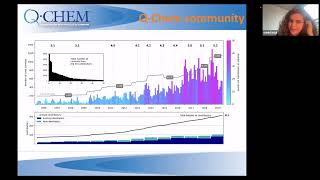
Introduction to Q-Chem Software Package - Session 1
Explore Q-Chem software: features, community, and applications in computational chemistry. Learn about ground state methods, excited states, and molecular dynamics simulations.
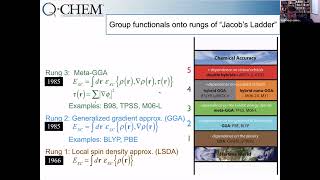
Density Functional Theory Overview - 2023 Virtual Winter School in Computational Chemistry
Explore density functional theory methods with Prof. Martin Head-Gordon, covering key concepts, functional design, and performance analysis in computational chemistry.
Molecular Properties and Spectra Using DFT and TDDFT - Session 6
Explore DFT and TDDFT applications in molecular properties and spectra with Prof. Martin Head-Gordon. Covers first/second-order properties and excited states, with accompanying lab exercise.
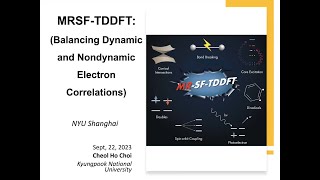
MRSF-TDDFT - Balancing Dynamic and NonDynamic Electron Correlations
Explore advanced quantum chemistry techniques for balancing dynamic and non-dynamic electron correlations in MRSF-TDDFT calculations.
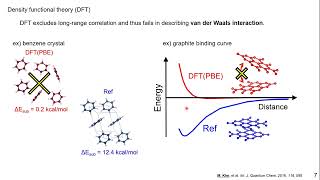
Efficient and Accurate van der Waals Correction for Density Functional Approaches in Material Simulations
Explore efficient van der Waals corrections for density functional approaches in material simulations, enhancing accuracy in computational chemistry.
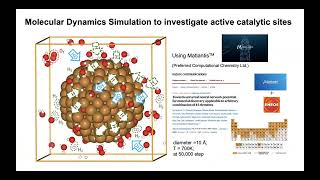
Electronic-Structure Informatics: Concept, Method, Applications, and Plausible Extension
Explore electronic-structure informatics, covering concepts, methods, applications, and potential extensions in computational chemistry and materials science.
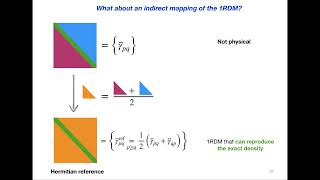
A Non-Hermitian Approach to the Representability Issue in Density-Matrix Embedding Theory
Explore non-hermitian approaches to representability in density-matrix embedding theory, enhancing understanding of quantum chemistry concepts and computational methods.
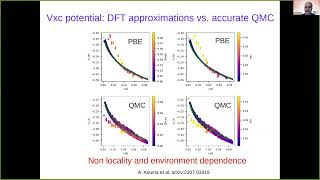
QE Tutorial 2022 - Design of Auxiliary Systems and Connectors for Spectroscopy
Explore advanced quantum mechanics concepts, focusing on Hubbard and Koopmans functionals in linear response, with emphasis on auxiliary systems and spectroscopy design.
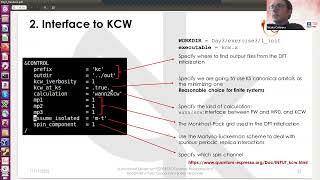
Spectral Properties of Finite and Extended Systems Using the KCW Code - QE Tutorial 2022
Explore spectral properties of finite and extended systems using KCW code in Quantum ESPRESSO, focusing on Hubbard and Koopmans functionals.
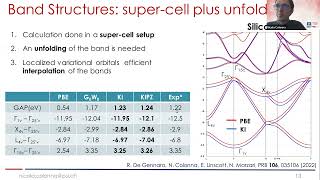
KCW: Implementation of Koopmans Functionals Based on DFPT - Advanced Quantum ESPRESSO Tutorial 2022
Explore Koopmans functionals implementation in Quantum ESPRESSO using density functional perturbation theory, enhancing electronic structure calculations.
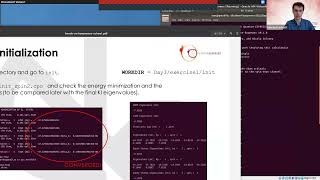
QE Tutorial 2022 - Spectral Properties of Finite and Extended Systems
Explore spectral properties of finite and extended systems through hands-on exercises using Quantum ESPRESSO, focusing on Hubbard and Koopmans functionals.
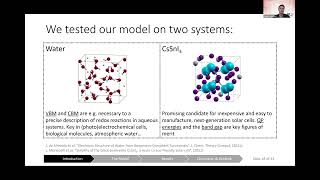
Accelerating the Calculation of Koopmans Screening Parameters Using Machine Learning
Accelerate Koopmans screening parameter calculations with machine learning techniques in Quantum ESPRESSO, enhancing efficiency in computational materials science.