A Mathematical Look at Electronic Structure Theory - JuliaCon 2021 Workshop
Explore density-functional theory and numerical techniques for solving it using Julia. Learn about discretization, solution algorithms, and practical implementation with hands-on coding exercises.
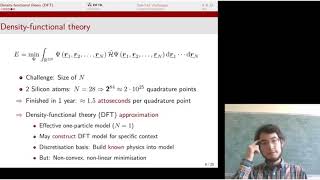
DFTK - A Julian Approach for Simulating Electrons in Solids
Introducing DFTK: A Julia package for density-functional theory simulations, offering flexibility for practical calculations and mathematical development in electronic structure research.
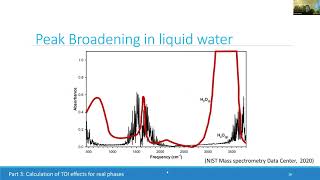
At the Top of Mt. Fuji - Uniting Theory and Observations of Oxygen Triple Isotope Systematics
Explore oxygen triple isotope systematics through theory and observations, uniting molecular insights with practical applications in geochemistry and beyond.
Physics-Informed Automatic Differentiation in Scientific Simulations
Explore how automatic differentiation intersects with physical symmetries and numerical analysis in scientific simulations, focusing on materials science applications in DFTK.jl.

Calculating the Adsorption Energy of a Charged Adsorbent in a Periodic Metallic System: BH4 Hydrolysis on AG(111) and AU(111) Surfaces
Learn to calculate adsorption energy for charged adsorbents on periodic metallic systems, focusing on BH4 hydrolysis on AG(111) and AU(111) surfaces.
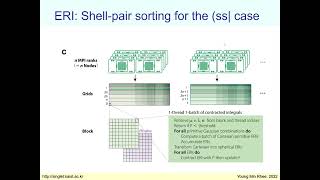
DFT on Expensive GPU-based Supercomputer
Explore advanced density functional theory computations using high-performance GPU supercomputers for cutting-edge quantum chemistry research.
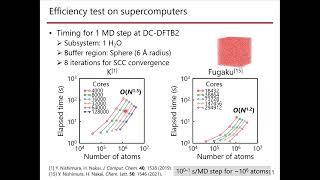
Recently Added Features in DCDFTBMD Program
Explore recent additions to DCDFTBMD program, enhancing molecular dynamics simulations and computational chemistry capabilities.
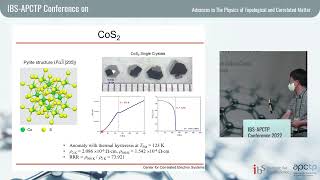
Large Anomalous Hall Conductivity in CoS2
Explore the anomalous Hall conductivity in CoS2, examining its pyrite structure, ferromagnetic properties, and electronic characteristics through experimental data and DFT results.
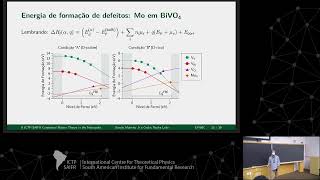
Estudos de Primeiros Princípios de Ligas BiV_{1-x}O_{4}Mo_{x} para Clivagem Fotocatalítica da Água
Explore estudos de primeiros princípios de ligas BiV_{1-x}O_{4}Mo_{x} para clivagem fotocatalítica da água, apresentados por Cedric Rocha Leão na conferência de Teoria da Matéria Condensada do ICTP-SAIFR.
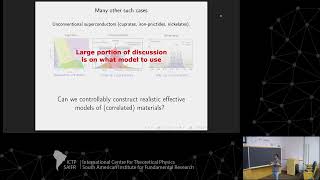
Constructing Realistic Low-Energy Effective Models of Materials
Explore techniques for constructing realistic low-energy effective models of materials, enhancing understanding of condensed matter theory.
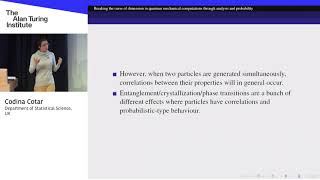
Breaking the Curse of Dimension in Quantum Mechanical Computations Through Analysis and Probability
Explore quantum mechanical computations, focusing on breaking dimensional constraints through analysis and probability. Learn about density functional theory and recent approaches to tackle existing issues.
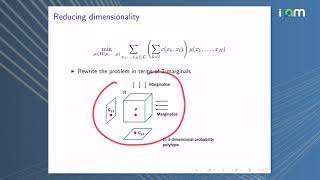
Strictly-Correlated Electron Functional and Multimarginal Optimal Transport
Explore convex optimization methods for multi-marginal transport problems in density functional theory, including relaxation techniques and rounding schemes for energy bounds.
Demystifying Density Functional Theory: From Fundamentals to Applications
Uncover the fundamental principles and applications of Density Functional Theory (DFT), exploring its role in physics, chemistry, and biology while understanding its operational framework and research potential.
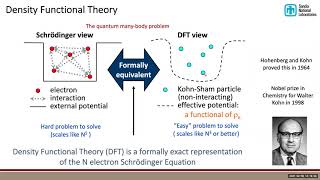
Shock Physics on the Sandia Z Pulsed Power Machine
Explore extreme dynamic compression studies using the Sandia Z Machine, focusing on deuterium's molecular-to-atomic transition and insulator-to-metal transition under various pressure and temperature conditions.
Matrix Product States for Real Materials
Explore recent advances in combining MPS algorithms with DMFT and DFT to study strongly correlated materials, focusing on applications to transition metal and rare earth oxides.

Density Functional Theory - IPAM at UCLA
Comprehensive exploration of density functional theory, covering advanced concepts and applications in materials science, presented by Prof. Vikram Gavini at IPAM's exascale mathematics workshop.
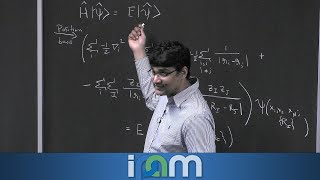
Density Functional Theory - IPAM at UCLA
Comprehensive introduction to density functional theory, exploring its principles and applications in materials science and computational physics.

Symbolic Regression for Discovery of a DFT Functional - IPAM at UCLA
Explore symbolic regression for DFT functional discovery, combining AutoML ideas to improve existing models in computational chemistry and materials science.
Machine Learning to Improve the Exchange and Correlation Functional in DFT
Explore machine learning approaches to improve exchange and correlation functionals in density functional theory, discussing physically informed methods and their advantages in quantum mechanics.
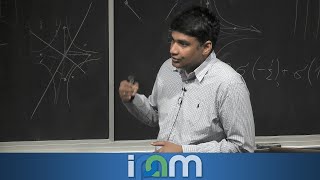
Fast, Accurate and Large-Scale Ab-Initio Calculations for Materials Modeling
Explore advanced computational methods for large-scale density functional theory calculations, their applications in materials modeling, and the performance of the DFT-FE open-source code.
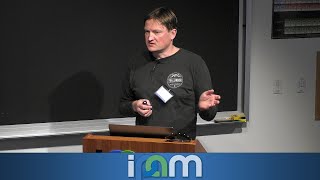
Many-Body Perturbation Theory and Wavefunction Methods: A Physics Perspective
Explore many-body perturbation theory and wavefunction methods from a physics perspective, covering applications, multiscale modeling, and advanced quantum mechanics concepts.