Elements of Electronic Structure Calculations - HF and DFT - IPAM at UCLA
Explore fundamental concepts of electronic structure calculations, including Hartree-Fock and Density Functional Theory, with insights on modern methodologies and applications in quantum mechanics.
Conditional Probability Density Functional Theory - IPAM at UCLA
Explore conditional probability density functional theory for electronic structure calculations, addressing challenges in DFT and offering insights into ground-state correlations and warm dense matter simulations.
Stochastic Density Functional Theory - IPAM at UCLA
Explore stochastic density functional theory for efficient ground-state calculations in extended materials, including noise reduction techniques and applications in warm dense matter at elevated temperatures.
Molecular Electron Densities via Machine Learning - IPAM at UCLA
Explore machine learning techniques for predicting molecular electron densities and energies, with applications in quantum mechanics and molecular dynamics simulations.
Error Bounds for Properties in Planewave Electronic Structure Calculations
Explore error bounds in planewave electronic structure calculations, focusing on ground state density matrix and interatomic forces estimation. Learn efficient approximation methods and see numerical results for materials systems.
Generating Reference Data and Controlling Accuracy in DFT and Hybrid DFT Simulations
Explore advanced techniques in DFT simulations, including all-electron approaches, pseudopotential validation, and hybrid DFT acceleration methods for improved accuracy and efficiency in quantum mechanics calculations.
Large Scale Hybrid DFT Functionals - Fast Algorithms and Finite-Size Effects - IPAM at UCLA
Explore accelerating DFT calculations with hybrid functionals and finite-size effects in Hartree-Fock calculations for periodic systems in this advanced mathematics lecture.
Large-Coupling Strength Expansion in DFT and Hartree-Fock Adiabatic Connections
Explore large-coupling strength expansions in DFT and Hartree-Fock adiabatic connections, examining their applications in quantum chemistry and electronic structure theory.
Quantum Mechanical Calculations of Electron Interactions in Condensed Matter
Explore precise quantum mechanical calculations for electron interactions in condensed matter, covering theory, challenges, and recent advancements in computational methods.
Recent Results in Density Functional Theory - IPAM at UCLA
Explore recent advancements in Density Functional Theory, including the Lieb-Oxford bound and Local Density Approximation, presented by Mathieu Lewin at IPAM's workshop on Model Reduction in Quantum Mechanics.

Spontaneous Disorder Near the Mott Transition on Frustrated Lattices
Explore spontaneous disorder in frustrated lattices near Mott transitions. Examine pyrochlore models, effective theories, and experimental realizations in molybdates. Analyze phase diagrams, magnetization, and transport properties.

Electronic Structure Calculations of Chiral Matter - IPAM at UCLA
Explore electronic structure calculations for chiral materials, focusing on quasi-1D nanostructures. Learn about helical Bloch waves, Kohn-Sham DFT, and machine learning techniques for predicting electronic fields.
Basis-Set Correction Based on Density-Functional Theory - IPAM at UCLA
Rigorous framework for basis-set correction in quantum mechanics using density-functional theory, explored through a one-dimensional model with delta-potential interactions for systematic analysis.
Beyond Density Functional Approximations by Lessons From Density Functional Theory
Exploring alternatives to density functional approximations in quantum mechanics, focusing on extrapolating model families and generalizing Kato's cusp condition for improved accuracy in electronic systems.
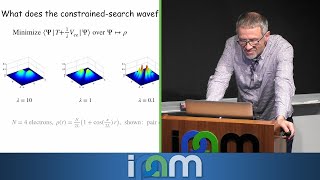
Fast Algorithm for the Strong-Interaction Limit of Density Functional Theory
Explore a novel algorithm for computing the strong-interaction limit in density functional theory, enhancing accuracy in modeling strongly correlated systems and overcoming computational challenges.
From Electrons to the Simulation of Materials - IPAM at UCLA
Explore computational workflows for predicting complex materials properties, from phase diagrams to nanostructures, using density functional theory and machine learning potentials.
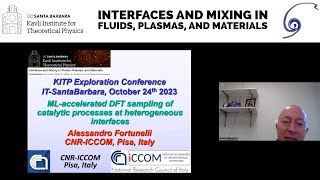
ML-Accelerated DFT Sampling of Catalytic Processes at Heterogeneous Interfaces - Al Fortunelli
Explores machine learning-accelerated density functional theory for sampling catalytic processes at heterogeneous interfaces, advancing computational methods in materials science and chemistry.

Some Open Mathematical Problems Concerning Charged Quantum Particles
Explore open mathematical challenges related to charged quantum particles, delving into complex theoretical concepts and unsolved problems in quantum physics.
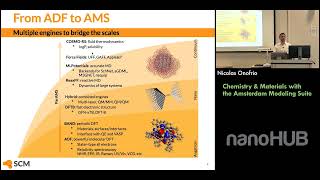
Chemistry and Materials with the Amsterdam Modeling Suite
Explore atomistic simulations using Amsterdam Modeling Suite. Learn about AMS driver, DFT engines, force fields, and PARAMS for novel molecular interactions. Gain insights through demos and practical applications.
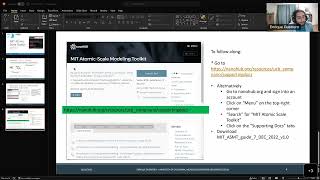
Teaching and Learning with the MIT Atomic Scale Modeling Toolkit - Classical and Quantum Atomic Modeling
Explore classical and quantum atomic modeling using MIT's toolkit. Perform molecular dynamics, Monte Carlo simulations, and quantum chemistry computations. Learn practical applications for various physics and chemistry courses.
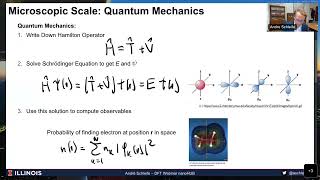
Density Functional Theory: Introduction and Applications
Explore Density Functional Theory fundamentals and applications using Quantum Espresso on nanoHUB. Learn to compute electronic structures, densities of state, total energies, and bulk modulus for materials.