
Physical vs. Logical Indexing with IDEA - Inverted Deduplication-Aware Index
Explores IDEA, a deduplication-aware term-index design that improves efficiency in indexing deduplicated data, reducing index size, indexing time, and lookup latency while supporting advanced functionalities.

Producing Apache Kafka Messages Using Apache Flink and Java
Learn to produce Apache Kafka messages using Apache Flink and Java in this comprehensive walkthrough. Covers Flink job setup, Kafka configuration, data generation, serialization, and execution verification.
Finding Infinite Counter-Models in Deductive Verification
Explore innovative techniques for finding infinite counter-models in deductive verification, enhancing automated solvers' capabilities and providing valuable insights for verification failures.
Functor of Points and Descent - Talk 2
Delve into advanced algebraic geometry concepts, exploring schemes, stacks, and topology through the lens of functor points and descent theory in this mathematical seminar.

Vector-Dynamic Array - Making Data Structures in C++
Learn to implement a dynamic array data structure in C++, covering reallocation, push/pop operations, and memory management techniques.
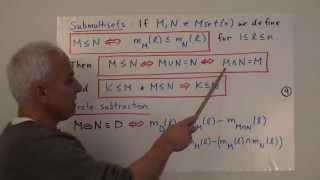
The Realm of Natural Number Multisets - Data Structures in Mathematics
Explore natural number multisets, their operations, and realm laws of arithmetic. Learn about k-msets, addition, union, and intersection in this expanded mathematical framework.
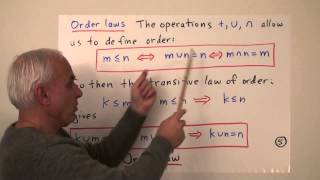
The Realm of Natural Numbers - Data Structures in Mathematics
Explore natural numbers through multisets, examining addition, union, and intersection operations. Discover unique properties, including a new distributive law that forms the basis for tropical calculus.
Fun With Lists, Ordered Sets, Multisets - Data Structures in Mathematics Math Foundations
Explore patterns and structures in k-lists, examining natural questions, operations, and relationships within this concrete data structure built using natural numbers.
Sets and Other Data Structures - Data Structures in Mathematics
Explore four fundamental data structures in mathematics: lists, ordered sets, multisets, and sets. Learn their characteristics, applications, and a new notation system for easier recognition and distinction.

The Hindu Arabic Number System Revisited - Data Structures in Mathematics Math Foundations
Explores three approaches to Hindu Arabic numerals, examining their mathematical foundations and practical applications in arithmetic and number representation.
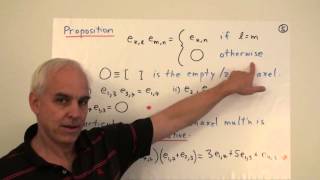
Maxel Theory - New Thinking About Matrices II - Data Structures Math Foundations
Exploring maxel theory as an extension of matrix theory, focusing on multiset views, distributive and associative laws, 1-maxels, and frames. Introduces new terminology and notation for a data structure-oriented approach.
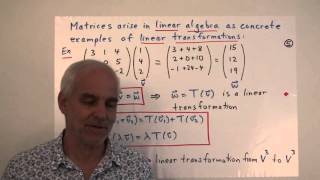
Arrays and Matrices II - Data Structures in Mathematics Math Foundations
Explore matrices from traditional linear algebra to a novel data structure approach. Learn matrix multiplication, algebra, and a new perspective using pixels and maxels.
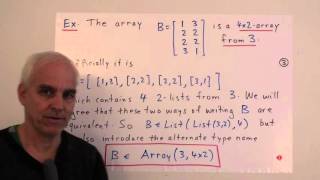
Arrays and Matrices - Data Structures in Mathematics Math Foundations | NJ Wildberger
Introduction to arrays and matrices as 2D data structures, exploring definitions, examples, and extending to 3D arrays. Distinguishes between arrays and matrices, offering a novel approach to linear algebra.
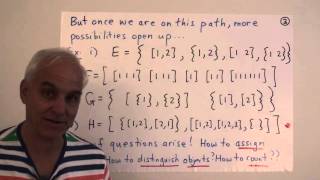
Higher Data Structures - Data Structures in Mathematics Math Foundations
Explore advanced mathematical data structures, including nested combinations of lists, ordered sets, multisets, and sets. Learn their applications in combinatorics, graph theory, and other mathematical fields.
An Improved Cutting Plane Method for Convex Optimization, Convex-Concave Games
Explore advanced cutting plane methods for convex optimization and games, covering improved algorithms, runtime bottlenecks, data structures, and practical applications in computational mathematics.
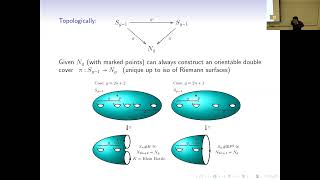
On the Nielsen Realization Problem and Cohomology of Mapping Class Groups of Non-orientable Surfaces
Exploración del problema de realización de Nielsen y cohomología de grupos de clases de mapeo en superficies no orientables, con aplicaciones en topología y teoría de grupos.
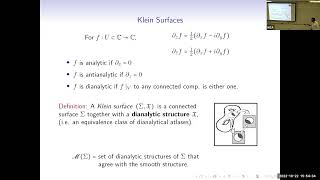
On Mapping Class Groups of Non-Orientable Surfaces
Exploración de grupos de clases de mapeo en superficies no orientables, abordando el problema de realización de Nielsen y la periodicidad p, con aplicaciones en cohomología de Farrell.
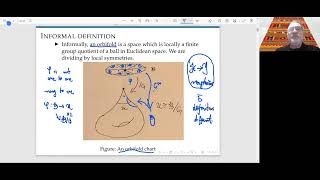
Orbifolds as Stacks & Stringy Cohomology and Localization
Explore orbifolds as stacks, twisted sectors, stringy cohomology, and localization methods in advanced mathematics with expert Ernesto Lupercio from CINVESTAV.
Yang-Baxter Elements and a New Proof of Homological Stability for the Mapping Class Group of Surfaces
Explores Yang-Baxter elements in monoidal categories, introducing a novel approach to prove homological stability for surface mapping class groups using semi-simplicial sets and bimarked surfaces.
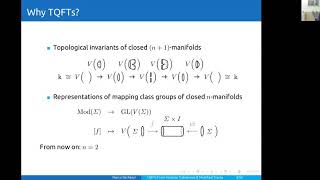
TQFTs from Non-Semisimple Modular Categories and Modified Traces - Lecture I
Explore advanced topological quantum field theories, focusing on non-semisimple constructions and modified traces for powerful invariants and mapping class group representations.
Matrix Data Structures
Explore efficient matrix data structures for fast algorithms, focusing on optimization techniques and their applications in computational mathematics.