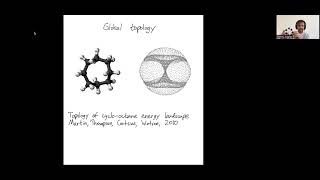
Henry Adams - Topology in Machine Learning
Explore persistent homology in machine learning, covering applications in materials science, computer vision, and agent-based modeling. Learn how topology relates to dataset geometry and explainable AI.
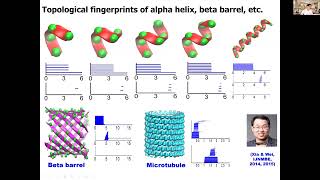
Persistent Topological Laplacians
Explores persistent topological Laplacians to address limitations in topological data analysis, enhancing the handling of complex data and uncovering SARS-CoV-2 evolution mechanisms.
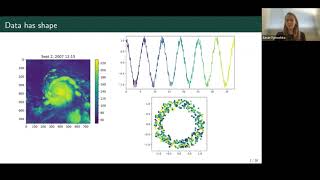
Topological Time Series Analysis for Hurricanes and Dynamical Systems
Explore topological data analysis applications in studying hurricane satellite imagery and dynamical system bifurcations using persistent homology and zigzag persistence techniques.
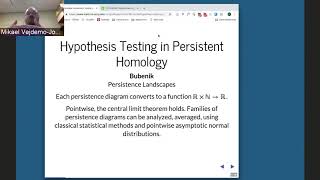
Multiple Hypothesis Testing with Persistent Homology
Exploring methods for multiple hypothesis testing in persistent homology, including family-wise error rates and false discovery rates, with applications to Mapper complex validation.

High-Throughput Spectroscopy and Material Discovery by Beyond-DFT Work and Data-Analysis
Explore high-throughput spectroscopy and materials discovery using advanced computational methods, workflows, and data analysis frameworks for accelerated insights in materials science.
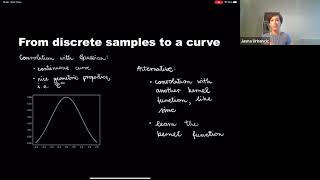
Optimizing Embedding Using Persistence
Explore optimizing Takens-type embeddings of time series using persistent (co)homology. Learn practical approaches for finding good embeddings and discuss the space of embeddings and open questions.
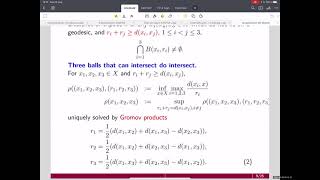
Geometry and Topology of Data
Explore geometric and topological properties of data sets, including curvature concepts and their relation to hyperconvexity, offering new insights into Topological Data Analysis.
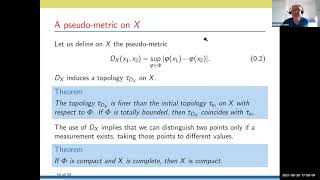
On the Role of Group Equivariant Non-Expansive Operators in TDA
Explore group equivariant non-expansive operators as tools for approximating data observers in Topological Data Analysis, focusing on their mathematical properties and applications.
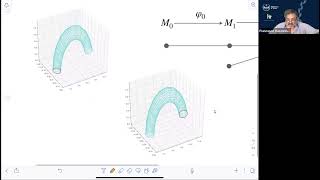
Parallel Decomposition of Persistence Modules Through Interval Bases
Explore parallel decomposition of persistence modules using interval bases, enhancing Topological Data Analysis with distributed computation and Hodge decomposition techniques.
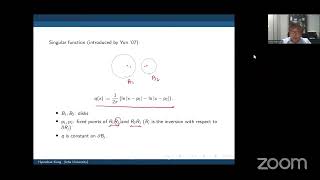
Quantitative Analysis of Field Concentration in Presence of Closely Located
Quantitative analysis of field concentration in composites with closely located inclusions, focusing on optimal estimates and asymptotic characterization in various physical contexts.

Transparent, Reproducible, and Adaptable Data Analysis with Snakemake
Explore Snakemake for sustainable data analysis, enabling transparency, reproducibility, and adaptability in scientific workflows and computational research.
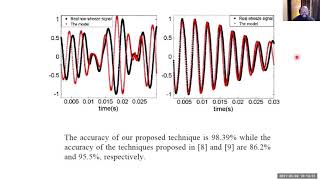
Quasiperiodicity and Persistent Kunneth Theorems
Explore quasiperiodicity in signals, persistent homology, and Kunneth theorems. Learn applications in time series analysis and computational chemistry through topological data analysis.
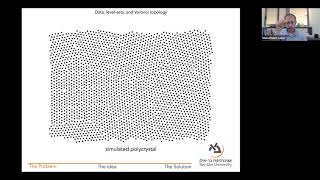
High-Dimensional Data, Level-Set Geometry, and Voronoi Analysis of Point Sets
Explore spatial point sets, high-dimensional data analysis, and Voronoi cell topology to understand complex physical systems and classify data structures in innovative ways.
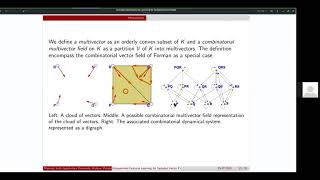
Unsupervised Features Learning for Sampled Vector Fields
Explore innovative techniques for analyzing sampled vector fields using graph structures and unsupervised learning, revealing hidden features correlated with known dynamics in analytical models.
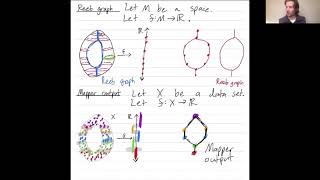
The Mapper Algorithm and Reeb Graphs
Explore the mapper algorithm in applied topology, its connection to Reeb graphs, and its application to high-dimensional data analysis and 3D object recognition.

Excel 2021 Full Course Tutorial
Comprehensive tutorial covering Excel 2021 basics to advanced features. Learn calculations, functions, data manipulation, pivot tables, macros, and automation techniques to enhance spreadsheet skills and efficiency.
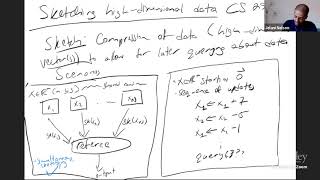
Sketching High-Dimensional Data
Explore techniques for efficiently summarizing and analyzing large datasets in high-dimensional spaces, focusing on probability, geometry, and computational methods.
The Structure of Optimal Private Tests for Simple Hypotheses
Explore optimal private tests for simple hypotheses, examining their structure and implications for data analysis in privacy-preserving contexts.
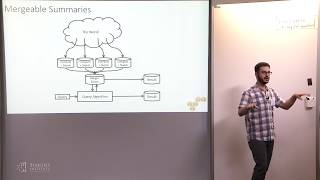
Mergeable Summaries and the Data Sketches Library
Explore mergeable summaries and the Data Sketches Library, focusing on mathematical and computational challenges in real-time decision making for big data analytics.
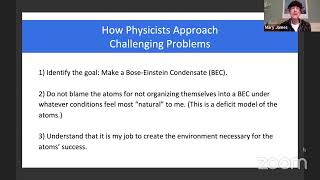
The Time Is Now — Charting a Course to 2030
Explore strategies to increase African American representation in physics, featuring TEAM-UP report insights, implementation guidance, and expert panel discussions on fostering inclusive academic environments.

Tableau Basics Full Course Tutorial
Comprehensive Tableau training covering fundamentals to advanced techniques. Learn data visualization, calculations, formatting, storytelling, and sharing insights using Tableau's powerful features.