Galaxy Zoo in the Deep Learning Era - Mike Walmsley
Exploring Galaxy Zoo's evolution with deep learning, focusing on self-supervised techniques and new tools for galaxy morphology analysis in the era of big astronomical data.
Galaxy Merger Reconstruction with Generative Graph Neural Networks - Yuan Sen Ting
Exploring galaxy merger reconstruction using generative graph neural networks, advancing our understanding of galaxy formation and evolution through innovative machine learning techniques.
Finding Environmental Measures Sensitive to Halo Properties Using Neural Networks
Exploring neural networks to identify environmental measures that reveal halo properties in galaxy formation studies, enhancing our understanding of cosmic structure evolution.
Learning to Simulate the Universe with Deep Learning - Elena Giusarma
Explore deep learning techniques for simulating the universe, focusing on innovative approaches to model cosmic structures and enhance our understanding of galaxy formation and evolution.
Outliers - How I Learned to Love Them, and Why You Should Too
Discover the value of statistical outliers in galaxy formation studies. Learn how anomalous galaxies challenge current paradigms and drive new insights in astrophysics and cosmology.
Tracing Dark Matter with Stars - Lina Necib
Explore innovative techniques for detecting dark matter using stellar dynamics. Learn how advanced statistical methods and machine learning are revolutionizing our understanding of galactic structure and evolution.

Can We Use ML to Understand Data Scientists - AI4Code Kaggle Competition EDA
Explore machine learning techniques to analyze data scientists' behavior through the AI4Code Kaggle competition, focusing on exploratory data analysis and insights.
Python for Data Science - Doing Math with Python
Learn essential math operations in Python for data science, including multiplication and exponents, using Jupyter Notebooks as a powerful computational tool.
Using Algebraic Factorizations for Interpretable Learning - IPAM at UCLA
Explore Non-negative Matrix Factorization for interpretable learning in imaging, medicine, forecasting, and collaborative filtering. Learn implementation, online, and streaming variations.
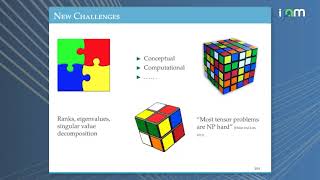
Low Rank Tensor Methods in High Dimensional Data Analysis
Explore low rank tensor methods for analyzing high-dimensional data in various fields. Learn about recent progress, challenges, and applications in extracting information from multilinear arrays.

Sex as a Biological Variable - IPAM at UCLA
Explore the impact of sex as a biological variable in scientific research, examining biases and implications for data analysis and interpretation in various fields.
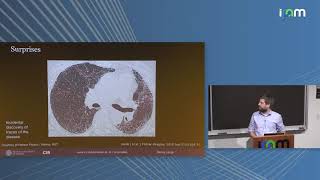
Deep Learning for Anomaly Detection - Expanding Our Marker Vocabulary
Explore deep learning techniques for anomaly detection in medical imaging, expanding marker vocabulary to enhance diagnostic capabilities and improve patient outcomes.
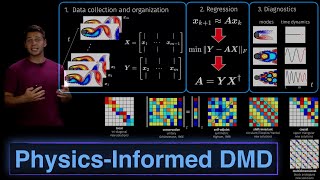
Physics-Informed Dynamic Mode Decomposition
Explore how physical laws enhance dynamic mode decomposition, improving model accuracy and generalization in complex systems analysis. Learn techniques for integrating conservation, symmetry, and other principles.
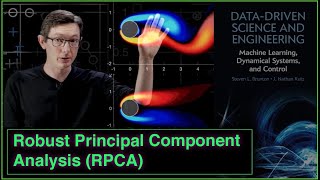
Robust Principal Component Analysis
Explore robust PCA for handling corrupted data in fields like fluid mechanics and image processing. Learn its applications and importance in data-driven science and engineering.

Excel 2021 Power User Full Course
Comprehensive tutorial for advanced Excel users covering powerful functions, pivot tables, data analysis techniques, and XLOOKUP. Develop skills to solve complex problems and streamline data processing efficiently.

Effortless Data Analysis and Cleaning with Data Wrangler in VS Code
Explore Data Wrangler in VS Code: Boost productivity with code-centric data cleaning, automated Pandas code generation, and insightful visualizations for efficient data analysis.
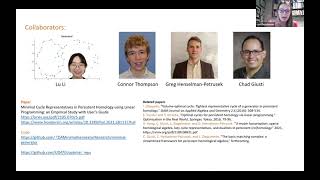
Minimal Cycle Representatives in Persistent Homology Using Linear Programming
Explores optimization techniques for selecting minimal cycle representatives in persistent homology, comparing effectiveness and computational costs of various algorithms using linear programming methods.
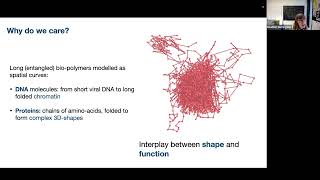
Shape of Data in Biology - Extending the PH Pipeline
Exploring spatial structure in biological data using topological data analysis, with focus on knotted proteins and introducing hyperTDA for interpretable, automated analysis of complex systems.
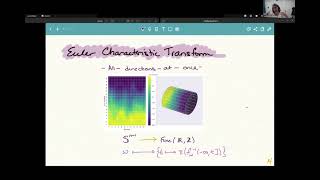
The Directional Transform
Explore the directional transform in topological data analysis, its applications in understanding complex structures, and its potential for enhancing machine learning models and data shape quantification.
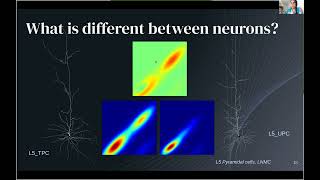
A Topological Understanding of Neuronal Morphologies
Exploring topological data analysis for neuronal morphologies, from single cells to networks. Highlights applications in classification, clustering, and solving inverse problems in neuroscience.
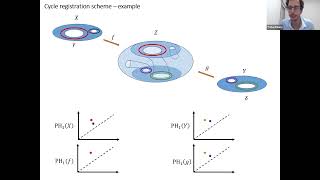
Persistent Cycle Registration and Topological Bootstrap
Novel approach for comparing persistent homology representations, utilizing spatial placement of persistent cycles. Demonstrates application in topological inference to differentiate signal from noise in point cloud data.