Information-Theoretic Quantum Cryptography Part 2 of 2 - IPAM at UCLA
Explore advanced quantum cryptography topics, including secure delegated computation, quantum key distribution, and certified deletion, with a focus on security against unbounded adversaries.
Information-Theoretic Quantum Cryptography Part 1 of 2 - IPAM at UCLA
Explore information-theoretic quantum cryptography, covering topics like quantum money, secure computation, and key distribution. Gain insights into the interplay between quantum information and cryptography.
Post-Quantum Key Exchange from Supersingular Isogenies - IPAM at UCLA
Explore post-quantum cryptography with a focus on Supersingular Isogeny Diffie-Hellman (SIDH) key exchange, aimed at beginners but benefiting from basic elliptic curve knowledge.

Introduction to Quantum Computing - Part 3 - IPAM at UCLA
Explore density matrices, mixed states, and quantum channels in cryptography. Learn about POVM measurement and distance measures for quantum states and operators.
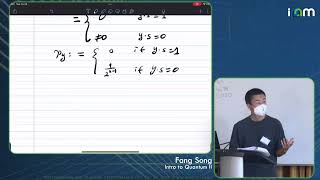
Introduction to Quantum Computing Part 2 of 3 - IPAM at UCLA
Explore quantum algorithms like period finding and Grover's search, including Simon's algorithm, phase estimation, and Shor's factoring algorithm. Examine their impact on cryptography and cryptosystem vulnerabilities.
Introduction to Cryptography Part 2 of 3 - IPAM at UCLA
Explore public-key cryptography, including key exchange, encryption, and digital signatures. Delve into the random-oracle model and its applications in constructing cryptosystems.
Jonathan Katz - Introduction to Cryptography Part 1 of 3 - IPAM at UCLA
Comprehensive introduction to modern cryptography, covering provable security, perfect secrecy, computational security, pseudorandom generators, and proof-by-reduction techniques for graduate-level students.
The Mathematics of Hiding Secrets in Software
Explore indistinguishability obfuscation, a powerful cryptographic tool for transforming programs into incomprehensible yet functionally equivalent versions, and its applications in securing software.
Geometry of Secure Computation
Explore the geometric framework for secure computation, focusing on round and communication complexity for randomized-output functions. Learn about innovative approaches to long-standing cryptography challenges.
Collision-Resistance from Multi-Collision-Resistance
Exploring the transformation of multi-collision-resistant hash functions into collision-resistant hash functions, with insights on Reed-Solomon codes and cryptographic primitives.
New Ways to Garble Arithmetic Circuits
Explores innovative techniques for garbling arithmetic circuits, improving efficiency, modularity, and functionality. Presents constant-rate schemes for large integers and modular computation, with enhanced capabilities for mixed arithmetic-Boolean opera…
Unclonable Polymers and Their Cryptographic Applications
Explore unclonable polymers and their innovative applications in cryptography, focusing on minimal complexity assumptions for enhanced security measures.
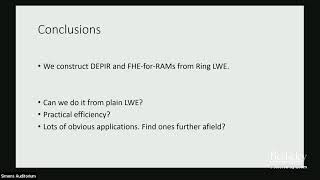
Doubly Efficient Private Information Retrieval and Fully Homomorphic RAM Computation from Ring LWE
Explores innovative cryptographic solutions for private internet searches, combining efficient data structures with Ring LWE-based encryption to enable secure, scalable information retrieval.
Black-Box Separations in Quantum Cryptography
Explores black-box separations in quantum cryptography, discussing efforts to extend classical results, related problems, and barriers for unconditional separations in the quantum setting.
Quantum Pseudorandomness in Algorithmica, and Its Implications to Cryptography and Complexity
Explore quantum pseudorandomness, its separation from one-way functions, and implications for cryptography and complexity theory. Discover potential for quantum cryptography without relying on traditional assumptions.
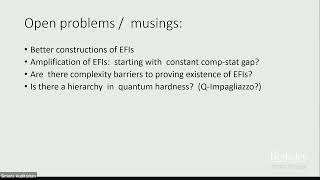
On the Computational Hardness Needed for Quantum Cryptography
Explores EFI pairs as essential for quantum cryptography, comparing their role to one-way functions in classical cryptography and demonstrating their necessity for various applications.
Commitments to Quantum States
Exploring quantum state commitments, their definition as erasure of sender's message, and applications in cryptography, including succinct arguments for NP and potentially QMA.
Quantum Minimalism
Exploring minimal quantum cryptographic assumptions beyond one-way functions, examining their significance and potential implications for future quantum-secure cryptographic systems.
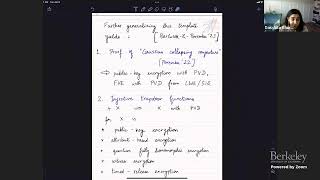
Cryptography with Certified Deletion
Explore quantum cryptography's certified deletion, enabling verifiable information-theoretic deletion of encrypted secrets, with applications in various cryptosystems and recent advancements in public verification.
Black-Hole Radiation Decoding as a Cryptographic Assumption
Explore the intriguing connection between black-hole radiation decoding and quantum cryptography, revealing how high-energy physics phenomena can imply the existence of secure cryptographic primitives.
Batch Proofs Are Statistically Hiding
Explore statistical hiding in batch proofs, examining implications for cryptographic assumptions and protocols. Insights on statistical soundness, computational soundness, and non-interactive batch arguments.