Secure Distributed Matrix Multiplication
Explore information-theoretic methods for secure distributed matrix multiplication, focusing on trustworthy machine learning applications and techniques.

Capturing One-Way Functions via NP-Hardness of Meta-Complexity
Explores the characterization of one-way functions through worst-case hardness assumptions, linking NP-hardness and distributional Kolmogorov complexity to cryptographic foundations.

Derandomization: A Quick Tutorial
Explore efficient methods for transforming interactive protocols into NP-type verifiers, using targeted pseudorandom generators and complexity-theoretic assumptions.
SNARGs Beyond Non-Signaling
Explores construction of SNARGs for monotone policy batch NP languages under LWE assumption, introducing predicate-extractable hash families as a novel approach beyond non-signaling PCPs.
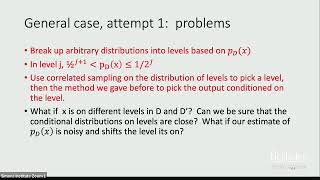
Cryptographic Hardness of Correlated Sampling
Explore the cryptographic implications of correlated sampling, examining minimal complexity assumptions and their impact on secure communication systems.
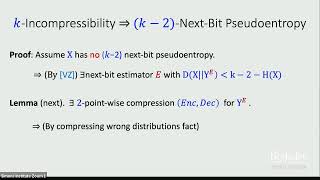
Incompressibility and Next-Block Pseudoentropy
Explores the relationship between incompressible distributions and next-block pseudoentropy, advancing understanding of computational entropy and its implications for cryptographic hardness assumptions.
Cryptography and Kolmogorov Complexity - A Quick Tutorial
Explore the intersection of cryptography and Kolmogorov complexity, examining minimal complexity assumptions and their implications for secure communication systems.

Constant-Round Arguments from One-Way Functions
Explore constant-round argument systems for log-space uniform circuits, achieving almost-linear verification time using only one-way functions, advancing cryptographic protocol efficiency.

Assumptions in Cryptography and Complexity Theory
Explore key assumptions in cryptography and complexity theory through an expert panel discussion, delving into minimal complexity requirements for cryptographic systems.
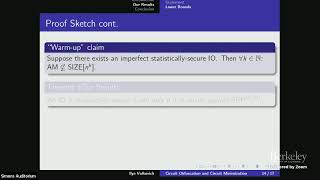
Mutual Empowerment Between Circuit Obfuscation and Circuit Minimization
Exploring connections between Indistinguishability Obfuscation and Minimum Circuit Size Problem, revealing implications for cryptography and computational complexity theory.

Fine-Grained Cryptography
Explore minimal complexity assumptions in cryptography, focusing on fine-grained approaches that provide strong guarantees against restricted adversarial classes.
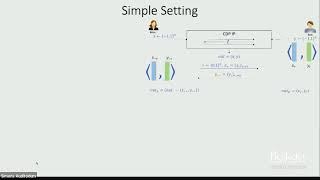
On the Complexity of Two-Party Differential Privacy
Explores limitations and cryptographic requirements for distributed differential privacy in two-party functions like inner product and Hamming distance, with implications for data analysis and privacy.
Communication Complexity, Streaming and Computational Assumptions
Explore how computational limitations and cryptographic tools can bypass impossibility results in communication complexity and streaming, with examples and open problems discussed.

New Techniques for Zero-Knowledge- Leveraging Inefficient Provers to Reduce Assumptions
Explores novel approaches in zero-knowledge proofs, focusing on transforming NIZK to ZAPs with inefficient provers. Discusses implications for cryptographic assumptions and fine-grained complexity settings.
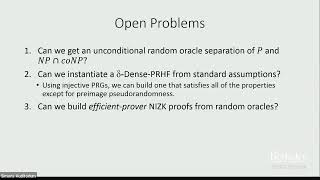
Hard Languages in NP ∩ coNP and NIZK Proofs from Unstructured Hardness
Explores unstructured hard languages in NP ∩ coNP, providing evidence for their existence and introducing a new NIZK proof construction, advancing understanding of computational complexity and cryptography.
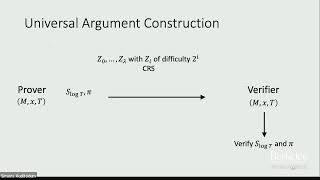
Non-Interactive Universal Arguments
Explore the concept of universal arguments and their construction for non-deterministic computations, focusing on recent developments in non-interactive succinct arguments and their universality.
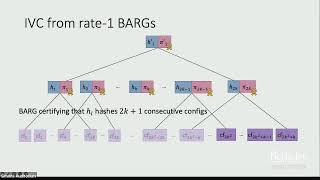
Rate-1 BARGs via Fully-Local SSB Hash Families
Explore fully-local SSB hash families and their applications in cryptography, including multi-hop aggregate signatures and incrementally verifiable computation.
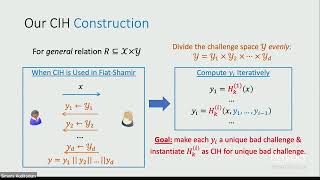
Correlation Intractability and SNARGs from Sub-exponential DDH
Explore groundbreaking constructions of SNARGs and correlation-intractable hash functions based on sub-exponential DDH, achieving poly-logarithmic proof sizes for Batch-NP and P.
Tutorial on Proof Systems
Explore minimal complexity assumptions in cryptography, focusing on proof systems and their applications in secure computation and blockchain technology.
Weakening Assumptions in Quantum Cryptography IV.a Part 1 of 2 - IPAM at UCLA
Explore quantum information's role in relaxing cryptographic assumptions, focusing on secure multiparty computation and oblivious transfer. Learn about advancements from Crepeau and Kilian to recent developments.
The Quantum Random Oracle Model Part 1 of 2 - IPAM at UCLA
Explore quantum random oracle models and proof techniques in cryptography, covering challenges in quantum settings and advanced methods like oneway-to-hiding theorem and compressed oracles.